
Bouffant caps, hairnets and beard covers for food plants: what the rules require
FDA’s current good manufacturing practice rule for human food requires plant management to ensure that everyone working in direct contact with food, food-contact surfaces or packaging wears, where appropriate and in an effective manner, hair nets, headbands, caps, beard covers or other effective hair restraints, and wears outer garments suitable to the operation that protect against allergen cross-contact and contamination of food; it names hair, perspiration and cosmetics among the foreign substances to guard against. USDA’s FSIS rule for meat and poultry plants requires outer clothing to be disposable or readily cleaned, clean at the start of each day and changed as often as necessary. Neither rule names a product, a fabric or a cap size; the plant’s own hygiene program decides, and the disposable cap, beard cover and head-and-face hood are how most plants meet it. International Enviroguard’s polypropylene bouffants come in 19, 21, 24 and 28 inch diameters, flat or pleated, white or blue; its SMS pleated bouffants in 21 and 24 inch; the S112NW beard restraint and NH2000 head-and-face hood cover the beard; all are rated by the manufacturer for dirt, grime and particulates in non-hazardous environments.
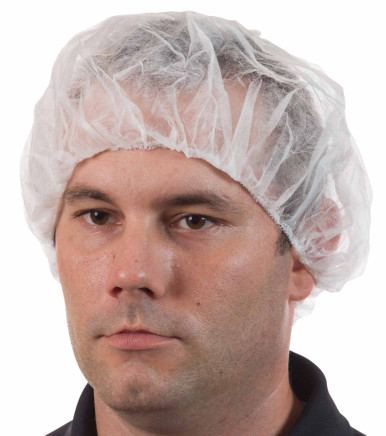 Enviroguard S110NW-21 Disposable Polypropylene 21" White Bouffant Cap21 inch polypropylene bouffant, latex-free elastic; Helmke drum Category 1 per the sell sheet. 1,000 per case.
Why is a hair restraint a food safety rule and not a comfort rule? Hair is a physical contaminant and a carrier of microorganisms, and it falls. FDA’s rule lists hair, perspiration and cosmetics by name among the foreign substances personnel practices must keep out of food, and treats the hair restraint as one of the hygienic practices management has to enforce, alongside hand washing, jewelry removal and suitable outer garments. A plant does not get to decide whether the rule applies; it decides which restraint is effective for the job, which is where cap size, pleats, beard covers and the full hood come in.
21 CFR 117.10(b)(6) and (b)(9).What do the two federal rules say?
FDA for most food plants, FSIS for meat, poultry and egg products; both on personnel.
Which bouffant size do you need?
The number on a bouffant is its flat diameter before the elastic gathers it, and it sets how much hair it holds. International Enviroguard makes its polypropylene bouffants in 19, 21, 24 and 28 inch diameters and its SMS bouffants in 21 and 24. The 19 inch cap is for short hair and small heads; 21 inch is the common line-worker size; 24 inch covers long or thick hair tied up, and 28 inch is for very long hair or wearing over a hat or hearing protection. A cap that is too small rides up and lets hair out at the nape, which is the usual audit finding, so plants with mixed crews stock two sizes rather than one. The manufacturer describes the fabric as lightweight, low-linting (the flat 21 inch is listed as non-linting) with latex-free elastic, rated for dirt, grime and particulates in non-hazardous environments.
International Enviroguard Polypropylene sell sheet (S110NW-19, -21, -24, -28, flat and pleated, white and blue) and SMS sell sheet (210NW-21PL, 210NW-24PL); S110NW-21 and S110NW-21PL product pages. The use of each size is our reading of the diameters, not a manufacturer statement.Flat or pleated, polypropylene or SMS?
Pleated bouffants are the same cap folded in accordion pleats so one comes off the stack at a time; the manufacturer’s stated reason is that a worker can take one easily instead of grabbing several from a bulk pack, and that the elastic closure goes on and comes off without pulling hairs and expands to a wide range of hairstyles. Flat bouffants are the lower-cost bulk pack. Polypropylene is a single spunbond layer, breathable, the economy fabric; SMS is the three-layer spunbond-meltblown-spunbond fabric, which the manufacturer calls durable and an excellent particulate barrier, for lines where the cap is worn all shift or where a customer standard asks for a heavier cap. Both carry the same latex-free elastic. Color is a plant choice: blue is the usual pick on food lines because it is visible if it falls into product, and the manufacturer offers 21 and 24 inch in blue.
International Enviroguard 210NW-21PL product page (pleated design, elastic closure, expandable fit); Polypropylene and SMS sell sheets (fabric descriptions, colors). The reason for blue is trade practice, not a manufacturer statement.When is a beard cover required?
FDA lists beard covers by name in the same sentence as hair nets, and makes the trigger “where appropriate” and the standard “in an effective manner.” The rule does not define a beard length; the plant’s program does, and most programs cover any facial hair beyond a shaved face because the audit question is whether hair can reach product. The S112NW beard restraint is a polypropylene cover with latex-free elastic that the manufacturer describes as low-linting and ventilated, rated for dirt, grime and particulates in non-hazardous environments. The NH2000 head-and-face hood, which the manufacturer calls a ninja hood, is the other way to meet both lines of the rule at once: a polypropylene hood that covers the head and face, which the product page says can replace separate bouffant and beard cover, and which the manufacturer positions as protecting the product from hair, dander and saliva as well as protecting the wearer’s face from particulates.
21 CFR 117.10(b)(6); International Enviroguard S112NW and NH2000 product pages and Polypropylene sell sheet.Do the caps shed particles themselves?
A cap that sheds lint is a contaminant of its own, which is why the manufacturer tests these items on the Helmke drum, the particle-release test in IEST-RP-CC003: the item tumbles in a rotating drum while a particle counter samples the air. The Polypropylene sell sheet reports a pass and Category 1 for the NH2000 hood, the S112NW beard restraint and all bouffants, pleated and flat; the SMS sheet reports Category 1 for the SMS fabric. The same numbers are what a pharmaceutical packaging or controlled-environment buyer looks for, which is why the manufacturer names pharma, labs and critical environments alongside food processing on these items.
International Enviroguard Polypropylene sell sheet (IEST-RP-CC003 Helmke garment cleanliness: NH2000, all bouffants, S112NW, Pass, Category 1); SMS sell sheet (Helmke Drum Particle Testing, Category 1); 210NW-21PL product page (applications).What about face masks on a food line?
Neither federal rule requires a face mask for hygiene; a plant adds one where its program or a customer calls for it, for example over product that is not cooked again. The manufacturer’s 2804 and 2804B masks are three-ply pleated, latex and fiberglass free, with ear loops, a pliable nose clip and ultrasonically bonded edges, and the sheet reports up to 99% bacterial filtration efficiency. The sheet also says, plainly, that these are general use masks not intended for use by healthcare professionals, and they are not respirators: a mask on a food line is a hygiene barrier for the product, not respiratory protection for the worker, and it does not stand in for a NIOSH-approved respirator where the hazard assessment calls for one.
International Enviroguard 3-Ply Pleated Face Mask sell sheet and 2804 product page (99% BFE, construction, packing, “General Use Masks, Not intended for use by Healthcare Professionals”); 29 CFR 1910.132(d) for the hazard assessment.How often is a cap changed?
FDA does not set a change frequency for hair restraints; FSIS sets one for outer clothing, clean at the start of each working day and changed as often as necessary to prevent adulteration, and most plants write their cap rule the same way: a fresh cap each entry to the production area, and a new one any time the worker leaves the floor, visits the restroom or the cap is soiled or torn. Those are program rules, not federal ones. The arithmetic for stocking is the case: bouffants, beard restraints and the NH2000 hood are 1,000 per case, and masks are 50 per box, 40 boxes per case, 2,000 per case.
9 CFR 416.5(b); 21 CFR 117.10(b)(6) (no frequency stated); International Enviroguard sell sheets, pack quantities.Questions people ask
Does FDA require hairnets in food plants?
21 CFR 117.10(b)(6) requires management to ensure personnel in direct contact with food, food-contact surfaces or packaging wear, where appropriate and in an effective manner, hair nets, headbands, caps, beard covers or other effective hair restraints.
Does FDA require beard covers?
Beard covers are named in the same sentence of 21 CFR 117.10(b)(6) as hair nets and caps, where appropriate. The rule sets no beard length; the plant’s hygiene program does.
What does USDA FSIS require for clothing in a meat plant?
9 CFR 416.5(b): aprons, frocks and other outer clothing must be disposable or readily cleaned, clean at the start of each working day, and changed during the day as often as necessary to prevent adulteration of product.
What size bouffant cap should I buy?
International Enviroguard makes 19, 21, 24 and 28 inch polypropylene bouffants and 21 and 24 inch SMS bouffants; 21 inch is the common size, 24 inch for long or thick hair, 28 inch over a hat or very long hair. Stock two sizes for a mixed crew.
What is the difference between a flat and a pleated bouffant?
The same cap, folded in pleats so one comes off the stack at a time; the manufacturer says the pleated cap is easier to take singly and its elastic goes on and off without pulling hair. Flat caps are the bulk pack.
What is a ninja hood?
The manufacturer’s name for its NH2000 polypropylene head-and-face cover, which covers hair and beard in one piece and, per the product page, can replace a separate bouffant and beard cover.
Are food-plant face masks respirators?
No. The 2804 masks are three-ply general use masks with up to 99% bacterial filtration efficiency, and the sheet says they are not intended for healthcare professionals. Respiratory protection comes from a NIOSH-approved respirator chosen under the hazard assessment.
The ratings, test results and standards shown here are the manufacturers' published values, reproduced as published. Nothing on this page is a recommendation by Bayshore Safety that any product is suitable for a particular task, hazard or workplace. Selecting safety products and protective equipment is the responsibility of the end user and the employer, based on their own hazard assessment and the regulations that apply to their work. Confirm every value on the manufacturer's own documentation before use.