
Sterile versus clean-processed: what GammaGuard CE and MicroGuard CE mean
Clean-processed means the garment was made and packaged to limit the particles it carries and sheds: International Enviroguard’s MicroGuard CE is described as clean-processed, individually packaged to prevent cross-contamination, low-linting, with tunnelized elastic, and its product pages mark it Sterile: No. Sterile means all of that plus sterilization in the sealed package: GammaGuard CE is individually packaged and sterilized to a 10⁻⁶ sterility assurance level, by gamma irradiation per the Cleanroom Catalog, made in an ISO 13485 certified facility, with a certificate of sterility in each case and a Sterile-Don fold that the manufacturer says protects against contamination during donning. Both lines are marked by the manufacturer as suitable for ISO 5 through ISO 9 cleanrooms, and both carry the same warning: not for use around heat, flames or sparks. The sterile line is the one for aseptic processing, compounding and anywhere the gowning procedure calls for a sterile garment; the clean-processed line is for controlled environments where particle control, not sterility, is the requirement.
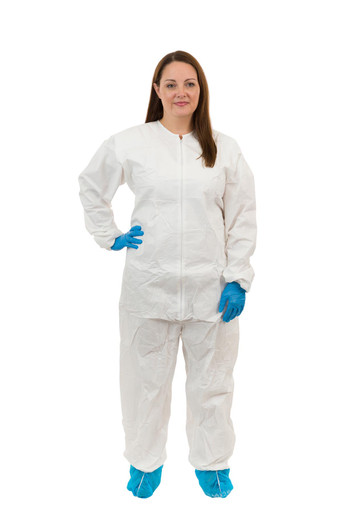 Enviroguard CE11013CIS GammaGuard CE Disposable Sterile Coverall, Tunnelized Elastic Wrist and Ankle, Serged SeamIndividually packaged and sterilized to a 10⁻⁶ SAL; bound seams, tunnelized elastic; certificate of sterility in each case.
Why does the package matter as much as the fabric? A cleanroom garment is only as clean as the last thing that touched it. A bulk carton of coveralls is handled, stacked and opened; each suit rubs the next and the room air gets in. The two CE lines are built around the package: each piece is sealed alone, so the first contact after the factory is the gowning bench, and the sterile line is irradiated through the sealed pack so the sterility claim survives shipping and storage until the pack is opened. That is the whole difference between the two lines, and it is why the sterile line costs more per piece and keeps for fewer years.
What is on each line’s sheet?
The claims the manufacturer makes for each, and the ones it does not.
What does a 10⁻⁶ sterility assurance level mean?
A sterility assurance level is the probability that a single viable microorganism survives on an item after sterilization; 10⁻⁶ is one in a million. International Enviroguard’s sheet states that all GammaGuard CE garments are sterilized to a 10⁻⁶ SAL and calls it the highest level possible, and the Cleanroom Catalog describes the method as gamma irradiation, which penetrates the packaging to sterilize the garment inside and which the fabric withstands without yellowing or deteriorating. The claim is backed on paper by a certificate of sterility in each case, and by manufacture in an ISO 13485 certified facility, the quality-system standard for medical devices. Those three things, the SAL statement, the certificate and the facility certification, are what a pharmacy or aseptic-fill gowning procedure asks for, and they are the things the MicroGuard CE sheet does not claim.
International Enviroguard GammaGuard CE sell sheet (10⁻⁶ SAL, certificate of sterility, ISO 13485); Cleanroom Catalog, gamma irradiated garments (Sterility Assurance Level 10^-6). The definition of SAL as a survival probability is the catalog’s own wording, “the probability of a microorganism surviving.”One thing to check with the manufacturer before specifying. The company’s website FAQ says both garment lines are sterilized to the 10⁻⁶ SAL; the MicroGuard CE sell sheet says clean-processed and its product pages say Sterile: No. The sell sheet and product data are the controlled documents and are what this page reports; a buyer who needs MicroGuard CE to be sterile should get that in writing from International Enviroguard rather than from the FAQ.
International Enviroguard product FAQ against the MicroGuard CE sell sheet and product pages (CE8013CI, CE8019CI, CE8046CI, CE8063CI, CE8065CI, CE8103CI through CE8106CI).What does clean-processed mean?
On the MicroGuard CE sheet it means three things done at the factory: the garment is processed to remove loose particles, it is individually packaged so it cannot pick up particles or cross-contaminate in the carton, and it is built with a low-linting fabric and tunnelized elastic so it generates fewer particles in wear. The GammaGuard CE catalog page describes its own clean processing the same way, as the Sterile-Don process in which all loose particles have been removed from the clothing before packaging; sterilization is the extra step. So every GammaGuard CE garment is clean-processed, and no MicroGuard CE garment is sterile. The MicroGuard CE fabric is the same microporous laminate as the industrial MicroGuard MP, which is why it carries the MP line’s liquid and blood penetration results and the GammaGuard sheet carries none.
International Enviroguard MicroGuard CE sell sheet (clean-processed, individually packaged, low-linting, tunnelized elastic; liquid and chemical testing); GammaGuard CE sell sheet (Sterile-Don process); MicroGuard MP sell sheet (same physical property values).Which is right for which room?
The manufacturer does not assign rooms, and ISO 14644-1 classifies air, not garments, so the choice is the room’s gowning procedure. The sheets give the same ISO suitability to both lines, 5 through 9, so the class alone does not pick one. What picks it is whether the procedure calls for a sterile garment: aseptic processing, sterile compounding and sterile medical device assembly gown in sterile garments and want the certificate; semiconductor, electronics, optics, pharmaceutical packaging and general controlled environments want particle control and anti-static behavior, which is the clean-processed line with its EN 1149-1 surface resistance figure. The GammaGuard CE sheet lists the garments needed for a full sterile gowning set, coverall or bunny suit, frock, hood, sleeves, shoe and boot covers, each pack sterile; the MicroGuard CE sheet lists the same set clean-processed.
ISO 14644-1:2015 scope as published by ISO; International Enviroguard GammaGuard CE and MicroGuard CE sell sheets (cleanroom classification tables, available garments, BS EN 1149-1:2006 result).What is the Helmke drum category on the sterile line?
The GammaGuard CE sheet reports a Helmke Drum Particle Test result of Category 1 under IEST-RP-CC003, the IEST recommended practice on cleanroom garment systems. The IEST describes the drum test as a measure of particles dislodged by mechanical energy under dry conditions: the garment is tumbled in a rotating drum while a discrete-particle counter samples the air inside. The category thresholds are set in the recommended practice itself, which the IEST publishes, so a buyer who specifies by category should check the current edition. The MicroGuard CE sheet prints no Helmke result; the manufacturer’s SMS fabric, its polypropylene bouffants and the NH2000 hood do print Category 1.
International Enviroguard GammaGuard CE, SMS and Polypropylene sell sheets; IEST-RP-CC003 as described by IEST (Appendix B, Helmke drum).How long do they keep, and how are they packed?
The manufacturer’s FAQ gives a shelf life of 8 years for the GammaGuard line and 10 years for its other protective clothing, in a dry, climate-controlled environment; the shorter figure is the sterile line’s. Cases are 25 coveralls, 50 frocks, 100 hoods, 100 pairs of sleeves, 200 pairs of shoe covers and 100 to 200 pairs of boot covers in the sterile line, each unit in its own pack; the clean-processed line is packed the same way per the sheet. Neither line should be opened outside the gowning area: the package is the barrier, and the Sterile-Don fold is designed to be opened so the outside of the garment is not handled.
International Enviroguard product FAQ (shelf life); GammaGuard CE and MicroGuard CE sell sheets (available garments, pack counts); Cleanroom Catalog (packaging, Sterile-Don).Questions people ask
Is MicroGuard CE sterile?
No. The MicroGuard CE sell sheet describes it as clean-processed and individually packaged, and every MicroGuard CE product page is marked Sterile: No. The manufacturer’s website FAQ says otherwise; get a written statement from the manufacturer if sterility is required.
How is GammaGuard CE sterilized?
By gamma irradiation through the sealed package, per International Enviroguard’s Cleanroom Catalog, to a 10⁻⁶ sterility assurance level, with a certificate of sterility in each case.
What is a sterility assurance level of 10⁻⁶?
A one-in-a-million probability that a viable microorganism survives on the garment after sterilization; the manufacturer calls it the highest level possible.
What is Sterile-Don packaging?
International Enviroguard’s packaging process for GammaGuard CE: loose particles are removed before packaging and the garment is folded so it can be put on without handling the outside, which the manufacturer says protects against contamination during donning.
What ISO class are sterile and clean-processed garments for?
The manufacturer marks both lines “Good” for ISO 5 through ISO 9 on its ISO 14644-1 class table. ISO 14644-1 itself classifies air, not garments; the room’s gowning procedure decides which line.
How long does a sterile garment keep?
The manufacturer’s FAQ gives 8 years for the GammaGuard line and 10 years for its other protective clothing, stored dry and climate-controlled.
Can cleanroom garments be worn near flame?
No. Both lines carry the manufacturer’s advisory that cleanroom apparel should not be used around heat, flames, sparks or in potentially flammable or explosive environments.
The ratings, test results and standards shown here are the manufacturers' published values, reproduced as published. Nothing on this page is a recommendation by Bayshore Safety that any product is suitable for a particular task, hazard or workplace. Selecting safety products and protective equipment is the responsibility of the end user and the employer, based on their own hazard assessment and the regulations that apply to their work. Confirm every value on the manufacturer's own documentation before use.