
Cleanroom garments: ISO classes, sterile 10⁻⁶, frocks, hoods and bunny suits
ISO 14644-1 classifies cleanroom air by the number of particles per cubic meter at a given size; it does not classify garments, so the garment choice comes from the manufacturer’s own suitability table and the room’s gowning procedure. International Enviroguard’s sell sheets print the ISO class limits at 0.5 micron (35 particles per cubic meter at ISO 3 up to 35,200,000 at ISO 9) and mark both its cleanroom fabrics, MicroGuard CE and GammaGuard CE, as suitable for ISO 5 through ISO 9. Sterile means GammaGuard CE: every piece individually packaged and sterilized to a 10⁻⁶ sterility assurance level, gamma irradiated per the cleanroom catalog, with a certificate of sterility in each case. Clean-processed means MicroGuard CE: processed and individually packaged to limit particles, but not sterile. Both lines come as coveralls with or without hood and boots (the bunny suit), frocks, full-face hoods, sleeves, and shoe and boot covers with non-skid soles.
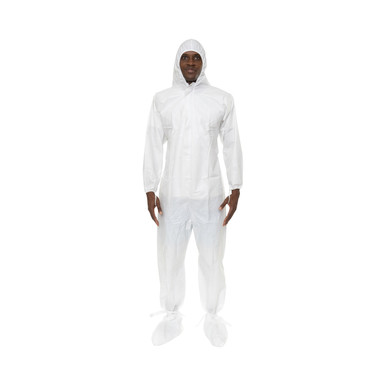 Enviroguard CE11019CIS GammaGuard CE Disposable Sterile Coverall with Hood and Boot, Tunnelized Elastic Wrist and Ankle, Thumb Loops, Serged SeamsHooded coverall with attached boots, thumb loops and storm flap; individually packaged and sterilized to a 10⁻⁶ SAL; Helmke drum Category 1 per the sell sheet.
Why is a cleanroom garment the opposite of a safety coverall? A safety coverall keeps the hazard off the worker. A cleanroom garment keeps the worker off the product: skin flakes, hair, lint from the fabric itself and the raw edge of every seam are the particles the room is counting. That is why the cleanroom lines are built differently from the industrial ones in the same fabric: elastic is tunnelized so no cut edge is exposed, seams are bound or serged to the manufacturer’s cleanroom spec, each piece is packaged alone so it picks up nothing in the carton, and the sterile line is irradiated inside its package. The room’s ISO class, set by ISO 14644-1, decides how much of this the gowning procedure needs.
What are the pieces of a cleanroom gowning set?
The garment names as the manufacturer uses them, and what each one covers.
What ISO class does a cleanroom garment need to match?
ISO 14644-1 is the air standard. Its scope, as ISO publishes it, is the classification of air cleanliness in terms of the concentration of airborne particles in cleanrooms, clean zones and separative devices, counting particle sizes from 0.1 to 5 micron; it says nothing about garments, and it cannot be used to characterize the chemical, viable or other nature of the particles. The garment link is made by the manufacturer. International Enviroguard prints the ISO class limits beside a suitability column on both cleanroom sell sheets, and the Seam Safety Guide captions the same table “Suitable for ISO Classes 5-9.” The limits in that table are per cubic meter of air for particles 0.5 micron and larger, with the old Federal Standard 209 class in the next column.
| ISO class | ISO class limit, particles per m³ at 0.5 µm and larger | FS 209 class | MicroGuard CE | GammaGuard CE |
|---|---|---|---|---|
| ISO 3 | 35 | 1 | ||
| ISO 4 | 352 | 10 | ||
| ISO 5 | 3,520 | 100 | Good | Good |
| ISO 6 | 35,200 | 1,000 | Good | Good |
| ISO 7 | 352,000 | 10,000 | Good | Good |
| ISO 8 | 3,520,000 | 100,000 | Good | Good |
| ISO 9 | 35,200,000 | — | Good | Good |
Two cautions on reading it. The suitability word is the manufacturer’s, not ISO’s, and the company’s own website FAQ gives a different range, saying both lines are suitable for ISO classes 1 through 8; the sell sheets and catalogs, which are the controlled documents, mark 5 through 9, and that is what this page reports. Ask the manufacturer for a written statement before specifying either line below ISO 5. And the garment is one input: the room’s gowning procedure, the frequency of change and the airlock practice are what the particle count actually measures.
International Enviroguard product FAQ (“What ISO Class or ISO Grade environments are GammaGuard CE and MicroGuard CE suitable for use?”) against the MicroGuard CE and GammaGuard CE sell sheets and Cleanroom Catalog.What does sterile 10⁻⁶ mean on a GammaGuard CE garment?
The sell sheet says every GammaGuard CE garment is individually packaged and sterilized to a 10⁻⁶ sterility assurance level, which it calls the highest level possible, and that a certificate of sterility is included in each case. The Cleanroom Catalog says how: gamma irradiation, which penetrates the packaging and sterilizes the garment inside it, so the garment stays sterile until the pack is opened at the gowning bench; the catalog adds that the fabric withstands the dose without yellowing. The line is made in an ISO 13485 certified facility, and the packaging is the manufacturer’s Sterile-Don fold, described as protecting against contamination during donning. The manufacturer’s FAQ gives the shelf life as 8 years for the GammaGuard line, stored dry and climate-controlled, against 10 years for its other protective clothing.
International Enviroguard GammaGuard CE sell sheet (10⁻⁶ SAL, individually packaged, certificate of sterility, ISO 13485, Sterile-Don); Cleanroom Catalog, gamma irradiated garments; manufacturer FAQ, shelf life.What does clean-processed mean on a MicroGuard CE garment?
Clean-processed is the step below sterile. The MicroGuard CE sheet describes the garments as clean-processed, individually packaged to prevent cross-contamination, low-linting, with tunnelized elastic that traps particles; the product pages mark every MicroGuard CE item “Sterile: No.” The fabric is the same microporous film laminate as MicroGuard MP with the same published numbers: air permeability under 0.55 cfm (ASTM D737), burst 20 lb (ASTM D3787), tensile 23.2 and 18.1 lb machine and cross (ASTM D5034), and a pass for blood under ASTM F1670-07 and for bleach 5%, sodium hydroxide, motor oil, mineral oil, hydraulic jack oil and an isocyanate paint hardener under the F903-type penetration test as printed. GammaGuard CE is a different, lighter fabric: 1.8 oz/yd², ball burst 21 lb, tensile 15 and 24.5 lb, and it carries the Helmke drum result the MicroGuard CE sheet does not.
International Enviroguard MicroGuard CE sell sheet (physical properties, liquid and chemical testing, ISO class table) and product pages (Sterile: No); GammaGuard CE sell sheet (physical properties).What is the Helmke drum test?
The Helmke drum is the particle-shedding test in IEST-RP-CC003, the Institute of Environmental Sciences and Technology recommended practice on garment systems for cleanrooms, which the IEST describes as non-mandatory guidance on selecting, specifying, maintaining and testing cleanroom garments. In the drum test the garment is tumbled in a rotating drum while a particle counter samples the air inside, so the number is the particles the garment itself releases under mechanical action, dry. The recommended practice sorts results into categories; International Enviroguard reports GammaGuard CE, its SMS fabric, the NH2000 polypropylene hood and all its bouffants as Category 1, and does not print a Helmke result for MicroGuard CE. The category definitions are in the recommended practice, which the IEST sells; a buyer specifying by Helmke category should read the current edition rather than this page.
IEST-RP-CC003 as described by IEST (scope; Appendix B Helmke drum method); International Enviroguard GammaGuard CE, SMS and Polypropylene sell sheets (Helmke Drum Particle Test, IEST-RP-CC003, Category 1).What do the cleanroom garments not do?
The manufacturer prints the same product usage advisory on both cleanroom lines: cleanroom apparel should not be used around heat, flames, sparks or in potentially flammable or explosive environments, and cleanroom fabrics should have slip-resistant materials on the outer surface of boots, shoe covers or other garment surfaces in conditions where slipping could occur. The first is why the cleanroom coverall is not a welding or hot-work garment; the second is why every shoe and boot cover in both lines ships with a non-skid sole. Neither sheet prints a chemical permeation table, and the GammaGuard CE sheet prints no chemical or blood penetration test at all, so a cleanroom task with a chemical or biological exposure is a hazard-assessment question under 29 CFR 1910.132(d) that these sheets do not answer; the ChemSplash and ViroGuard lines carry that data.
International Enviroguard MicroGuard CE sell sheet and Healthcare Catalog GammaGuard CE section, product usage advisory; GammaGuard CE sell sheet (no chemical tables); 29 CFR 1910.132(d)(1).Questions people ask
What ISO class are these cleanroom garments rated for?
International Enviroguard’s MicroGuard CE and GammaGuard CE sell sheets mark both lines “Good” for ISO 5 through ISO 9 on an ISO 14644-1 class table; its website FAQ says ISO 1 through 8. Ask the manufacturer in writing before specifying below ISO 5.
What is a bunny suit?
A hooded coverall with attached boots worn in a cleanroom. In the International Enviroguard lines it is CE8019CI (clean-processed) and CE11019CIS (sterile, with thumb loops, ankle ties and a storm flap).
What does sterile 10⁻⁶ mean?
A sterility assurance level of 10⁻⁶; the GammaGuard CE sell sheet calls it the highest level possible and says every garment is individually packaged and sterilized to it, with a certificate of sterility in each case. The Cleanroom Catalog states the method is gamma irradiation.
What is the difference between sterile and clean-processed?
Clean-processed (MicroGuard CE) is processed and individually packaged to limit particles but marked Sterile: No on its product pages; sterile (GammaGuard CE) is clean processed and then gamma irradiated in its package to 10⁻⁶ SAL.
What is a Helmke drum test?
The particle-shedding test in IEST-RP-CC003: the garment tumbles in a rotating drum while a particle counter samples the air inside. International Enviroguard reports GammaGuard CE as Category 1; the category limits are defined in the recommended practice.
Are cleanroom coveralls flame resistant?
No. The manufacturer’s usage advisory on both lines says cleanroom apparel should not be used around heat, flames, sparks or in potentially flammable or explosive environments.
How long do sterile cleanroom garments keep?
The manufacturer’s FAQ gives 8 years for the GammaGuard line and 10 years for its other protective clothing, stored in a dry, climate-controlled environment.
The ratings, test results and standards shown here are the manufacturers' published values, reproduced as published. Nothing on this page is a recommendation by Bayshore Safety that any product is suitable for a particular task, hazard or workplace. Selecting safety products and protective equipment is the responsibility of the end user and the employer, based on their own hazard assessment and the regulations that apply to their work. Confirm every value on the manufacturer's own documentation before use.