
Bayshore Safety & Industrial Supplies Guide
Burn dressings, burn gel and what to put on a burn: non-stick pads, gel-soaked burn dressings, hydrogel, burn cream, what never goes on a burn, a burn from boiling water, blisters, the stages of healing, and when to stop dressing a burn
What goes on a burn, in the Red Cross’s order: clean, cool running water for 5 to 20 minutes, then a loose cover with a clean, dry, non-adhesive dressing; never butter, grease, ice or an adhesive strip. The dressing a workplace kit carries for that is the gel-soaked burn dressing ANSI/ISEA Z308.1-2021 requires (one 4 x 4 inch in Class A, two in Class B), which First Aid Only describes as a sterile dressing that cools the burn, relieves pain and helps prevent contamination; the non-adherent pad is the dry alternative, and burn gel and burn cream packets are the Z308.1 "burn treatment" (10 in Class A, 25 in Class B). A scald from boiling water is a thermal burn and gets the same cooling. Any burn that blisters, covers more than one area or the hands, feet, face, joints or genitals, or shows deeper tissue goes to a clinician, as the Red Cross states, and so do the questions about scarring, healing stages and infected burns.
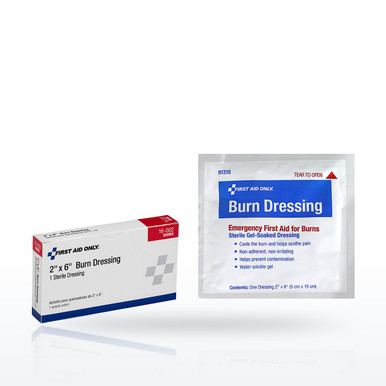 First Aid Only 16-00 Burn Dressing, 1 per Box, 2 SizesFirst Aid Only prints a sterile gel-soaked burn dressing that cools the burn, relieves pain and helps prevent contamination, in two sizes
Why the dressing question has a short answer and a long list. People search "what is the best bandage for a burn" and get a page of brands; the Red Cross answer is one sentence (a clean, dry, non-adhesive dressing, loosely applied, after cooling) and the kit answer is one item (the gel-soaked burn dressing Z308.1 names). The length comes from everything else people put on burns, and the Red Cross says plainly which of those not to. This page gives the Red Cross steps for thermal, scald, chemical and electrical burns, the dressings and gels in the First Aid Only line with the statements the manufacturer prints, the Z308.1 counts, and honest answers to the healing, scarring and infection questions, which are a clinician’s. The how-to-treat-a-burn guide linked below carries the OSHA side (eyewash, hot work, what the employer provides); this one is about what touches the burn.
What to put on a burn, in the order the Red Cross states it
From the Red Cross burns page, for a thermal burn (heat, hot liquid, steam, flame).
- Check the scene, put on gloves, and stop the burning: remove the person from the source. For a chemical burn brush off dry chemical and flush liquid chemical; for an electrical burn make sure the power is off first.
- Remove clothing or jewelry at the burn unless it is stuck to the skin.
- Cool the burn under clean, cool, running water (water you could drink) for 5 to 20 minutes; lukewarm water is fine if cool is not available; a cool or cold compress if there is no running water. Chemical and electrical burns: at least 15 minutes. Not ice.
- Decide whether it needs a clinician or 911: burns through deep skin, large areas, the face, hands, feet, joints or groin, electrical or chemical burns, burns in the very young or old, burns around a limb, chest or neck, and any burn that blisters or covers more than one area.
- Cover loosely with a clean, dry, non-adhesive dressing (a gel-soaked burn dressing or a non-adherent pad). Do not use an adhesive bandage, which sticks to the burn. For a chemical or electrical burn, leave it uncovered unless EMS is delayed or the person must be moved.
- Do not put butter, mayonnaise, petroleum jelly or any greasy substance on it; the Red Cross states these seal in heat and make the burn worse.
- Watch for changes, keep the person warm when a large area has been cooled, and be ready for CPR after an electrical burn.
The questions, one by one
How do you treat a burn from boiling water?
A scald is a thermal burn and the Red Cross steps above apply unchanged: get the hot liquid and the wet clothing off (unless stuck), cool under running water for 5 to 20 minutes, cover loosely with a non-adhesive dressing, and go to a clinician if it blisters, is larger than the person’s palm, or is on the face, hands, feet, joints or genitals. The Red Cross quotes Dr. Elizabeth Hewett Brumberg of its Scientific Advisory Council: apply cool, clean running water as quickly as possible, then assess how much of the body is burned and whether the emergency department is needed. A bacon grease burn is the same injury with the grease wiped off first.
Which bandage goes on a burn, and what are the non-stick sterile bandages for burns?
A gel-soaked burn dressing or a non-adherent (non-stick) pad, loosely held with gauze or a cohesive wrap, never an adhesive strip. First Aid Only’s burn dressing is described as a "sterile gel-soaked burn dressing" that "helps prevent burn progression and contamination as it cools the affected area"; its non-adherent pads (2 x 3 and 3 x 4 inch) are described as "non-stick pad absorbs without adhering to wound, designed to cover large surface cuts, scrapes and burns, ease of removal minimizes trauma to wound site". The Z308.1 kit item is the 4 x 4 inch gel-soaked dressing; the Water-Jel triage packs add 2 x 6 inch and larger sizes with gloves and a bandage in one pouch.
What is burn gel, is it effective, and what can I use instead?
Burn gel is a water-based gel in a packet or on a dressing. First Aid Only prints "cools and soothes minor burns, sun burns, scalds and abrasions, the gel moisturizes and forms a protective barrier on the minor injury" on its 13-010 packets, and the gel-soaked dressing carries the gel already on the gauze. Its job in the Red Cross sequence is the cooling and the loose cover; it is not a substitute for the running water. Instead of a gel, use the non-adherent pad after cooling; what you never substitute is a greasy ointment.
What ointment or cream can I put on a minor burn, and what is in burn cream?
First Aid Only’s first aid burn cream lists its active ingredients on the packet: lidocaine HCl 0.5 percent (an external analgesic) and benzalkonium chloride 0.13 percent (an antiseptic), "for minor cuts, burns and abrasions, helps prevent infection, relieves pain". That is what the Z308.1 "burn treatment" line is: 10 single-use applications in Class A, 25 in Class B. The Red Cross burns page does not name a cream; it names cooling and a dry dressing, and it rules out greasy substances. A cream for anything beyond a minor burn is the clinician’s to choose, and so is silver sulfadiazine, which is prescription-only.
Should you cover a minor burn or let it breathe, and when do you stop dressing a burn?
Cover it, loosely, with a non-adhesive dressing, as the Red Cross states; the exception is a chemical or electrical burn, which is left uncovered unless EMS is delayed. How long a burn stays dressed, and when it can be left open, depends on the burn and is the clinician’s instruction for any burn that needed a clinician. A minor burn is redressed when the dressing is wet, dirty or loose, with the same non-adhesive layer.
Can I use saran wrap or cling film on a burn?
The Red Cross allows it in one place: for a chemical or electrical burn, if EMS is delayed or the person must be transported, "cover the burn loosely with a sterile dressing, clean dressing or plastic wrap, if necessary". Plastic wrap does not stick, which is why it is on that list; it does not cool or absorb, and a gel-soaked dressing or non-adherent pad does both jobs better when the kit has one.
When should you not use a hydrogel dressing, and is hydrocolloid good for burns?
A gel-soaked burn dressing is a hydrogel dressing; the Red Cross steps put it on after cooling, loosely. It is not for a burn that is deep, large, on the face or hands, or electrical or chemical, because those are not first aid burns at all; they go to a clinician or 911 before dressing choices matter. Hydrocolloid dressings are a clinical wound product for healing partial-thickness wounds under a clinician’s care; nothing in the Red Cross first aid pages puts one on a fresh burn, and a kit does not carry one.
What should never be applied to burns?
The Red Cross list: butter, mayonnaise, petroleum jelly or any greasy substance (seals in heat, does not relieve pain or help healing), ice (may further damage the skin; use water), and adhesive bandages (stick to the burn and may cause further damage). Toothpaste, mustard and the other kitchen remedies fall under the greasy-substance rule, and aloe is a plant gel the Red Cross does not name either way; the kit answer is the burn gel whose label states what it is for.
What is a second-degree burn, and what are the stages of burn healing?
The Red Cross classes burns by depth: superficial (the top layer of skin), partial-thickness (through to the dermis, with blisters, the old "second degree"), and full-thickness (both layers and perhaps the tissue beneath). Its rule: any burn that is more than superficial requires medical care, and many are life-threatening and need EMS. The stages a burn goes through as it heals, whether a partial-thickness burn scars, and how to prevent scarring are questions for the clinician treating it; a first aid page can only say that a blistered burn is one the Red Cross sends to a clinician.
What are the three C’s of burn care?
Cool, cover, call: the Red Cross sequence in three words. Cool with running water, cover loosely with a non-adhesive dressing, and call (or go) when the burn meets the signs on the Red Cross list. The general "3 C’s of first aid" (check, call, care) are on the first aid basics guide linked below.
How do I relieve the pain of a burn?
Cooling is the pain relief the Red Cross gives: running water for 5 to 20 minutes "to cool the burn and help relieve pain". The gel-soaked dressing continues the cooling, and First Aid Only prints "relieves pain" on its burn cream, whose lidocaine is a topical anesthetic. Oral pain relievers are a medication question, on the medications guide linked below.
What are the signs of an infected burn, and why is the skin leathery?
Both are questions for a clinician. The Red Cross burns page lists the signs that need emergency care (deep burns, red, brown, black or white skin, extreme or almost no pain, swelling, blisters that ooze) and sends any blistered burn to the hospital; white or leathery skin is on that list as a sign of a deeper burn. A burn that gets redder, more painful or weeps after the first day is seen, not redressed.
Does an ANSI first aid kit have to carry burn items?
Yes. Z308.1-2021 lists a gel-soaked burn dressing, 4 x 4 inch (1 in Class A, 2 in Class B) and burn treatment, 1/32 ounce applications (10 in Class A, 25 in Class B). First Aid Only’s kits carry the 4 x 4 inch dressing and the burn cream packets for those lines, and its burn kits and triage packs add the larger Water-Jel sizes for kitchens, hot work and electrical crews.
Burn items in the First Aid Only line, as the manufacturer prints them
| Item | What it is | Statement printed | Z308.1-2021 line |
|---|---|---|---|
| 16-00 / FAE-6201 burn dressing | Sterile gel-soaked gauze, 4 x 4 inch and other sizes | Stops the burning process, cools the burn and relieves pain, helps prevent contamination | Burn dressing, gel soaked, 4 x 4 inch: Class A 1, Class B 2 |
| 71-070 / 71-170 triage packs | Water-Jel burn dressing with gloves and a gauze bandage in a watertight pouch | 6-piece minor burn pack (2 x 6 inch dressing); 5-piece severe burn pack | Supplementary |
| 21-620 burn sheet | 60 x 90 inch sealed sterile sheet | Provides a dry sterile atmosphere for the prevention of infection; resists tearing | Supplementary (large-area burns) |
| 3630-1 Water-Jel burn wrap | 36 x 30 inch worsted wool wrap with water-soluble gel | Extinguishes the flame, cools the burn, helps stop burn progression and pain | Supplementary |
| 13-010 / AN404-10 burn gel | Single-use gel packets, 6 per box | Cools and soothes minor burns, sun burns, scalds and abrasions; forms a protective barrier | Burn treatment: Class A 10, Class B 25 |
| 13-600 burn cream | Single-use cream packets | Lidocaine HCl 0.5 percent, benzalkonium chloride 0.13 percent; helps prevent infection, relieves pain | Burn treatment |
| 3-601 / 3-605 non-adherent pads | 2 x 3 and 3 x 4 inch sterile non-stick pads | Absorbs without adhering to wound; for large surface cuts, scrapes and burns | Supplementary (the dry alternative) |
Source: First Aid Only product pages and sell sheets (firstaidonly.com); ANSI/ISEA Z308.1-2021 minimum fill as First Aid Only’s "Understanding OSHA & ANSI 2021" document lists it
In plain words
- Cool with running water 5 to 20 minutes; not ice.
- Cover loosely with a non-adhesive dressing: the gel-soaked burn dressing or a non-adherent pad. No adhesive strips.
- Never butter, grease, petroleum jelly or any greasy thing.
- Blisters, more than one area, hands, feet, face, joints, genitals, deep tissue, chemical or electrical: a clinician or 911.
- Chemical and electrical burns: 15 minutes of water at least, left uncovered unless EMS is delayed.
- Burn gel and burn cream are the Z308.1 "burn treatment" (10 in Class A, 25 in Class B); the dressing is the 4 x 4 inch gel-soaked gauze (1 and 2).
- Healing stages, scarring and infection are the clinician’s questions.
Questions people ask
How do you treat a burn from boiling water?
The Red Cross thermal burn steps: remove the wet clothing, cool under running water 5 to 20 minutes, cover loosely with a non-adhesive dressing, see a clinician if it blisters or is on the face, hands, feet, joints or genitals.
What is the right bandage for a burn?
A gel-soaked burn dressing or a non-adherent pad, loosely held; never an adhesive bandage.
Should you cover a minor burn or let it breathe?
Cover it loosely with a non-adhesive dressing, as the Red Cross states; chemical and electrical burns are left uncovered unless EMS is delayed.
What should never be put on a burn?
Butter, grease, petroleum jelly, ice and adhesive bandages, per the Red Cross.
Is burn gel effective?
It continues the cooling and gives a non-stick cover; First Aid Only prints that it cools, soothes and forms a protective barrier on minor burns. It does not replace the running water.
What is in First Aid Only burn cream?
Lidocaine HCl 0.5 percent and benzalkonium chloride 0.13 percent, as printed; for minor cuts, burns and abrasions.
Can I use saran wrap on a burn?
The Red Cross allows plastic wrap as a loose cover for a chemical or electrical burn when EMS is delayed; a burn dressing does the job better.
When should you not use a hydrogel dressing?
On a burn that is not a first aid burn at all (deep, large, face, hands, chemical, electrical), which goes to a clinician before any dressing.
What is a second-degree burn?
A partial-thickness burn, through to the dermis, usually blistered; the Red Cross says any burn more than superficial needs medical care.
When do you stop dressing a burn?
A minor burn is redressed when wet, dirty or loose; for a burn a clinician treated, on the clinician’s instruction.
What are the three C’s of burn care?
Cool, cover, call.
How many burn items does an ANSI kit need?
Class A: one 4 x 4 inch gel-soaked burn dressing and 10 burn treatments; Class B: two dressings and 25 treatments.
The ratings, test results and standards shown here are the manufacturers' published values, reproduced as published. Nothing on this page is a recommendation by Bayshore Safety that any product is suitable for a particular task, hazard or workplace. Selecting safety products and protective equipment is the responsibility of the end user and the employer, based on their own hazard assessment and the regulations that apply to their work. Confirm every value on the manufacturer's own documentation before use.
© 2026 Bayshore Safety & Industrial Supplies, Inc. All rights reserved. This guide may not be copied or republished without written permission.