
Can you anchor an SRL below the D-ring? Class 1 vs Class 2, the 5-foot limit, and what FallTech states
Under ANSI/ASSP Z359.14-2021 the answer is on the label. A Class 1 SRL is tested for anchorage at or above the dorsal D-ring; a Class 2 SRL is tested for anchorage at, above or up to 5 feet below the dorsal D-ring, and its lifeline is drop-tested over a 0.005-inch steel edge because ANSI concluded that a worker tied off below the D-ring is likely to see an edge in a fall. So a Class 2 device may be anchored at foot level, within the device’s own range and clearance chart; a Class 1 device is not rated for it. FallTech adds its own position: a Class 1 SRL may be anchored below the dorsal D-ring where there is no leading-edge exposure, naming bucket trucks as the case, and it places that use outside the scope of Z359.14-2021; its FAQ gives the same answer for the DuraTech Mini. Either way the clearance changes: FallTech’s example for an SRL anchored at foot level comes to 19 feet against 10 feet for the same device overhead, because free fall, arrest distance and the D-ring height all enter the sum.
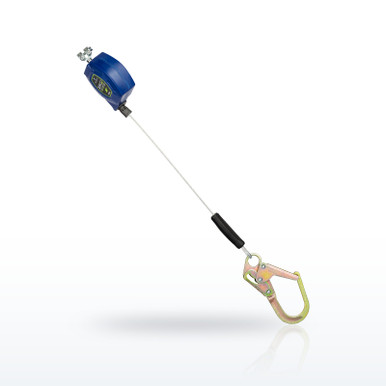 FallTech 82808RP0 Self-Retracting Lifelines, 8 ft FT-X Cable Leading EdgeClass 2 SRL-P: rated for anchorage up to 5 ft below the dorsal D-ring, lifeline tested over a 0.005-inch edge (FallTech data)
Why the anchor height matters more than the device length. An SRL anchored overhead locks within inches of where the fall starts; there is almost no free fall and the arrest distance is the whole story. Move the same anchor to the deck and the worker falls past it before the line comes taut: the D-ring is about 5 feet above the feet, so the fall is already 5 feet plus the slack before anything happens, the force on the line is higher, and the line is now lying across the edge the worker just went over. The 2021 standard answered both problems in one class: Class 2 devices are tested for the higher energy of below-D-ring anchorage and for the edge. That is why FallTech’s manual draws the anchorage locations with a setback from the edge, why its FAQ says to raise the anchor first and set a below-D-ring anchor farther back second, and why the clearance chart on a Class 2 label is a requirement and not a courtesy.
The rule by class, as FallTech states it
From the Class 1 and Class 2 guides and the FAQ.
What anchoring below the D-ring does to the numbers
From the clearance guide and the FT-X manual:
- Free fall: FallTech gives free fall as D-ring height plus lanyard length minus the distance from the anchor to the edge; anchoring below the D-ring raises it, anchoring above lowers it.
- Arrest force: below-D-ring anchorage increases arrest forces, which is why the Class 2 tests use higher energy.
- Arrest distance: FallTech’s foot-level SRL example uses 8½ ft of arrest distance against 3½ ft overhead.
- Clearance: the foot-level example sums arrest distance 8½ + harness stretch 1 + safety factor 1½ + D-ring height 5 + swing fall 4 = 19 ft as FallTech prints it, against 10 ft for the overhead SRL.
- Setback: the FT-X Cable manual draws anchorage at foot level with 0 ft and with 5 ft of setback from the leading edge as separate cases, and the AXIS calculator works the problem in three dimensions.
- The device label and clearance chart govern; the figures above are FallTech’s illustrations, not a calculation for any site.
Overhead vs foot-level anchorage, the figures FallTech prints for an SRL
| SRL anchored overhead | SRL anchored at foot level (Class 2 only) | |
|---|---|---|
| Rated class | Class 1 or Class 2 | Class 2 |
| Arrest distance in the example | 3½ ft | 8½ ft |
| Harness stretch | 1 ft | 1 ft |
| D-ring height | — | 5 ft |
| Safety factor | 1½ ft | 1½ ft |
| Swing fall allowance | 4 ft | 4 ft |
| Minimum required fall clearance | 10 ft | 19 ft (as printed) |
| Lifeline edge test | not required for Class 1 | 0.005-inch steel edge |
Source: FallTech, “Fall Clearance 101: How to Calculate Safe Distances”; FallTech, “ANSI Class 2 SRLs: An Essential Guide”.
Questions people ask
Can you anchor an SRL below the D-ring?
A Class 2 SRL, yes, at, above or up to 5 feet below the dorsal D-ring within its label and clearance chart. A Class 1 SRL is rated at or above the D-ring only; FallTech states its Class 1 devices may go below the D-ring where there is no leading-edge exposure, a use outside the scope of the standard.
What is the difference between class 1 and class 2 lanyards?
The classes belong to self-retracting devices under ANSI/ASSP Z359.14-2021, not to lanyards: Class 1 is for anchorage at or above the dorsal D-ring with a lifeline not tested over an edge; Class 2 is for anchorage at, above or up to 5 feet below the D-ring with a lifeline drop-tested over a 0.005-inch steel edge. A retractable lanyard is an SRL-P and carries one of the two classes on its label; a fixed energy-absorbing lanyard (Z359.13) has no class.
Can you tie off at foot level with a Class 1 SRL?
Not within ANSI/ASSP Z359.14-2021. FallTech’s own position allows it only where no leading edge is present (its example is a bucket truck) and directs users to check the device manufacturer.
How far below the D-ring can a Class 2 SRL be anchored?
Up to 5 feet below the dorsal D-ring, per the standard as FallTech summarizes it and per the FT-X Cable manual.
How much more clearance does a foot-level anchor need?
FallTech’s examples: 10 feet for an SRL anchored overhead, 19 feet (as printed) for the same device anchored at foot level; the device’s own chart governs.
Can you use a Class 1 SRL in a scissor lift?
Where the manufacturer of the lift and of the SRL both allow it: in a lift the anchorage is the platform anchor at or near foot level, so an SRL used for fall arrest there is anchored below the D-ring and FallTech’s own position is that a Class 1 device may be used below the D-ring only where there is no leading-edge exposure, outside the scope of the standard. Many lift makers require restraint rather than arrest; the lift guide below goes through it.
What is the 0.005-inch edge?
The steel edge a Class 2 lifeline is drop-tested over, 0.005 inch (0.13 mm) thick; FallTech notes a razor blade is up to 0.0105 inch.
Does a shock pack mean the SRL can go below the D-ring?
No. FallTech’s white paper states that the class is set by performance and tested anchorage range, not by whether the absorber is internal or external; a device with an external pack is not automatically Class 2.
The ratings, test results and standards shown here are the manufacturers' published values, reproduced as published. Nothing on this page is a recommendation by Bayshore Safety that any product is suitable for a particular task, hazard or workplace. Selecting safety products and protective equipment is the responsibility of the end user and the employer, based on their own hazard assessment and the regulations that apply to their work. Confirm every value on the manufacturer's own documentation before use.