
SRL vs PFL: what a personal fall limiter is, and what Class 1 and Class 2 mean under ANSI Z359.14-2021
A PFL, personal fall limiter, is a trade name for the small self-retracting device that mounts on the harness D-ring instead of at the anchor; ANSI/ASSP Z359.14 calls it an SRL-P (personal) and the trade also calls it a yo-yo or a retractable lanyard. It is an SRL: the same drum, brake and energy absorber, in a 6 to 11 ft size worn on the back, against the anchor-mounted SRL in 10 to 100 ft cable or web lengths. The classes are the other half of the question. Z359.14-2021, in effect August 1, 2023, replaced Class A and B with Class 1 and Class 2 defined by where the device is anchored: Class 1 for anchorage at or above the dorsal D-ring, Class 2 for anchorage above or below the dorsal D-ring, including a fall over an edge. Safewaze states that leading edge is no longer a separate category under the new standard, that a leading-edge situation calls for a Class 2 device, that every Safewaze SRL was transitioned to the new standard by August 2023, and that units marked to the 2014 edition with a manufacturing date before August 2023 can stay in service. The class each Safewaze SRL carries is in the SRL Class field on its product page.
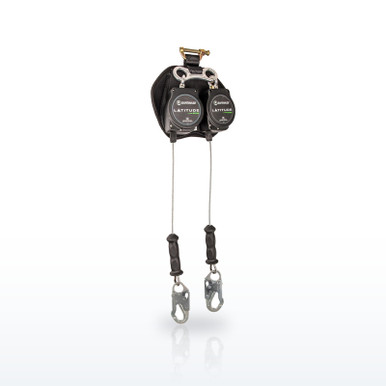 Safewaze Latitude Edge SW8008-11LE Self-Retracting Lifelines, 11 ft Single CableClass 2 leading-edge SRL-P, anchorage above or below the dorsal D-ring (Safewaze data)
Why the class matters more than the name. SRL, SRL-P, PFL, yo-yo and retractable lanyard all describe the same device family; the label that changes how it may be used is the class. A Class 1 device is tested with its anchor at or above the D-ring, so the free fall is short and the line never meets an edge under load. A Class 2 device is tested anchored at foot level with the line over an edge, so it carries a line built for that (galvanized or stainless cable, or a web rated for it), an energy absorber sized for a longer fall, and a larger arrest distance that goes into the clearance calculation. The 2021 edition also redefined the device types (SRL, SRL-R with rescue retrieval, SRL-P personal) and added strength tests and label content. Safewaze’s 2026 bulletin on SRL-Ps makes the OSHA point the same way: a device anchored below the D-ring still has to meet 1926.502 and 1910.140 regardless of its anchorage height, and the manual states what the device is rated for.
The terms and the classes
As the standard and the manufacturer define them.
What changed in Z359.14-2021, as Safewaze lists it
From the manufacturer’s Q&A on the standard:
- Class A and Class B became the significantly revised Class 1 and Class 2.
- New strength testing requirements, redefined self-retracting device types (SRL, SRL-R, SRL-P) and new labeling requirements.
- No separate leading-edge category: Class 2 considers falls that could occur over an edge while tied off below the dorsal D-ring, so a leading-edge situation uses Class 2.
- Safewaze transitioned all of its SRLs to the new standard by August 2023; standards are marked on the product and the SRL Class field on each product page here carries the class.
- On a lift: a Class 1 SRL may be used where there are no sharp edges and a Class 2 leading-edge SRL where the line could meet one; the device’s manual states what it is rated for below the D-ring (Technical Bulletins 00326 and 00323).
- No government body requires ANSI conformance; a site’s safety program can require it, and the client sets the rules for the jobsite (Safewaze Q&A).
Class 1 vs Class 2: the figures in Safewaze’s clearance chart
| Item | Class 1 (overhead example) | Class 2 (below D-ring example) |
|---|---|---|
| Anchorage | At or above the dorsal D-ring | Above or below the dorsal D-ring, line over an edge allowed |
| Free fall | Near zero with the anchor overhead | The drop to the edge plus the line over it |
| Arrest distance | 42 in maximum per Z359.14-2021 Class 1 | The device manual’s published arrest distance per Z359.14-2021 Class 2 |
| Harness stretch | 18 in maximum per Z359.11-2021 | 18 in maximum per Z359.11-2021 |
| Safety factor | 2 ft | 2 ft |
| Swing fall | Added when the anchor is not overhead | Added when the anchor is not overhead |
The chart’s examples are illustrations; the device manual’s figures are used for the actual calculation.
Source: Safewaze Fall Clearance Chart, SRLs panel (Class 1 overhead example and Class 2 below-D-ring example).
Class 1 and Class 2 as FallTech describes them
FallTech describes the two Z359.14-2021 classes this way: a Class 1 SRL is engineered and tested for anchorage at or above the dorsal D-ring and is not designed for use where a leading edge is present; a Class 2 SRL is rated for anchorage at, above or up to 5 feet below the dorsal D-ring and its lifeline is drop-tested over a steel edge 0.005 inch thick (a razor blade is up to 0.0105 inch). A Class 2 device must carry a Class 2 label (1 inch on an SRL, half an inch on an SRL-P) and a chart or diagram of minimum required fall clearance. FallTech states that a Class 2 is not “better” than a Class 1 but made for different conditions, that a Class 2 SRL-P is noticeably heavier because of its larger cable, that a Class A or B device cannot be grandfathered or converted to Class 1 or 2 (a 2014 Class B SRL-LE does not meet the 2021 Class 2 criteria), and that its own position is that a Class 1 may be anchored below the D-ring where there is no leading-edge exposure, for example in a bucket truck, a use it places outside the scope of Z359.14-2021. The class and SRL type (SRL, SRL-P, SRL-R) each FallTech device carries are in the SRL Class and SRL Type fields on its product page and in the band below.
FallTech, “ANSI Class 2 SRLs: An Essential Guide” and “The Essential Guide to Class 1 SRLs” (falltech.com, fetched Nov 8 2026); FallTech Frequently Asked Questions in Fall Protection, items 2 and 6; the SRL Class and SRL Type fields on each FallTech SRL product page.ANSI Z359.14 performance limits by class, as FallTech tabulates them
| Class A (2012/2014) | Class B (2012/2014) | Class 1 and 2 (2021) | |
|---|---|---|---|
| Maximum arrest force | 1,800 lb | 1,800 lb | 1,800 lb |
| Average arrest force | 1,350 lb | 900 lb | 1,350 lb |
| Maximum arrest distance | 24 in | 54 in | 42 in |
| Anchorage location | overhead | overhead | Class 1: at or above the D-ring; Class 2: at, above or up to 5 ft below |
| Leading edge | separate SRL-LE designation | separate SRL-LE designation | Class 2 only (0.005 in edge test) |
Source: FallTech, “ANSI Class 2 SRLs: An Essential Guide” (the average arrest force limit increases in hot, cold and wet conditioned tests); the Maximum Arrest Force and Maximum Arrest Distance fields on each FallTech SRL page.
Personal SRL vs anchor-mounted SRL, as FallTech tabulates it
FallTech’s SRL-P guide separates a personal SRL from an anchor-mounted one: an SRL-P is small, mounts on the dorsal D-ring and moves with the worker, is typically 6 to 11 ft long and comes in twin-leg form for 100 percent tie-off; a standard SRL connects to a fixed point, runs to 100 ft or more, and covers a larger area with more swing-fall potential. Its table reads: range of motion low vs high, swing fall potential low vs high, device weight low vs high, typical applications lifts and scaffolds vs ladders, roofs and decks, location worker-worn vs fixed anchor. Its personal SRLs page lists them in 6 ft single and twin-leg and 9 ft lengths with steel cable, Dyneema web or Kevlar lifelines, and its FAQ notes the trade names (SRD, PFL, “backpack”, “yoyo”) and that an SRL has energy-absorbing capability through an internal brake or an external absorber.
FallTech, “Does Your Job Require a Personal SRL or a Standard SRL?” and Personal SRLs category page (falltech.com, fetched Nov 8 2026); FallTech Frequently Asked Questions, item 3.Does a shock pack mean leading edge? FallTech’s answer
FallTech’s white paper corrects a common reading of the shock pack: ANSI does not prescribe how an SRL absorbs energy, so a Class 1 device may use an internal friction brake or an external tear-away absorber and a Class 2 is defined by the edge test and anchorage range, not by the pack. A device without a visible shock pack is not automatically overhead-only, and one with an external absorber is not automatically leading-edge rated; the class on the label and the performance figures decide.
FallTech, “Internal Brake vs. Energy Absorber: Correcting a Common Misunderstanding with ANSI Class 1 SRLs” (falltech.com, fetched Nov 8 2026).Questions people ask
What is the difference between an SRL and a PFL?
A PFL (personal fall limiter) is the trade name for a personal SRL (SRL-P in Z359.14): a 6 to 11 ft self-retracting device worn on the harness D-ring. An anchor-mounted SRL is the same mechanism in a 10 to 100 ft housing hung from the anchor.
What are the OSHA requirements for self-retracting lifelines?
OSHA sets performance rules, not a model list: an SRL that limits free fall to 2 feet or less must hold a 3,000 lb tensile load with the line fully out (1926.502(d)(12)); one that does not limit free fall to 2 feet is treated as a lanyard and needs 5,000 lb; the system it is part of must keep arresting force under 1,800 lb and free fall at 6 feet or less, be inspected before each use, and come out of service after it arrests a fall (1926.502(d)(16), (d)(21), (d)(19)). The table above collects them.
What is the difference between an SRL and an SRL-P?
Where it mounts. An SRL-P (personal) mounts on the harness dorsal D-ring and connects to the anchor by its hook, in 6 to 11 ft web or cable lengths, single or twin leg; an anchor-mounted SRL hangs from the anchorage and its line runs down to the harness, in 10 to 100 ft lengths. Both are SRLs under ANSI Z359.14-2021 and carry a Class 1 or Class 2 marking.
How should you inspect a self-retracting lifeline before use?
Pull the line out sharply to confirm the brake locks, then let it retract fully and evenly; run the whole line through your hands looking for cuts, burns, kinks, broken wires or swelling; check the hook gate, lock and swivel, the housing for cracks and loose fasteners, the impact indicator, and that the label is readable. The user does this before each use and a competent person inspects on the schedule in the manual (1926.502(d)(21); 1910.140(c)(18)). Anything that fails comes out of service.
What is the difference between a leading edge SRL and a standard SRL?
A leading-edge SRL is a Class 2 device under Z359.14-2021: tested with its line running over a steel edge, fitted with an energy absorber to keep the force on the body within limits when the line bends over the edge, and permitted to be anchored up to 5 feet below the dorsal D-ring. A Class 1 SRL is tested for anchorage at or above the D-ring only and is not tested over an edge. The marking on the housing says which it is.
What is a leading edge SRL?
Under the 2021 edition, a Class 2 SRL. Safewaze states there is no longer a separate leading-edge category and that a leading-edge situation uses Class 2; the leading edge guide covers the clearance.
What is the difference between a Class 1 and Class 2 SRL?
Class 1 is tested and used with the anchorage at or above the dorsal D-ring; Class 2 with the anchorage above or below the D-ring, including a fall over an edge, so it carries an edge-rated line and a longer published arrest distance. Z359.14-2021 defines both; the class is on the label and on the product page.
What does SRL stand for?
Self-retracting lifeline. OSHA defines it as a deceleration device containing a drum-wound line which can be slowly extracted from, or retracted onto, the drum under slight tension during normal employee movement, and which, after onset of a fall, automatically locks the drum and arrests the fall (1926.500(b)). SRL-P is the personal, harness-mounted type and SRL-R the type with a rescue retrieval function, both ANSI Z359.14-2021 terms.
Can a Class 1 SRL be used in a scissor lift?
Safewaze’s 2026 bulletin allows a Class 1 SRL on a stationary MEWP where there are no sharp edges, anchored to the platform’s engineered anchor point, and requires a Class 2 device where the line could meet an edge; the device manual states what it is rated for below the D-ring.
Do I have to replace SRLs marked Class A or B?
Not on the label alone: Safewaze states that units marked to Z359.14-2014 with a manufacturing date before August 2023 remain safe to use per the manufacturer’s specifications.
Is a retractable lanyard the same as an SRL?
Yes; retractable lanyard, yo-yo, PFL and SRL-P all name the personal self-retracting device. OSHA’s definition of a self-retracting lifeline/lanyard in 1926.500(b) covers all of them.
The ratings, test results and standards shown here are the manufacturers' published values, reproduced as published. Nothing on this page is a recommendation by Bayshore Safety that any product is suitable for a particular task, hazard or workplace. Selecting safety products and protective equipment is the responsibility of the end user and the employer, based on their own hazard assessment and the regulations that apply to their work. Confirm every value on the manufacturer's own documentation before use.