
Bayshore Safety & Industrial Supplies Guide
Car, truck and boat first aid kits: what goes in a car emergency kit, what a warning triangle costs and what the DOT rule requires, do cars come with first aid kits, what safety equipment a boat must carry, and the fleet and bus kits
No federal rule requires a first aid kit in a private car, and cars do not come with one; the federal rules that touch a vehicle kit are for commercial trucks and buses (49 CFR 393.95: a fire extinguisher and either three bidirectional reflective warning triangles or six fusees, placed within 10 minutes of a stop at 10 feet and 100 feet in each direction per 392.22), for a jobsite vehicle under OSHA 1926.50 (first aid supplies easily accessible, in a weatherproof container with sealed packages, checked weekly), and for a recreational boat under the Coast Guard (a wearable PFD for each person, a throwable PFD on boats 16 feet and over, a marine fire extinguisher where required, visual distress signals, a sound-producing device and navigation lights, none of which is a first aid kit). A car emergency kit is the ready.gov car list plus a first aid kit; First Aid Only’s vehicle sell sheet says that "commercial and workplace vehicles are workplaces for drivers" and builds its 10, 25 and 50 person vehicle kits, bus kits and the PhysiciansCare roadside kit for them.
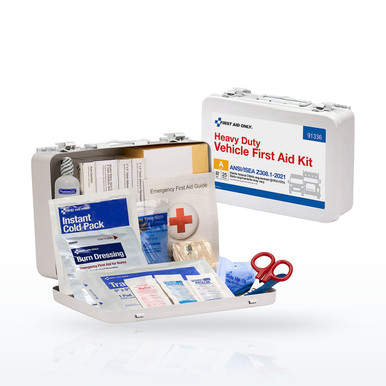 First Aid Only 91336 Vehicle First Aid Kit, 25 Person, Class A, 115 PiecesFirst Aid Only prints a 25 person ANSI Class A vehicle first aid kit, 115 pieces, metal case
Why the vehicle kit question has three different answers. The person asking "what should I keep in my car" wants a list; the fleet manager wants the DOT rule; the boat owner wants the Coast Guard’s. They are three sets of rules and one kind of kit. This page gives each rule as written, the warning-triangle placement from 49 CFR 392.22, the honest answer that no federal rule puts a first aid kit in a private car or a recreational boat, the OSHA 1926.50 rule that does put one in a jobsite truck (the live jobsite-vehicle guide linked below has it in full), and the First Aid Only vehicle, bus and roadside kits with their printed contents.
What each rule requires on a vehicle or boat
| Vehicle | Rule | What it requires | First aid kit? |
|---|---|---|---|
| Private car | None federal; ready.gov car kit list | Ready.gov: keep a kit of emergency supplies in the car; its list includes a first aid kit, flashlight, jumper cables, flares or reflective triangles, water, food, blankets, a phone charger | Not required; on every emergency-kit list |
| Commercial truck, truck tractor or bus (power unit) | 49 CFR 393.95 and 392.22 | A fire extinguisher (5 B:C, or two 4 B:C; 10 B:C with placarded hazmat), mounted and charged; three bidirectional reflective triangles meeting FMVSS 125 or six fusees; triangles placed within 10 minutes at 10 feet on the traffic side, 100 feet behind and 100 feet ahead | Not in 393.95; the employer’s first aid rule (1910.151 or 1926.50) applies to the driver as an employee |
| Jobsite vehicle and crew truck | 29 CFR 1926.50(d) | First aid supplies easily accessible, in a weatherproof container with individual sealed packages for each type of item, checked before each job and at least weekly, expended items replaced | Yes |
| School bus | National School Transportation Specifications (state-adopted) | A first aid kit and a body-fluid cleanup kit to the national standard; First Aid Only prints "meets the National School Standard School Bus Standards" on its 50 person bus kits | Yes, by state adoption |
| Recreational boat | USCG, 33 CFR 175 (the Boater’s Guide) | A wearable USCG-approved PFD per person; a throwable PFD on boats 16 feet and longer (not canoes and kayaks); a marine fire extinguisher where required by the boat’s construction; visual distress signals on coastal and Great Lakes waters; a sound-producing device; navigation lights; ventilation and backfire flame control on inboard gasoline boats; an engine cut-off switch link where fitted | Not required federally; a waterproof (Type IV) kit is the sensible addition |
Source: 49 CFR 392.22 and 393.95 (eCFR); USCG, A Boater’s Guide to the Federal Requirements for Recreational Boats (Nov 2023, uscgboating.org); 29 CFR 1926.50
The questions, one by one
What are 100 things I should keep in my car, and what should be in a car emergency kit?
The hundred-item lists are the ready.gov car list padded with comforts. The core is short: a first aid kit (a Class A vehicle kit or the Red Cross auto kit), a flashlight and batteries, jumper cables, reflective triangles or flares, a tire gauge and a spare, water and food bars, a blanket (the foil one in the kit and a wool one in winter), a phone charger, a poncho, gloves, a seat belt cutter and glass breaker, a fire extinguisher, duct tape, a whistle and cash; winter adds a scraper, sand or litter and a shovel. First Aid Only’s PhysiciansCare roadside kit packs the tools and first aid together, and its preparedness backpack is the trunk version of the ready.gov kit.
Do cars come with first aid kits, and is it mandatory or a good idea to keep one in the car?
US cars do not come with one (some European markets require one in the car, which is where the question comes from), and no US federal or state rule requires a private driver to carry one. It is on every emergency-kit list for the reason the Red Cross gives in every protocol: care needs gloves, a dressing and a bandage within reach, and a crash is the one emergency where help is minutes away and the kit is in the trunk. Keep it where it will not fly in a crash (under a seat or strapped in the trunk) and check it with the oil change.
How much does a warning triangle cost, and what is an emergency triangle?
A bidirectional reflective triangle is a red and orange reflective triangle on a weighted base that stands on the road; 49 CFR 393.95(f) requires three of them (meeting FMVSS 125) or at least six fusees on every commercial truck, truck tractor and bus. They are sold in sets of three in a case, and the current price of the roadside kit that carries them is on its row; we sell the kit rather than loose triangles. The alternative devices (LED flares, red flags) may be added but not substituted, as 393.95(f)(3) states.
How far apart do you place warning triangles, and how do you put them out?
49 CFR 392.22(b): within 10 minutes of stopping on the traveled way or shoulder, one triangle on the traffic side 4 paces (about 10 feet) from the vehicle toward approaching traffic, one 40 paces (about 100 feet) behind in the center of the lane or shoulder, and one 40 paces (about 100 feet) ahead; on a divided highway or one-way road, 10, 100 and 200 feet all behind; on a hill or curve, the far one at 100 to 500 feet so it can be seen. Hazard flashers go on at once and stay on until the triangles are out. The rule is for commercial vehicles; a private driver follows the same spacing because it is what traffic can see.
Does DOT require triangles, and how many?
Yes for commercial motor vehicles: three bidirectional emergency reflective triangles, or six fusees, under 393.95(f), and the fire extinguisher under 393.95(a). Fusees may not be carried on vehicles hauling explosives, flammable gas or flammable liquid, or running on compressed gas. First aid kits are not in 393.95; the driver’s employer owes first aid under 1910.151 or 1926.50 like any other employee.
What safety devices do you have to have on a boat, and what should be in a marine first aid kit?
The USCG Boater’s Guide lists the federal equipment: a wearable, USCG-approved PFD of the right size for each person on board, readily accessible, plus a throwable (Type IV) PFD on boats 16 feet and longer except canoes and kayaks; a marine-type fire extinguisher (5-B or 20-B as the boat’s size and construction require); visual distress signals on coastal waters, the Great Lakes and connecting waters; a sound-producing device (a whistle or horn); navigation lights between sunset and sunrise; ventilation and backfire flame control on inboard gasoline engines; an engine cut-off switch link where the boat has one. A first aid kit is not on the federal list, and the Guide lists it among the items it suggests carrying. A marine kit is a Type IV (waterproof) kit with the Z308.1 fill plus sting relief, motion sickness tablets, sunscreen and an emergency blanket; the Type I to IV guide linked below covers the container.
What is a fleet first aid kit, and what kit does a work truck need?
A kit sized and cased for a vehicle: First Aid Only’s vehicle sell sheet matches kits to vehicles (a 10 person plastic or metal kit for pickups and work vans, a 25 person Class A kit for freight trucks and fleet terminals, the SmartCompliance 25 person cabinet for a fleet garage) and advises adding kit refills to the vehicle inspection report. A work truck on a jobsite is under 1926.50(d): weatherproof container, individually sealed packages, checked weekly; the weatherproof contractor kits and the Type III and IV vehicle kits in the band are built for it, and the live jobsite-vehicle guide has the rule in full.
What is a school bus first aid kit?
A kit built to the National School Transportation Specifications and Procedures, which most states adopt for school buses and which call for a first aid kit and a body-fluid cleanup kit on the bus; First Aid Only prints "meets the National School Standard School Bus Standards" on its 991 and 991P 50 person bus kits (165 pieces, weatherproof steel or plastic). The state’s pupil transportation rules say what is enforced.
What are the 3 P’s of winter driving, and the emergency tools for a car?
Prepare, protect, prevent: the winter-driving mnemonic state DOTs use (prepare the car and the kit, protect yourself with the belt and the kit, prevent crashes by slowing down). The tools are in the car list above; the ones that matter in a crash are the seat belt cutter and glass breaker (First Aid Only prints "sharp blade to slice seatbelts is recessed for safety, double-headed hammer for breaking car windows"), the triangles and the first aid kit.
Can I keep a first aid kit in a hot car, and what about freezing?
Yes, with two cautions: heat shortens the life of ointments, medications and eyewash, so the kit is checked more often than one indoors, and a weatherproof case keeps dust and damp out; freezing does not harm bandages and dressings but can burst a liquid, so a 32 oz eyewash bottle station rides in the cab, not the bed. The Red Cross auto kit and the vehicle kits in the band are packed in resealable or weatherproof cases for that reason.
What is the number one killer of truck drivers, and what are the new DOT rules?
Transportation incidents are the leading cause of death for truck drivers in the Bureau of Labor Statistics’ fatal injury counts, which is the case for the triangles, the extinguisher and the kit. We do not track DOT rule changes; the eCFR text of 393.95 and 392.22 cited here is current as of November 2026, and a carrier reads the FMCSA’s own notices.
In plain words
- Private car: no rule; keep a kit anyway, strapped down, checked with the oil change.
- Commercial truck or bus: extinguisher, three reflective triangles or six fusees (393.95); triangles out within 10 minutes at 10, 100 and 100 feet (392.22).
- Jobsite truck: weatherproof kit, sealed packages, checked weekly (1926.50).
- Boat: PFDs, throwable, extinguisher, distress signals, sound device, lights (USCG); a first aid kit is suggested, not required.
- School bus: a kit to the national school bus standard, by state adoption.
- Ready.gov car list: first aid kit, light, cables, triangles, water, food, blanket, charger.
Questions people ask
Do cars come with first aid kits?
Not in the US, and no federal or state rule requires one in a private car.
Is it mandatory to keep a first aid kit in a car?
No for a private car; yes for a jobsite vehicle under OSHA 1926.50, and a commercial vehicle’s driver is owed first aid by the employer.
What should be in a car emergency kit?
A first aid kit, flashlight, jumper cables, reflective triangles, water, food, blanket, charger, poncho, gloves, a seat belt cutter and an extinguisher; ready.gov’s car list is the base.
How much does a warning triangle cost?
They are sold in sets of three; we sell the roadside kit that carries them, priced on its row.
Does DOT require triangles?
Yes: three bidirectional reflective triangles or six fusees on commercial trucks and buses (49 CFR 393.95(f)).
How far do you place warning triangles?
Within 10 minutes: 10 feet on the traffic side, 100 feet behind and 100 feet ahead; 10, 100 and 200 feet behind on a divided highway (49 CFR 392.22).
What safety equipment must a boat carry?
USCG: a wearable PFD per person, a throwable on boats 16 feet and over, a marine fire extinguisher where required, visual distress signals on coastal waters, a sound device and navigation lights.
Is a first aid kit required on a boat?
Not federally; the USCG guide suggests carrying one; a Type IV waterproof kit is the fit.
What first aid kit does a work truck need?
A weatherproof kit with sealed packages checked weekly (1926.50(d)); First Aid Only’s 25 person Class A vehicle kits and contractor kits.
What is a school bus first aid kit?
A kit to the National School Transportation Specifications; First Aid Only’s 50 person bus kits print that standard.
Can a first aid kit stay in a hot car?
Yes in a weatherproof case, checked more often because heat shortens ointments, medications and eyewash; liquids ride in the cab in winter.
What are the 3 P’s of winter driving?
Prepare, protect, prevent.
The ratings, test results and standards shown here are the manufacturers' published values, reproduced as published. Nothing on this page is a recommendation by Bayshore Safety that any product is suitable for a particular task, hazard or workplace. Selecting safety products and protective equipment is the responsibility of the end user and the employer, based on their own hazard assessment and the regulations that apply to their work. Confirm every value on the manufacturer's own documentation before use.
© 2026 Bayshore Safety & Industrial Supplies, Inc. All rights reserved. This guide may not be copied or republished without written permission.