
ChemSplash 1 versus ChemSplash 2 versus Tychem 2000 and 4000, by the published data
By the manufacturers’ own sheets: ChemSplash 1 is a breathable hybrid membrane with European penetration classes (ISO 6530 / EN 368 Class 3 on nine liquids, including 96% sulfuric acid, 50% sodium hydroxide and 48 to 50% hydrofluoric acid) and no published ASTM F739 permeation data, so it cannot be set against Tychem on the same test. ChemSplash 2 (2.9 oz/yd²) publishes ASTM F903 passes on nineteen ASTM F1001 chemicals and ASTM F739 breakthrough times normalized at 1.0 µg/cm²/min; Tychem 2000 (polyethylene-coated Tyvek, 10 mil, 2.5 oz/yd²) and Tychem 4000 (Tyvek laminated with Saranex 23-P film, 12 mil, 3.6 oz/yd²) publish F739 times normalized at 0.1 µg/cm²/min, a stricter detection point, with DuPont stating at least 30 minutes against more than 40 and more than 124 chemicals respectively. On the chemicals all three publish, the caustic and strong-acid rows are over 480 minutes for every fabric, the solvent rows separate them, and the different normalization means a ChemSplash 2 minute is not a Tychem minute. ChemSplash 2 and both Tychem grades carry a storm flap; ChemSplash 2 seams are taped, the Tychem items here are bound, and DuPont warns that serged and bound seams are degraded by some liquids such as strong acids.
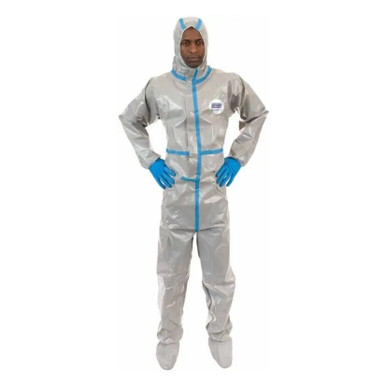 Enviroguard 7319GT ChemSplash 2 Disposable Chemical Splash Coverall, Hood and Boots, Elastic Wrist, Thumb Loops, Taped SeamsRespirator hood and boots, taped seams, storm flap with pressure-sensitive tape; sell sheet publishes ASTM F903 and F739 data.
Why can’t the four fabrics be ranked from their sheets? Because the sheets do not run the same tests. International Enviroguard tests ChemSplash 1 to the European penetration method, ISO 6530, and reports classes; it tests ChemSplash 2 to the American pair, ASTM F903 penetration and ASTM F739 permeation, and reports pass/fail and minutes; DuPont reports F739 minutes for Tychem, but at a different detection threshold from the one Enviroguard uses. A permeation minute, a penetration pass and a repellency class are three different measurements of three different things, and the hazard assessment under 29 CFR 1910.132(d) has to compare like with like. This page lines up only what was measured the same way, and says where the comparison stops.
What does each sheet actually publish?
The four fabrics, by the figures their manufacturers print.
How do ChemSplash 2, Tychem 2000 and Tychem 4000 compare on the same chemicals?
All three publish ASTM F739 permeation results, and the chemicals below appear on all three sheets. F739 clamps the fabric between a chemical and a detector and reports the time until the chemical comes through at a set rate. The rate matters: ASTM’s own summary says the method’s standardized breakthrough is the time the permeation rate reaches 0.1 µg/cm²/min, and that a normalized breakthrough at 1.0 µg/cm²/min may also be reported. DuPont’s table is at 0.1 (its legend reads “BT0.1 Normalized breakthrough time at 0.1 µg/cm²/min”); Enviroguard’s ChemSplash 2 table says “Using BT criteria of 1.0 µg/cm²/min.” The stricter 0.1 point is reached sooner, so a Tychem minute is earned against a tighter test than a ChemSplash 2 minute, and the columns are shown side by side only to read the pattern, not to rank the numbers.
| Chemical | ChemSplash 2, min at 1.0 µg/cm²/min | Tychem 2000, min at 0.1 µg/cm²/min | Tychem 4000, min at 0.1 µg/cm²/min |
|---|---|---|---|
| Sodium hydroxide 50% | >480 | >480 | >480 |
| Sulfuric acid (98% / >95%) | >480 | >480 | >480 |
| Methanol | >480 | imm | >480 |
| n-Hexane | >480 | imm | imm |
| Dimethylformamide (N,N-) | >120 / 109 | imm | 90 |
| Nitrobenzene | 98 | imm | 59 |
| Acetonitrile | 32 | imm | 60 |
| Tetrachloroethylene | 30 | imm | imm |
| Acetone | 21 | imm | 13 |
| Diethylamine | 18 | imm | 15 |
| Ethyl acetate | 18 | imm | imm |
| Toluene | 4 | imm | imm |
| Tetrahydrofuran | IMMEDIATE | imm | imm |
| Dichloromethane | IMMEDIATE | imm | imm |
| Carbon disulfide | IMMEDIATE | imm | imm |
| Ammonia, gas | >480 | imm | 26 |
| Chlorine, gas | >480 | imm | >480 |
| 1,3-Butadiene, gas | 160 | imm | >480 |
| Hydrogen chloride, gas | 20 | imm | >480 |
| Methyl chloride, gas | 320 / >480 | imm | >480 |
| Ethylene oxide, gas | >480 | imm | imm |
Read down the table and the three fabrics sort themselves. Against 50% caustic and concentrated sulfuric acid, none of them breaks through in eight hours. Against the fast solvents at the bottom, dichloromethane, tetrahydrofuran, carbon disulfide, toluene, all three fail inside ten minutes. The middle of the table is where the sheets differ: Tychem 2000 is immediate on every solvent and gas on this list, and DuPont’s own count, more than 40 chemicals at 30 minutes or better, is the smallest of the three; Tychem 4000 and ChemSplash 2 each hold some of the solvents and gases and lose others, and not the same ones. For a specific chemical the only safe reading is the row for that chemical, on the manufacturer’s current sheet, at the manufacturer’s stated threshold, against the length of the task.
The same three tables; DuPont Tychem 2000 product page (“at least 30 minutes of protection against >40 chemical challenges”) and Tychem 4000 product page (more than 124).Where does ChemSplash 1 fit?
Nowhere on that table, because its sheet does not run F739. ChemSplash 1 is tested to ISO 6530 / EN 368, the European liquid penetration test, whose full title on the ChemSplash 2 sheet is Protective clothing, Protection against liquid chemicals, Test method for resistance of materials to penetration by liquids: a measured volume of liquid is applied at a set flow rate and the result is reported as penetration, repellency and absorption indices, which the ChemSplash 1 sheet reports as classes. The sheet prints penetration Class 3 on all nine liquids tested, n-heptane, dichloromethane, toluene, isopropanol, 50% sodium hydroxide, 36 to 37% hydrochloric acid, 48 to 50% hydrofluoric acid, JP-8 jet fuel and 96% sulfuric acid, with repellency Class 3 for the acids and caustic, Class 2 for isopropanol and JP-8, and Class 1 for heptane, dichloromethane and toluene; the catalog adds an EN 374-3 chemical penetration pass. A penetration class says the liquid did not run through the fabric in the test; it says nothing about how long the chemical takes to permeate through intact fabric, which is what the Tychem numbers measure, and the Tychem pages do not print an ISO 6530 result. The manufacturer’s own positioning is the honest one: ChemSplash 1 is the breathable splash suit (MVTR over 3,000 g/m²/24 h, hydrostatic head 226 cm) for manufacturing, emergency response and environmental cleanup where the threat is splash, and ChemSplash 2 is the step up for aggressive chemicals, acids and caustics with the F903 and F739 data to show it.
International Enviroguard ChemSplash 1 sell sheet (agent testing, physical properties, applications) and Industrial Catalog (EN 374-3); ChemSplash 2 sell sheet; DuPont Tychem 2000 and 4000 product pages (no ISO 6530 result printed).Does a penetration pass mean the chemical will not get through?
No. ASTM F903 holds the liquid against the outside of the fabric under pressure for a set time and reports whether liquid was seen on the other side; ASTM’s summary of the method says plainly that in some cases significant amounts of hazardous materials will permeate specimens that pass the penetration tests, and points to F739 for permeation. ChemSplash 2’s catalog table shows it in one row: toluene is an F903 pass and a 4-minute F739 breakthrough.
ASTM F903-18 scope, 1.1 and 1.3, as summarized by ASTM; International Enviroguard Industrial Catalog, ChemSplash 2 agent testing.What about seams, zippers and the storm flap?
All the figures above are fabric swatches. DuPont states that in many cases seams and closures have shorter breakthrough times and higher permeation rates than the fabric, and carries a specific warning that serged and bound seams are degraded by some hazardous liquid chemicals, such as strong acids, and should not be worn when those chemicals are present; the QC127B and SL127B coveralls listed here have bound seams. Enviroguard’s answer on the ChemSplash side is tape: every ChemSplash 2 style is taped, with a storm flap over the zipper sealed by pressure-sensitive tape, and ChemSplash 1 comes in a taped YT version with a red stripe to tell it from the serged YS. For a liquid that runs, the seam and the zipper are the path, and the hazard assessment should ask the manufacturer for seam data rather than assume the fabric number.
DuPont Tychem 2000 and Tychem 4000 product pages, permeation data disclaimer and special warning on serged and bound seams; International Enviroguard ChemSplash 1 and ChemSplash 2 sell sheets (seams, storm flap); ViroGuard 2 sell sheet (fabric and seam results).What do the physical numbers say?
Only the tests both manufacturers ran line up. Basis weight is ASTM D3776 on all three sheets that print it: Tychem 2000 2.5 oz/yd², ChemSplash 2 2.9, Tychem 4000 3.6, and ChemSplash 1 prints none. Burst is not the same test: DuPont prints Mullen burst (ASTM D3786) in psi, 68 and 71, while Enviroguard prints ball burst (ASTM D751) in pounds, 52, and those cannot be converted into each other. Grab tensile is ASTM D5034 on both: Tychem 2000 39 and 43 lbf, Tychem 4000 44 and 48 lbf, ChemSplash 2 51.2 and 36.2 lb, machine and cross direction; ChemSplash 1 prints an ISO 13934-1 strip tensile in newtons instead. Flammability: DuPont prints 16 CFR 1610 Class 1 for both grades, a wearing-apparel classification and not a flame-resistance rating; the ChemSplash 1 catalog prints an EN 1146 pass and neither ChemSplash sheet claims FR.
DuPont Tychem 2000 QC127B YL and Tychem 4000 SL127B WH garment technical data sheets (typical fabric values); International Enviroguard ChemSplash 1 and ChemSplash 2 sell sheets and Industrial Catalog, physical properties as printed.Questions people ask
Is ChemSplash 2 equivalent to Tychem 4000?
The manufacturers do not say so, and the sheets cannot prove it: both publish ASTM F739 breakthrough times, but ChemSplash 2 normalizes at 1.0 µg/cm²/min and DuPont at 0.1 µg/cm²/min. On the shared chemicals both hold 50% sodium hydroxide and concentrated sulfuric acid over 480 minutes and both fail dichloromethane, THF, toluene and carbon disulfide immediately; the middle rows differ.
Is ChemSplash 1 equivalent to Tychem 2000?
There is no shared test to say. ChemSplash 1 publishes ISO 6530 / EN 368 penetration and repellency classes and no F739 data; Tychem 2000 publishes F739 breakthrough times and no ISO 6530 result. Both are splash garments with a storm flap option, and that is as far as the data goes.
What does normalized breakthrough time mean?
The minutes until the chemical permeates the fabric at a set rate in ASTM F739. ASTM’s standardized point is 0.1 µg/cm²/min, which DuPont uses; the method also allows a normalized time at 1.0 µg/cm²/min, which Enviroguard’s ChemSplash 2 sheet uses. The lower rate is reached sooner.
Which suit is good for sulfuric acid?
On the sheets, ChemSplash 2 (98%), Tychem 2000 and Tychem 4000 (over 95%) all print more than 480 minutes under F739, and ChemSplash 1 prints Class 3 penetration and repellency under ISO 6530 at 96%. DuPont warns that serged and bound seams are degraded by strong acids; the hazard assessment decides the suit and the seam.
What is Tychem 2000 made of?
DuPont states it is Tyvek protective fabric coated with 1.25 mils of polyethylene, 10 mil thick, 2.5 oz/yd². Tychem 4000 is Tyvek laminated with Dow Saranex 23-P film, 12 mil, 3.6 oz/yd².
Are ChemSplash or Tychem suits flame resistant?
No. DuPont prints 16 CFR 1610 Class 1, a wearing-apparel flammability class, not an FR rating; the ChemSplash sheets claim no FR. Enviroguard’s FR chemical splash fabric is PyroGuard CRFR.
Do the breakthrough times apply to the seams?
No. DuPont states the data reflect fabric, and that seams and closures in many cases have shorter breakthrough times and higher permeation rates. ChemSplash 2 is taped at every seam with a sealed storm flap; ask the manufacturer for seam data on a liquid that runs.
The ratings, test results and standards shown here are the manufacturers' published values, reproduced as published. Nothing on this page is a recommendation by Bayshore Safety that any product is suitable for a particular task, hazard or workplace. Selecting safety products and protective equipment is the responsibility of the end user and the employer, based on their own hazard assessment and the regulations that apply to their work. Confirm every value on the manufacturer's own documentation before use.