
Permeation versus penetration: how to read a chemical resistance table
Penetration is liquid getting through the fabric as a liquid: through pores, pinholes, seams or stitch holes. ASTM F903 tests it by holding the chemical against the fabric under pressure and watching for it on the other side; the result is pass or fail, or the minutes until it was seen. Permeation is the chemical passing through the material at the molecular level, with no visible leak; ASTM F739 tests it in a cell with a detector on the clean side and reports a breakthrough time in minutes and a permeation rate in micrograms per square centimeter per minute. A fabric can pass penetration and still permeate in minutes: on International Enviroguard’s ChemSplash 2 table, toluene is an F903 pass with a 4-minute F739 breakthrough, while sodium hydroxide 50% is a pass with no breakthrough in 480 minutes. ISO 6530 is the European penetration test, reported as penetration and repellency indices or classes, so read the chemical, the test and the number, in that order.
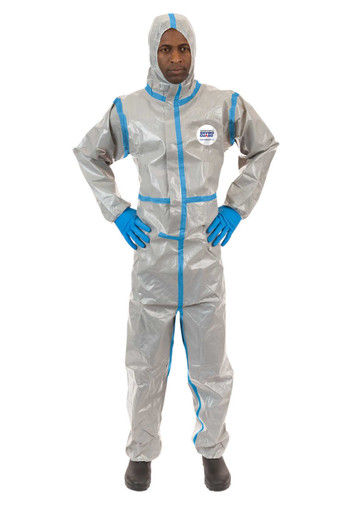 Enviroguard 7315GT ChemSplash 2 Disposable Chemical Splash Coverall with Hood, Elastic Wrist and Ankle, Thumb Loops, Taped SeamsTaped seams, attached hood. Sell sheet publishes ASTM F903 penetration on nineteen ASTM F1001 chemicals and ASTM F739 breakthrough times.
Why does the distinction matter? Because the two words describe two different failures, and a sell sheet can show a pass on one while the other is failing in minutes. A penetration pass tells you the liquid did not come through as a liquid during the test. It does not tell you the chemical did not travel through the material molecule by molecule, invisibly, and that is what a permeation breakthrough time measures. ASTM’s own summary of the penetration method says as much: materials that pass a penetration test can still be permeated by significant amounts of hazardous chemicals. The manufacturer’s seam guide adds the third route, which no fabric test covers: holes in the suit, gaps between the suit and other PPE, and the needle holes of a stitched seam.
ASTM F903-18 scope, as summarized by ASTM; International Enviroguard Seam Safety Guide, how seam construction impacts safety.What does each test measure?
The four methods that appear on the sell sheets, in plain words.
How do you read a table that shows both?
International Enviroguard’s industrial catalog prints a ChemSplash 2 table with a penetration column and two permeation columns for the same chemicals. Ten rows, verbatim:
| Chemical (ASTM F1001) | Penetration, ASTM F903 | Permeation, normalized breakthrough, minutes, ASTM F739 | Permeation rate, µg/cm²/min |
|---|---|---|---|
| Acetone | PASS | 21 | 1.1 |
| Carbon disulfide | PASS | IMMEDIATE | 50 |
| Dichloromethane | PASS | IMMEDIATE | >50 |
| Methanol | PASS | >480 | ND |
| N-hexane | PASS | >480 | ND |
| Nitrobenzene | PASS | 98 | 4.2 |
| Sodium hydroxide (50%) | PASS | >480 | ND |
| Sulfuric acid (98%) | PASS | >480 | ND |
| Tetrahydrofuran | PASS | IMMEDIATE | >50 |
| Toluene | PASS | 4 | 43 |
Every row passes penetration, so the penetration column alone would make the fabric look the same for all ten. The permeation columns separate them. Methanol, hexane, sodium hydroxide 50% and sulfuric acid 98% show no breakthrough in 480 minutes and no detectable rate, which is as good as the test reports. Acetone breaks through at 21 minutes, nitrobenzene at 98, toluene at 4. Carbon disulfide, dichloromethane and tetrahydrofuran are printed as immediate, with rates of 50 micrograms per square centimeter per minute and more. For a job with toluene, the number that matters is 4 minutes, and the penetration pass is beside the point.
Same table; ASTM F739-20 significance statement (longer breakthrough and lower rate indicate a better barrier), as summarized by ASTM.What does a breakthrough time mean?
ASTM F739 reports more than one. Breakthrough detection time is when the detector first sees the chemical. Standardized breakthrough time is when the permeation rate reaches 0.1 µg/cm²/min; ASTM’s summary notes that reporting a standardized breakthrough beyond the test period means the chemical did not exceed that rate during the period, though it may have permeated at a lower one. Normalized breakthrough, at 1.0 µg/cm²/min, is the older figure and the one on the Enviroguard sheets, which say so in the heading. The sheets also report the test as 480 minutes long, so a figure of more than 480 means no breakthrough in eight hours, not never. A breakthrough time is a fabric-swatch figure at the test temperature with continuous contact; a warm chemical, a mixture, or a seam is not in the number.
ASTM F739-20 scope and section 5, as summarized by ASTM; International Enviroguard ChemSplash 2 sell sheet (ASTM F739-12, BT criteria of 1.0 µg/cm²/min).What does a penetration time mean?
The PyroGuard CRFR sheet reports penetration as time to penetrate in minutes rather than pass or fail, next to an F739 breakthrough for the same chemical, which makes the gap between the two tests easy to see. Hexane: more than 60 minutes to penetrate, more than 480 minutes breakthrough. Sodium hydroxide 40%: more than 60 and more than 480. Toluene: more than 60 minutes to penetrate, 6 minutes breakthrough. Acetone: more than 60 and 12. Styrene: more than 60 and under 1. Sulfuric acid 96%: 45 minutes to penetrate, 38 minutes breakthrough. Dichloromethane: 2 minutes to penetrate, and the breakthrough column reads IMB, an abbreviation the sheet prints without spelling out, as it prints NT for chemicals with no breakthrough figure. A penetration time of more than 60 minutes with a breakthrough of 6 is the pattern to watch for: the liquid stayed out, the molecules did not.
International Enviroguard PyroGuard CRFR sell sheet, testing table (ASTM F903 time to penetrate; ASTM F739 normalized breakthrough), as printed.What is an ISO 6530 class?
ISO 6530 is the European penetration method. A measured volume of liquid is run down an inclined fabric specimen and the method yields three indices: how much penetrated, how much was absorbed, how much ran off. The ChemSplash 2 sheet prints the raw indices for two liquids: n-heptane 99%, penetration 0.0 percent, repellency 95.2 and 96.2 percent, absorption 4.8 and 3.8 percent (length and width); isopropanol 99.5%, penetration 0.0 percent, repellency 95.6 and 95.4 percent. The ChemSplash 1 sheet reports the same test, labeled ISO 6530 / EN 368, as classes: penetration Class 3 for all nine chemicals, and repellency Class 3 for sodium hydroxide 50%, hydrochloric, hydrofluoric and sulfuric acids, Class 2 for isopropanol and JP8 jet fuel, Class 1 for n-heptane, dichloromethane and toluene. A class is a band for the index, with 3 the best on these sheets. It is a penetration result for a low-volatility liquid running off a slope; it is not a breakthrough time, and an ISO 6530 Class 3 cannot be compared to an ASTM F739 minute figure.
ISO 6530:2005 scope, as published by ISO; International Enviroguard ChemSplash 2 sell sheet (ISO 6530:2005 table) and ChemSplash 1 sell sheet (agent testing).How do you use the table on a job?
- Find the chemical by name and concentration. Sulfuric acid 96% and 98% are different rows; a chemical that is not on the table has not been tested against that fabric.
- Check which test the column is. Penetration (F903, ISO 6530) tells you whether liquid came through; permeation (F739) tells you how long before the molecules did.
- Match the breakthrough time to the task with margin. The employer’s selection has to be based on the performance characteristics of the PPE relative to the task and its duration, and a 21-minute breakthrough does not cover a two-hour transfer.
- Check the seams. The manufacturer’s seam guide says the most likely route of contamination is not permeation through the fabric but penetration through holes, gaps and seams; serged seams are not liquid-tight, taped seams are.
- Treat a blood pass as a blood pass. F1670 and F1671 are penetration tests for synthetic blood and a virus surrogate; they say nothing about solvents.
Questions people ask
What is the difference between permeation and penetration?
Penetration is liquid passing through a fabric, seam or closure as a liquid, tested by ASTM F903 or ISO 6530 and reported as pass/fail, minutes or a class. Permeation is the chemical passing through the material at the molecular level, tested by ASTM F739 and reported as a breakthrough time and rate.
What is breakthrough time?
The time in ASTM F739 until the chemical is detected on the clean side of the swatch at a set rate: 0.1 µg/cm²/min for the standardized figure, 1.0 µg/cm²/min for the normalized figure the Enviroguard sheets use. Longer is better; more than 480 means none in the eight-hour test.
Can a suit pass F903 and still fail against a chemical?
Yes. ASTM notes that significant amounts of hazardous chemicals can permeate specimens that pass the penetration test; on the ChemSplash 2 table toluene is an F903 pass with a 4-minute F739 breakthrough.
What does ASTM F1001 mean on a sell sheet?
It is the standard guide that recommends a list of liquid and gaseous chemicals for evaluating protective clothing materials. A sheet headed ASTM F1001 is naming the chemical list, not a test result.
What is ISO 6530?
The European test for resistance of protective clothing materials to penetration by liquids, mainly chemicals of low volatility, giving indices of penetration, absorption and repellency; the ChemSplash 1 sheet reports it as classes 1 to 3.
Does the chemical table cover the seams?
Only if it says so. Fabric tests are run on swatches; International Enviroguard’s seam guide says holes, gaps and stitched seams are the most likely route in, which is why ChemSplash 2, PyroGuard CRFR and ViroGuard 2 have taped seams.
The ratings, test results and standards shown here are the manufacturers' published values, reproduced as published. Nothing on this page is a recommendation by Bayshore Safety that any product is suitable for a particular task, hazard or workplace. Selecting safety products and protective equipment is the responsibility of the end user and the employer, based on their own hazard assessment and the regulations that apply to their work. Confirm every value on the manufacturer's own documentation before use.