
Type 3, 4, 5 and 6 protective clothing explained, and what a US buyer should take from them
The types are European garment classes for chemical protective clothing. Type 3 is clothing with liquid-tight connections and Type 4 clothing with spray-tight connections, both under EN 14605; Type 5 is clothing resistant to penetration by airborne solid particles under EN ISO 13982-1; Type 6 is limited-performance clothing for a light spray, liquid aerosols or low-pressure, low-volume splashes under EN 13034. A whole garment is tested, not just the fabric: Type 5 and 6 suits go into a dust or spray cabin on a person, and Types 1 to 4 must have sealed seams. OSHA does not use the types. A US employer still has to do the hazard assessment under 29 CFR 1910.132(d) and select PPE that protects against the hazards it identifies; a Type 5/6 mark on a sell sheet is evidence the employer can weigh, not a rule it can rely on.
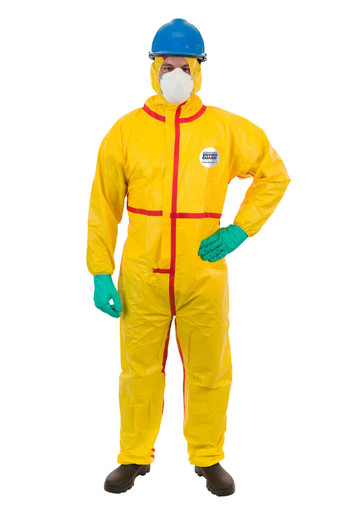 Enviroguard 7015YT ChemSplash 1 Disposable Chemical Splash Coverall with Hood, Elastic Wrist and Ankle, Taped SeamsTaped seams, attached hood. The sell sheet labels ChemSplash 1 Category III, Type 5 (BS EN ISO 13982-1:2004) and Type 6 (BS EN 13034:2005).
Why do the types show up on American sell sheets? Because the same coveralls are sold in Europe, where a chemical protective garment has to be certified to one of these types before it can carry the CE mark. The type is a shorthand for a whole-garment test: a person wears the suit in a cabin and is sprayed or dusted, and the suit passes or fails on what gets inside. That is a different kind of evidence from a fabric test, and it is useful to a US buyer for exactly that reason, as long as the buyer knows that OSHA never asks for it and that the hazard assessment still has to be done.
International Enviroguard Seam Safety Guide, CE standards Types 3 to 6 and seam testing; 29 CFR 1910.132(d)(1).What does each type mean?
In the words of the standards’ own scopes, from the wettest to the driest.
What should a US buyer take from a Type 5 or 6 mark?
Three things. First, that the whole garment, with its seams, zipper and hood, was put in a cabin on a person and did not let in more than the standard allows; a fabric result such as ASTM F2299 or F903 says nothing about the seams. Second, that the test conditions matter: Kimberly-Clark’s European A20 sheet states its Type 5 and 6 results were obtained with the wrists, ankles and hood taped, and reports an average total inward leakage of 4.41 percent, so a buyer who does not tape the suit is not getting the tested garment. Third, that the mark is European. OSHA’s PPE rule requires the employer to assess the workplace, select PPE that will protect the affected employee from the hazards identified, select PPE that fits, and certify the assessment in writing. It never mentions the types, and no type substitutes for that assessment.
International Enviroguard Seam Safety Guide, seam resistance testing; Kimberly-Clark KleenGuard A20 product information sheet (97100 series); 29 CFR 1910.132(d)(1), (d)(1)(i), (d)(1)(iii) and (d)(2).What is the difference between Type 3 and Type 4?
How hard the liquid hits. EN 14605 covers both in one document: Type 3 clothing has liquid-tight connections between its parts and Type 4 has spray-tight connections. The manufacturer’s guide puts it as liquid chemical jet sprays for Type 3 and liquid chemical sprays for Type 4. In both, the seams are the point. The guide states that for finished garments of Types 1 to 4, any seam that is not sealed results in a fail, and that the standards require permeation testing on a seam for at least one chemical with a result of at least Class 1. That is why a Type 3 or 4 garment has taped or welded seams and a Type 5 or 6 garment usually has serged ones.
EN 14605:2005 scope; International Enviroguard Seam Safety Guide, CE standards and seam testing.What is the difference between Type 5 and Type 6?
Dust versus a light splash. ISO 13982-1 is written only for airborne solid particulates and says so: it does not apply to other forms of challenge by solid chemicals, such as dust penetrating a material by rubbing or flexing. EN 13034 is written for a potential exposure to a light spray, liquid aerosols or low-pressure, low-volume splashes, where a complete liquid permeation barrier is not required. A suit is often certified to both, which is what the ChemSplash 1 sheet shows: Type 5 to BS EN ISO 13982-1:2004 described as dry particle suits for protection against hazardous dusts, and Type 6 to BS EN 13034:2005 described as reduced spray suits for light spray and splashes where there is no directional spray or build-up of liquid on the suit. The manufacturer’s seam guide adds that there is no specific seam test for Type 5 and 6; the whole-garment cabin test is the check, and seams that open under stress fail it.
ISO 13982-1:2004 abstract; EN 13034:2005+A1:2009 scope; International Enviroguard ChemSplash 1 sell sheet (standards) and Seam Safety Guide.Does OSHA recognize Type 5 and 6?
No. The US rules for protective clothing are performance rules on the employer, not garment classes. 1910.132(a) requires protective clothing wherever it is necessary by reason of hazards of processes or environment, chemical hazards, radiological hazards or mechanical irritants capable of causing injury through absorption, inhalation or physical contact. 1910.132(d) requires the hazard assessment and the selection. The hazardous waste standard uses its own Levels A to D, which name a respirator and a clothing layer, not a type. So a US buyer uses the type the way a buyer uses any other test result: as data about the garment that the hazard assessment compares with the hazard.
29 CFR 1910.132(a) and (d); 29 CFR 1910.120 Appendix B.Which of our coveralls carry a type?
International Enviroguard labels ChemSplash 1 Category III, Type 5 and Type 6 on its sell sheet, in both the serged YS and taped YT styles; it also states the garments meet EN 1149-5 for electrostatic properties. Its seam guide describes serged and bound seams as suitable for Types 5 and 6 and stitched-and-taped seams as the construction used for Types 3 and 4, but the sheets for ChemSplash 2, PyroGuard CRFR and ViroGuard 2, which all have taped seams, publish US test data rather than a European type. MicroGuard MP, SMS and polypropylene carry no type on their sheets. Kimberly-Clark types its European A20 (Type 5 and 6, taped at the openings) but not the US product page for the A20 coveralls we sell. Where a type matters to a buyer, the sell sheet is the only place it counts.
International Enviroguard ChemSplash 1 sell sheet and Seam Safety Guide; ChemSplash 2, PyroGuard CRFR and ViroGuard 2 sell sheets; Kimberly-Clark KleenGuard A20 product information sheet and US product page.Questions people ask
What is Type 5 and Type 6 protective clothing?
Type 5 is chemical protective clothing resistant to penetration by airborne solid particles under ISO 13982-1; Type 6 is limited-performance clothing for a light spray, liquid aerosols or low-pressure, low-volume splashes under EN 13034. Both are European whole-garment classes.
What is the difference between Type 3 and Type 4?
Both come from EN 14605. Type 3 clothing has liquid-tight connections between its parts and Type 4 has spray-tight connections; the manufacturer’s guide describes the challenges as a liquid jet and a liquid spray, and both need sealed seams.
Does OSHA require Type 5/6 coveralls?
No. OSHA does not use the European types; 29 CFR 1910.132(d) requires the employer to assess the hazards and select PPE that protects against them, and the type mark is data the assessment can use.
Is a Tyvek suit Type 5?
The type belongs to a specific certified garment, not a fabric. Read the sell sheet of the exact style; International Enviroguard labels ChemSplash 1 Type 5 and 6, and DuPont labels its garments on their own product pages.
Do Type 5/6 suits have to be taped at the wrists?
Only if they were tested that way. Kimberly-Clark’s European A20 sheet states its Type 5 and 6 results were obtained with taping at the wrists, ankles and hood, which is the condition the mark describes.
Can a serged seam coverall be Type 5?
Yes. The manufacturer’s seam guide describes serged and bound seams as suitable for Types 5 and 6, and sealed (taped or welded) seams as required for Types 1 to 4.
The ratings, test results and standards shown here are the manufacturers' published values, reproduced as published. Nothing on this page is a recommendation by Bayshore Safety that any product is suitable for a particular task, hazard or workplace. Selecting safety products and protective equipment is the responsibility of the end user and the employer, based on their own hazard assessment and the regulations that apply to their work. Confirm every value on the manufacturer's own documentation before use.