
Mold remediation PPE: what EPA and OSHA say about coveralls, and the garment data
EPA’s Mold Remediation in Schools and Commercial Buildings guide recommends disposable clothing during a medium or large remediation project to prevent the transfer and spread of mold to clothing and to eliminate skin contact with mold. It sets two clothing levels: Limited, where disposable paper overalls can be used, and Full, where mold-impervious disposable head and foot coverings and a body suit made of a breathable material such as Tyvek should be used, with all gaps around ankles and wrists sealed, which many remediators do with duct tape. EPA’s Table 2 ties the PPE level to the area affected: Minimum under 10 square feet, Limited or Full between 10 and 100, Full over 100 or where exposure is expected to be significant, always with professional judgment. OSHA’s SHIB 03-10-10 says the same in its Level IV procedure for contamination over 100 contiguous square feet: disposable protective clothing covering the entire body including both head and shoes, with gloves and full-facepiece HEPA respirators, and that disposable PPE is discarded after use into impermeable bags. Neither agency names a fabric. International Enviroguard lists mold remediation as an SMS application and publishes an ASTM F2299 particle result for MicroGuard MP; a hooded style with attached boots, or separate hoods and shoe covers, is how the head and foot coverings the agencies describe get covered.
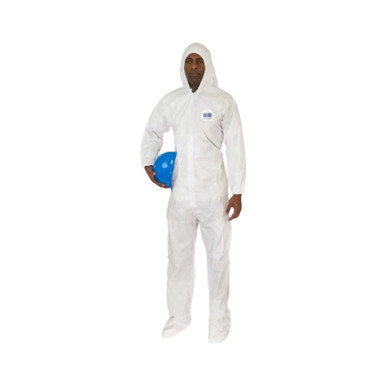 Enviroguard 8019 MicroGuard MP Disposable Microporous Coverall with Hood and Boot, Elastic Wrist, Open AnkleMicroporous film laminate with attached hood and boots, elastic wrists. ASTM F2299 dry and wet particle result: No Particle Penetration. Manufacturer describes the laminate as breathable.
Why do the agencies care about the coverall on a mold job? EPA says the primary function of PPE on a remediation is to avoid inhaling mold and mold spores and to avoid mold contact with the skin or eyes, and lists the actions that stir spores up: breaking up moldy wallboard, invasive work in a wall cavity, stripping wallpaper, and using fans to dry things. OSHA adds the second reason: protective clothing minimizes cross-contamination between work areas and clean areas and prevents the transfer and spread of mold and other contaminants to street clothing. A suit that goes into the bag at the containment door is what stops the spores riding home.
EPA mold remediation guide, Chapter 3, Personal Protective Equipment; OSHA SHIB 03-10-10, Protective Clothing.What do the EPA and OSHA levels look like?
EPA sizes the job by area in Table 2; OSHA’s SHIB sizes it in four levels. The clothing lines from each.
What coverall does EPA recommend for mold remediation?
EPA does not name a product. Its Full level asks for three things: a body suit of a breathable material, with Tyvek given as the example; mold-impervious disposable head and foot coverings; and sealed gaps at the wrists and ankles. Its Limited level says disposable paper overalls can be used. EPA says the level is based on the total surface area contaminated and the potential for remediator and occupant exposure, and that the remediation manager should use professional judgment, raise the PPE level if more contamination turns up than expected, and treat the whole thing as guidelines. The guide has a residential focus but states it applies to other building types.
EPA mold remediation guide, Chapter 3, Disposable Protective Clothing; Table 2 and its footnotes.Read against the garment data, the three EPA items map to the features on a coverall sell sheet: a hood and attached boots or separate hood and shoe covers for the head and foot coverings, elastic wrists and ankles under the tape for the gaps, and a fabric the manufacturer describes as breathable with a published particle result for the body suit.
EPA mold remediation guide, Chapter 3; International Enviroguard garment lists.What does OSHA say about mold coveralls?
OSHA has no mold standard; its SHIB 03-10-10 is guidance, and it points to the standards that do apply: training under the Hazard Communication standard, 1910.1200, and respirators under 1910.134, with training, medical clearance and fit testing before anyone wears one. For clothing, the SHIB says appropriate personal protective clothing, reusable or disposable, is recommended to minimize cross-contamination, prevent transfer of mold to street clothing and eliminate skin contact with mold and potential chemical exposures. Its Level IV procedure is the only place it specifies coverage: disposable protective clothing covering the entire body including both head and shoes. It also says more protective respirators may be needed if asbestos or lead are encountered, and that biocide applicators select protection from the product manufacturer’s warnings.
OSHA SHIB 03-10-10, Levels I through IV, Respiratory Protection and Protective Clothing.Behind the guidance sits the general PPE rule: the employer assesses the workplace for hazards that require PPE, selects what protects against them, fits it and trains on it, and pays for it. Mold on a remediation job is a hazard of the process, and the assessment is where the clothing choice is written down.
29 CFR 1910.132(a), (d)(1), (f) and (h)(1); 1926.95(a) in construction.Which fabrics does the manufacturer list for mold?
SMS is the one International Enviroguard names: its catalog lists asbestos and lead abatement, mold remediation, manufacturing and assembly operations, and its brand page lists asbestos and mold removal, mold remediation and general cleanup work. The SMS sheet describes three layers, spunbond polypropylene over meltblown polypropylene over spunbond polypropylene, as an excellent dust, particulate and liquid barrier for light splashes and sprays, breathable so heat and moisture vapor escape, with a Helmke drum result of Category 1 by IEST-RP-CC003.4. MicroGuard MP is not listed by name for mold, but its sheet publishes the particle result: dry particle filtration efficiency and wet particle filtration efficiency by ASTM F2299, both No Particle Penetration, with air permeability under 0.55 cfm by ASTM D737 and the manufacturer’s statement that the laminate lets heat and moisture vapor escape. Polypropylene is described as an excellent dust and particulate barrier for non-hazardous environments.
International Enviroguard SMS sell sheet and Industrial Catalog (applications, fabric description, Helmke drum); MicroGuard MP sell sheet (physical properties table); Polypropylene sell sheet.One honest note on the test: ASTM’s scope for F2299 says it is a method for measuring the initial particle filtration efficiency of materials used in medical face masks, using monodispersed aerosols in the 0.1 to 5.0 micron range. It is a fabric filtration test, not a whole-garment test, and the result on the sheet is the manufacturer’s.
ASTM F2299/F2299M scope, paragraph 1.1.Hood and boots attached, or separate?
Both cover what the agencies describe. Attached: 8019 (MicroGuard MP), 2229 and 2229B (SMS), 2019 and 2029 (polypropylene) have hood and boots on the suit, so there is no seam to tape at the ankle. Separate: 8015 and 2225 have a hood and elastic ankles, worn with shoe covers such as the 8103 non-skid microporous cover, the 2001 SMS cover or the V3100 anti-skid polypropylene cover, and the 8002 microporous full-face hood or the NH2000 polypropylene head and face cover add a second layer over the hood when a half-mask respirator leaves the face open. The 8103 and V3100 have non-skid soles per the manufacturer; EPA’s containment tips assume the work is inside polyethylene sheeting under negative pressure, and OSHA’s SHIB recommends misting surfaces before remediation, so floors get wet.
International Enviroguard MicroGuard MP, SMS and Polypropylene garment lists; EPA mold remediation guide, Containment Tips; OSHA SHIB 03-10-10, Levels I through III (dust suppression by misting).What about the respirator and the gloves?
EPA’s minimum is an N-95, with a half-face or full-face HEPA respirator at Limited and a full-face PAPR at Full, all under a complete respiratory protection program as OSHA requires. Gloves go to mid-forearm, and the glove material follows the cleaner: ordinary household rubber for mild detergent or plain water, and natural rubber, neoprene, nitrile, polyurethane or PVC for bleach or a strong cleaning solution. EPA also says not to use fungicides made for outdoor use indoors, and never to mix bleach with ammonia cleaners. The coverall sleeve goes under the glove cuff, taped, so the seal the Full level asks for is at the wrist, not at the elbow.
EPA mold remediation guide, Chapter 3, Respiratory Protection, Skin and Eye Protection and Mold Remediation/Cleanup and Biocides; OSHA SHIB 03-10-10, Respiratory Protection (29 CFR 1910.134).Questions people ask
Does OSHA require Tyvek suits for mold remediation?
OSHA has no mold standard. Its SHIB 03-10-10 recommends disposable protective clothing covering the entire body including head and shoes at Level IV (over 100 contiguous square feet) and names no fabric; the general PPE rule, 29 CFR 1910.132, governs the employer’s choice.
What PPE does EPA recommend for mold?
Gloves and eye protection always; an N-95 at Minimum; a HEPA air-purifying respirator and disposable paper overalls at Limited; a full-face PAPR, mold-impervious disposable head and foot coverings and a breathable body suit such as Tyvek with sealed gaps at Full (EPA mold remediation guide, Chapter 3).
How big a mold job needs full PPE?
EPA Table 2 lists Full PPE for areas over 100 square feet or where remediator or occupant exposure is expected to be significant, with professional judgment; OSHA’s Level IV starts at more than 100 contiguous square feet.
Can you reuse a mold remediation coverall?
OSHA’s SHIB says disposable PPE should be discarded after it is used, placed into impermeable bags; EPA’s Full level is built on disposable head, foot and body coverings.
Which disposable fabric does the manufacturer list for mold?
International Enviroguard lists mold remediation as an SMS application in its catalog and on its SMS brand page; MicroGuard MP publishes an ASTM F2299 particle result but is not named for mold.
Do I need shoe covers and a hood for mold?
EPA’s Full level calls for mold-impervious disposable head and foot coverings, and OSHA’s Level IV clothing covers head and shoes; attached hood and boots, or a hooded suit with separate hood and shoe covers, both cover it.
Is an N95 enough for mold?
EPA lists the N-95 as the Minimum level for small areas; Limited uses a half-face or full-face HEPA respirator and Full uses a full-face PAPR, all under an OSHA 1910.134 respiratory protection program.
The ratings, test results and standards shown here are the manufacturers' published values, reproduced as published. Nothing on this page is a recommendation by Bayshore Safety that any product is suitable for a particular task, hazard or workplace. Selecting safety products and protective equipment is the responsibility of the end user and the employer, based on their own hazard assessment and the regulations that apply to their work. Confirm every value on the manufacturer's own documentation before use.