
Bayshore Safety & Industrial Supplies Guide
CPR masks, CPR face shields and pocket masks: what a CPR mask is for, the one-way valve, where to get one, how to place it, whether it can be reused, what counts as a breathing barrier, what to do with no mask, and what a bag valve mask (Ambu bag) is
A CPR mask, CPR face shield or pocket mask is a breathing barrier: it sits between the rescuer’s mouth and the person’s mouth during rescue breaths so that saliva, blood and vomit do not pass either way, with a one-way valve that lets the rescuer’s breath in and nothing back. ANSI/ISEA Z308.1-2021 requires one breathing barrier in every Class A and Class B kit, and OSHA’s 1910.151 Appendix A names the PPE that 1910.1030 requires for anyone expected to give first aid where blood is possible. The face shield is a flat film with a valve that folds into a keychain; the pocket mask is a cupped mask with a cuff and a replaceable valve and filter, and First Aid Only describes its Laerdal pocket mask as having "a pre-inflated cuff for effective seal, an oxygen inlet version, replaceable disposable one-way valve and filter, latex-free". With no mask, the Red Cross teaches compression-only CPR. A bag valve mask (Ambu is a brand) is a self-inflating bag squeezed by a trained responder; it is an EMS and healthcare device, not a first aid kit item, and we do not sell one.
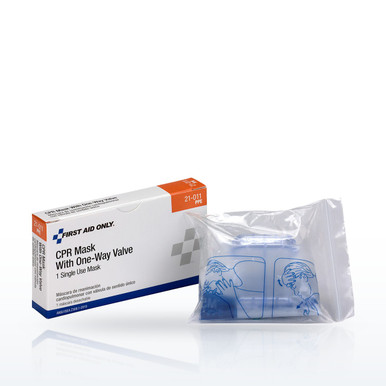 First Aid Only 21-011 CPR Mask, 1 per BoxFirst Aid Only prints a CPR mask with one-way valve for personal protection from potentially infectious body fluids, 1 per box
Why the valve is the product. Every CPR barrier is a sheet of plastic or silicone with a one-way valve in it; the differences are in the seal (a flat shield lies on the face, a pocket mask’s cuff seals around the nose and mouth), the filter, the oxygen inlet, and how it packs (a keychain, a case, a treatment pack). Nearly all of the questions in this cluster are about the barrier itself: what it is for, where to get one, how to place it, whether it can be reused and what to do without one, plus a run of questions about bag valve masks that belong to EMS training. This page answers the barrier questions with the Red Cross and the manufacturer’s statements, explains what a BVM is and why it is not in a first aid kit, and gives the Z308.1 and OSHA basis for the breathing barrier in the cabinet.
The three barriers, and what each does
Statements are First Aid Only’s; the use is the Red Cross’s.
The questions, one by one
What are CPR masks for, and what is a mouth-to-mouth resuscitation device?
For rescue breaths without mouth-to-mouth contact. The mask or shield lets the rescuer blow into the person’s mouth through a one-way valve that stops anything coming back; First Aid Only prints "prevents mouth to mouth contact during CPR" and "one way valve eliminates blow back to caregiver" on its EMT-grade mask. "Mouth-to-mouth resuscitation device" is the formal name for the same thing. Every one of them is a breathing barrier in the Z308.1 sense.
Where can you get a CPR mask?
From us, in every form: the single-use mask in a unit box (21-011), the EMT-grade mask with gloves and wipes in a watertight bag (21-700), the face shield keychains (M5092, J5095 by the 30), the Laerdal pocket mask in a case (363705), the SmartCompliance refill with four nitrile gloves (FAE-6100), and inside every Z308.1 kit and the CPR kits and stations in the band. Pharmacies and the Red Cross store sell them too. We sell nationwide.
How do you place a CPR mask or face shield?
Shield: unfold it, lay it over the face with the valve or filter patch over the mouth, hook the ear loops if it has them, pinch the nose through the film and breathe through the valve. Pocket mask: narrow end over the bridge of the nose, cuff pressed to the face with both hands or the thumb-and-fingers grip the mask instructions show, head tilted back, breathe through the valve and watch the chest rise. The Red Cross cardiac arrest page: if the first breath does not make the chest rise, re-tilt the head and check the seal before the second.
Can a CPR mask be reused?
A face shield and the unit-box mask are single use: the film has been in contact with the person’s mouth and the valve has been breathed through, and First Aid Only sells them as single-use items. A pocket mask is built to be reused: its one-way valve and filter are replaceable and the mask body is cleaned and disinfected as the manufacturer directs, which is why it comes in a hard case. A training mask is a separate product.
What can be used as a CPR breathing barrier if there is no mask?
Nothing improvised counts as a barrier: a cloth or handkerchief does not have a valve and is not a seal. The Red Cross answer is compression-only CPR, continuous chest compressions without breaths, until an AED or a barrier arrives; its cardiac arrest page says to give CPR "or compression only CPR based on level of training". A keychain shield on every supervisor’s keys is the way to have a barrier where the kit is not.
What is the golden rule of CPR, is it still 30 compressions to 2 breaths, and what are the 7 steps of CPR?
The golden rule courses teach is: start compressions at once and do not stop except for the AED, a change of rescuer or signs of life; the Red Cross cardiac arrest page puts it as "every second counts", keep going until the person shows an obvious sign of life, the scene becomes unsafe, an AED is ready, you are too exhausted, another trained responder takes over or EMS begins care, and change rescuers every 1 to 2 minutes with minimum interruption. The compression-to-breath ratio and the full CPR sequence are taught in the course and printed on the CPR card in every First Aid Only CPR kit; this page does not teach CPR, and the Red Cross pages we cite give the frame (check, call, care; CPR and AED immediately) rather than the counts.
What is compression-only CPR?
Chest compressions without rescue breaths, for a rescuer without a barrier, without training in breaths, or unwilling to give them. The Red Cross cardiac arrest and burns pages both name it as an option "based on level of training"; its FAQ adds that compressions "pump a small amount of blood around the body to keep the organs, most importantly the brain, alive" and that a heart usually restarts only with a shock from a defibrillator.
Is an Ambu bag a bag valve mask, and what does BVM stand for?
Yes. BVM is bag valve mask; Ambu is the Danish company whose name became the generic word for it (the company’s name is its own, not an abbreviation). A BVM is a self-inflating bag, a one-way valve and a face mask; a trained responder seals the mask and squeezes the bag to push air into the lungs, and an oxygen reservoir can be attached. It replaces mouth-to-mask breathing in EMS and healthcare, where two rescuers can hold the seal and squeeze the bag. It is not a first aid kit item and First Aid Only does not sell one; the pocket mask is the lay responder’s equivalent.
How do you use an Ambu bag, how often do you squeeze it, what is the flow rate, and what size mask fits an adult?
Those are healthcare-provider skills (BLS and EMS courses teach the rate, the volume, the oxygen flow, the two-rescuer technique and the mask sizes), and a first aid page should not give the numbers. What a safety buyer needs to know is that a BVM is used by trained personnel, that the common problems courses warn about are a poor mask seal and squeezing too hard or too fast, and that a workplace first aid kit carries a pocket mask or face shield instead.
How do you clean an Ambu bag or a pocket mask after use?
As the manufacturer directs: disposable BVMs are discarded after one patient; reusable BVMs and pocket masks are taken apart, the one-way valve and filter replaced or cleaned, the parts washed and disinfected and the unit reassembled and tested. First Aid Only prints "replaceable disposable one-way valve and filter" on its Laerdal pocket mask, which is the part that is thrown away.
Why is it called a pocket mask?
Because it folds flat into a case that fits a pocket; Laerdal’s Pocket Mask has been the name since the 1980s. First Aid Only’s 363705 comes in a plastic case with a pair of latex-free gloves, an antimicrobial hand wipe and a pouch.
Does OSHA require CPR masks at work?
Not by name. 1910.151 Appendix A says that where employees may be exposed to blood or other potentially infectious materials while using first aid supplies, the employer provides the PPE of 1910.1030(d)(3), which lists masks and face shields among gloves, gowns and eye protection; and OSHA 3317 states that an employee expected to render first aid as a job duty is covered by the bloodborne pathogens standard. Z308.1-2021 makes the breathing barrier a required kit item. The first aid provider guide linked below has the training side.
What is in a CPR kit or CPR station?
First Aid Only’s American Red Cross CPR station lists a backboard with mounting materials, four CPR face shields with one-way valves, eight latex-free vinyl gloves, four antimicrobial wipes, a biohazard bag and CPR cards in English and Spanish; the 1-person CPR kit (205-CPR) is a mask, gloves and wipes in a plastic case; the CPR and shock triage pack adds an emergency blanket; and the AED first response pack adds a razor and shears for the AED. The Class B AED and first aid response bag holds all eight treatment packs and any AED.
In plain words
- A CPR mask, shield or pocket mask is a breathing barrier with a one-way valve; nothing comes back to you.
- Shield and unit-box mask: single use. Pocket mask: reusable with a new valve and filter.
- No barrier: compression-only CPR, as the Red Cross states.
- Z308.1-2021: one breathing barrier in every kit. 1910.151 Appendix A: 1910.1030 PPE for first aiders where blood is possible.
- An Ambu bag is a bag valve mask: a trained responder’s device, not a kit item.
- The CPR card in the kit carries the counts; the course teaches them.
Questions people ask
What is a CPR mask for?
Rescue breaths without mouth-to-mouth contact; a one-way valve stops anything coming back to the rescuer.
Where can I get a CPR mask?
From us as a unit-box mask, a keychain shield, an EMT-grade mask pack, a pocket mask, a SmartCompliance refill, or inside every Z308.1 kit.
How do you place a CPR mask?
Valve over the mouth, nose pinched (shield) or cuff sealed over nose and mouth (pocket mask), head tilted back; re-tilt and re-seal if the chest does not rise.
Can a CPR mask be reused?
Shields and unit masks are single use; a pocket mask is reused after its valve and filter are replaced and it is cleaned.
What can be used as a CPR breathing barrier?
Only a mask or shield with a one-way valve; with none, the Red Cross option is compression-only CPR.
What do I do in CPR if I don’t have a mask?
Compression-only CPR until a barrier or an AED arrives.
Is an Ambu bag a bag valve mask?
Yes; Ambu is the brand name that became the generic word. It is a trained responder’s device, not a first aid kit item.
What does BVM stand for?
Bag valve mask.
Why is it called a pocket mask?
It folds into a case that fits a pocket; Laerdal’s product name.
Does OSHA require a CPR mask?
Not by name; 1910.151 Appendix A points to 1910.1030 PPE (masks, face shields, gloves) for first aiders where blood is possible, and Z308.1 requires a breathing barrier in every kit.
What is the golden rule of CPR?
Start compressions at once and do not stop except for the AED, a rescuer change or signs of life; the Red Cross says every second counts.
What is in a CPR station?
Face shields with one-way valves, gloves, wipes, a biohazard bag, CPR cards and a backboard, as First Aid Only lists its Red Cross CPR station.
The ratings, test results and standards shown here are the manufacturers' published values, reproduced as published. Nothing on this page is a recommendation by Bayshore Safety that any product is suitable for a particular task, hazard or workplace. Selecting safety products and protective equipment is the responsibility of the end user and the employer, based on their own hazard assessment and the regulations that apply to their work. Confirm every value on the manufacturer's own documentation before use.
© 2026 Bayshore Safety & Industrial Supplies, Inc. All rights reserved. This guide may not be copied or republished without written permission.