
Cut-resistant sleeves: how the length, the ANSI cut level and the thumb hole are chosen, from the manufacturer’s data
A cut-resistant sleeve is a knit tube of cut-resistant yarn worn from the wrist to the upper arm, rated on the same ANSI/ISEA 105 scale as a glove (A1 to A9, from the TDM-100 test in grams) and sold by length: PIP’s Kut Gard and Claw Cover sleeves run from 10 to 24 inches, most at 14, 18 and 20, with a thumb hole, a thumb loop, a closed top or a cut-and-sewn tapered top as the manufacturer lists per style. The yarns are Kevlar, ACP (a steel-core aramid blend), Dyneema and PolyKor, in 1, 2 or 3 ply; several carry an ASTM F1060 contact-heat level as well, and a number carry a 21 CFR food-contact listing. The level is the manufacturer’s rating; OSHA 1910.138 leaves the choice of arm protection to the employer’s hazard assessment.
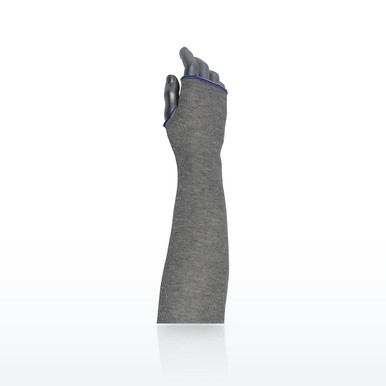 Kut Gard 20-DATO Cut Resistant Sleeves, ANSI A4, 18 in.Cut-resistant sleeve with the manufacturer’s cut level, gram result and length (PIP data)
Why a sleeve and not a longer glove. Forearm lacerations come from the same edges as hand cuts: sheet metal and glass carried against the body, blades at a slicer, wire and strapping. A gauntlet glove covers a few inches of wrist; a sleeve covers the forearm and, at 18 inches and up, the elbow and biceps, and it can be worn with whatever glove the task needs. The knit is rated by the same test as a glove, so a sleeve marked A4 stopped at least 1,500 grams on the TDM-100, and PIP publishes the gram result per style; a sleeve with a thumb hole stays down over the wrist, and a closed-top or tapered sleeve stays up without a strap.
What the manufacturer’s data lists per sleeve
The columns on each product page.
How a sleeve is sized and worn, from the manufacturer’s instructions
- Measure from the wrist crease to where the cover has to end; a sleeve is sold by its finished length, not by arm size, except the tapered styles, which list a size.
- Wear the sleeve under the glove cuff, thumb hole over the thumb, so the edge of the knit is covered and the sleeve cannot ride up.
- A sleeve rated for cut is not rated for puncture or heat unless the data lists those; several Kut Gard styles carry an ASTM F1060 contact-heat figure and the product page shows it.
- The cut-resistant yarns are launderable on the manufacturer’s instructions; the wash guide covers Kevlar, HPPE and Dyneema care.
MCR Safety’s sleeves
The MCR Safety Cut Pro sleeves on this site are 7 to 18 gauge Kevlar, HyperMax, Dyneema, ARX or Hero knits, 10 to 24 inches long, most with a thumb slot, and MCR Safety states the ANSI/ISEA 105 cut level, abrasion level, contact heat level and EN 388 tear level on each; the sleeve guide carries the test methods MCR Safety’s laboratory runs for them.
MCR Safety, “Sleeve Cut Protection” guide; MCR Safety product pages and specification sheets for the styles shown, fetched Nov 6 2026Portwest’s sleeves
Portwest lists two sleeves on the US file: the A690 (ANSI A4, EN 388 4X4XD, 18 in, HPPE and glass fiber, listed as food contact under the EU rule) and the Portwest CTP CT90 (ANSI A8, EN 388 3X4XF, 14 in, Portwest’s DyUltra fiber). Each page carries the level, code and length Portwest states.
Portwest product pages and US data sheets for the styles shown (documents.portwest.com), fetched Nov 7 2026Questions people ask
What cut level should a sleeve be?
The same scale as the glove: A1 to A9 by the TDM-100 grams. The level for a task is the employer’s hazard assessment; the manufacturer publishes the level and the gram result for every sleeve above.
How long should a cut-resistant sleeve be?
By what has to be covered: 14 inches for the forearm, 18 to reach past the elbow, 20 to 24 for the upper arm. The length is the finished knit length.
Do cut-resistant sleeves have thumb holes?
Many do; PIP lists a thumb hole, a thumb loop or none per style, and the product page shows it. The hole keeps the sleeve from riding up under the glove.
Are cut-resistant sleeves heat resistant?
Only where the manufacturer lists an ASTM F1060 contact-heat level; several Kut Gard aramid styles do, with the temperature in the data.
Can cut-resistant sleeves be washed?
Yes, on the manufacturer’s instructions for the yarn; see the wash guide.
Does OSHA require sleeves?
29 CFR 1910.138(a) requires hand protection selected for the hazard and leaves arm protection to the employer’s hazard assessment under 1910.132(d); no OSHA paragraph names sleeves.
What is the EN standard for cut-resistant sleeves and gloves?
EN 388, which rates abrasion, blade cut, tear and puncture with four digits and adds the ISO 13997 straight-blade cut letter A to F; a sleeve is tested the same way as a glove. Portwest lists its cut-resistant sleeves with the EN 388 code and the ANSI/ISEA 105 level together.
Do cut-resistant sleeves work?
To the ANSI/ISEA 105 level printed on them, measured on the TDM-100 straight-blade test: A1 to A9 in grams, the same scale as a glove. A sleeve protects where the knit is intact and covers the arm; it carries no puncture or heat rating unless the manufacturer lists one, and MCR Safety states the cut, abrasion, contact heat and EN 388 tear levels on each of its Cut Pro sleeves.
What are cut-resistant sleeves made of?
Knit cut-resistant yarns: Kevlar and other aramids, HPPE (Dyneema, HyperMax and similar polyethylenes), steel-core or glass-core blends and proprietary spun yarns such as MCR Safety’s ARX and Hero, in one to three plies and 7 to 18 gauge. The yarn and ply are on each product page as the manufacturer lists them.
What is a Kevlar sleeve, and do Kevlar sleeves work?
A knit arm sleeve in DuPont’s para-aramid yarn (or an aramid blend with a steel core, which PIP calls ACP), rated on the ANSI/ISEA 105 cut scale like a glove (A2 to A9 across PIP’s Kut Gard line) and often carrying an ASTM F1060 contact heat level; it protects the forearm to the level tested, and the level, length and thumb hole are chosen as the guide describes.
What are the arm sleeve protectors for elderly or thin skin?
A separate product: soft knit or padded sleeves sold for skin tears, not rated under ANSI/ISEA 105. The cut-resistant sleeves here are work PPE for blades and sheet metal; the fiberglass coverall guide covers the light sleeves worn against itch.
What are the arm sleeve protectors used at work?
Cut-resistant sleeves (ANSI/ISEA 105 A2 to A9) for blades and metal, chemical sleeves (vinyl, polyethylene) for splash, FR and leather sleeves for welding; each is rated or described by its manufacturer for its hazard, and the chemical aprons and sleeves guide covers the splash ones.
The ratings, test results and standards shown here are the manufacturers' published values, reproduced as published. Nothing on this page is a recommendation by Bayshore Safety that any product is suitable for a particular task, hazard or workplace. Selecting safety products and protective equipment is the responsibility of the end user and the employer, based on their own hazard assessment and the regulations that apply to their work. Confirm every value on the manufacturer's own documentation before use.