
Does OSHA require safety-toe shoes? What 1910.136 says, the ASTM F2413 codes, and composite vs steel vs alloy toe
OSHA requires protective footwear when the hazard calls for it, not for every job. 29 CFR 1910.136(a) says the employer shall ensure each affected employee uses protective footwear when working in areas where there is a danger of foot injuries from falling or rolling objects, or objects piercing the sole, or where the employee’s feet are exposed to electrical hazards; 1910.136(b) says that footwear must comply with ASTM F2412 and F2413 (or the earlier ANSI Z41), and construction follows the same rule through 1926.95 and 1926.96. Which workers are “affected” comes out of the hazard assessment under 1910.132(d). The F2413 label inside the boot tells you what it passed: I and C for impact and compression on the toe, then letters for the extra tests (Mt metatarsal, EH electrical hazard, SD static dissipative with the resistance limit, PR puncture resistance, and in the 2024 edition SR slip resistance). Composite, steel and alloy toes pass the same impact and compression tests, 75 foot-pounds and 2,500 pounds, so none holds more than another by the standard; they differ in weight, thickness, cold transfer and whether they set off a metal detector. The employer pays for safety-toe footwear unless it is non-specialty footwear the employee is allowed to wear off site (1910.132(h)(2)).
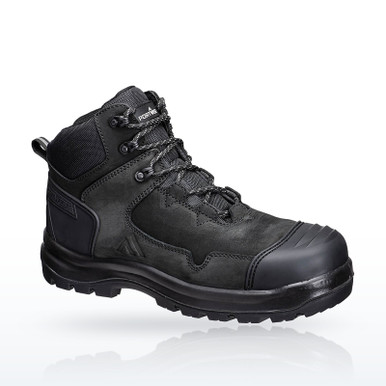 Portwest CompositeLite FD04 Safety Boots, Composite ToeASTM F2413-24 I C SD35 PR SR, as Portwest states it (Portwest data)
Why the toe material does not change the rating. ASTM F2412 drops a 50-pound weight on the toe from a height that delivers 75 foot-pounds and presses a 2,500-pound load on it, and the boot passes if the clearance left inside the toe cap is at least half an inch for a men’s boot (15/32 inch for women’s). A steel cap, an aluminum alloy cap and a composite cap (fiberglass, carbon fiber or plastic) all have to leave that clearance; the standard has no higher or lower class for one material. What the material changes is the boot around it: steel is the thinnest cap and the heaviest, it conducts heat and cold and it sets off a metal detector; alloy is lighter than steel at about the same thickness; composite is the lightest and thickest, does not conduct and passes a metal detector, which is why airports, secure sites and electrical work ask for it. Portwest states the toe material and the F2413 code on every safety shoe and boot page here; its soft-toe work boots carry ASTM F2892 instead, the soft-toe standard with the same SD, PR and SR letters and no toe test.
The ASTM F2413 codes, letter by letter
What each mark on the label means, with the figure from the standard.
Composite vs steel vs alloy, by what the standards and the pages say
- Same rating: all three pass I/75 and C/75 under F2412 or the boot does not carry the F2413 mark; “how much weight can a composite toe hold” has the standard’s answer, 2,500 pounds of compression and a 75 foot-pound impact, the same as steel.
- Weight and thickness: composite caps are the lightest and the thickest; steel the thinnest and heaviest; alloy (aluminum or titanium) between them. The data sheet weights Portwest prints are for the carton, not the pair, so compare the materials, not those figures.
- Metal detectors: a composite toe passes; steel and alloy do not. Portwest describes its CompositeLite line as non-metallic toecaps and midsoles for that reason.
- Heat and cold: metal caps conduct, composite does not; in a freezer or on a hot deck the composite cap stays closer to body temperature.
- Electrical: the toe material is not the EH rating; EH is tested on the whole boot. A composite-toe boot without EH on its label has no EH rating, and a steel-toe boot can carry EH.
- Europe reads the same boots differently: the EN ISO 20345 code on the same Portwest label (S1P, S3, S3S, S7) is explained in its own guide, linked below.
Questions people ask
Does OSHA require safety-toe shoes?
When the hazard assessment finds a danger of foot injury from falling or rolling objects, sole punctures or electrical hazards, 1910.136(a) requires protective footwear, and (b) requires it to meet ASTM F2412 and F2413. Where no such hazard exists, OSHA does not require them.
How much weight can a composite toe hold?
The same as steel by the standard: ASTM F2412 tests every safety toe at 2,500 pounds of compression and a 75 foot-pound impact, and the cap must leave at least half an inch of clearance (men’s). There is no higher class for steel or lower class for composite.
Can a composite toe go through a metal detector?
Yes, that is the usual reason for choosing it; Portwest lists its CompositeLite caps and midsoles as non-metallic. Steel and alloy caps set detectors off.
What are alloy toe boots?
Boots with an aluminum or titanium toe cap: lighter than steel at about the same thickness, still metal (detectors, heat and cold), rated I/75 and C/75 like the others. Portwest’s US file lists composite and steel caps, no alloy.
Who pays for safety-toe boots?
The employer, under 1910.132(h), unless the footwear is non-specialty safety-toe footwear the employer lets the employee wear off site, which is the one footwear exception the rule names; metatarsal guards and specialty boots are employer-paid.
Does ASTM F2413-18 exceed ASTM F2413-11?
Not on the toe. The impact (75 foot-pounds) and compression (2,500 pounds) requirements for the protective toe cap are the same in the 2005, 2011, 2017/2018 and 2024 editions; a boot made to F2413-11 is not weaker than one made to F2413-18. What the later editions changed is the label and the classifications: the 2017/2018 edition dropped the “75” after I, C and Mt (one level, so no number is needed) and split static dissipative into SD 100, SD 35 and SD 10 by resistance range; the 2024 edition added SR slip resistance. OSHA 1910.136(b) names the 2005 editions and accepts later ones as at least equivalent.
What is the difference between ASTM F2412 and F2413?
F2412 is the book of test methods (how the toe is struck and compressed, how the midsole is punctured, how EH is tested); F2413 is the performance specification that says what results a boot must reach and how the label reads. A boot label cites F2413 because that is the standard it meets; OSHA 1910.136(b) names both.
What are the ANSI standards for safety shoes, and what is the ISO standard?
ANSI Z41 was the US standard until it was withdrawn in 2005 and replaced by ASTM F2412 and F2413; OSHA still lists Z41-1999 and Z41-1991 as acceptable for older boots. The international standard is ISO 20345 (EN ISO 20345 in Europe), with the S1, S1P, S3 and S7 codes explained in the companion guide linked below; Portwest’s boots carry it beside the F2413 label.
What is a safety toe shoe, and what does ASTM stand for on boots?
A shoe or boot with a protective toe cap (steel, composite or alloy) that passed the F2412 impact and compression tests, shown by the I/C on the ASTM F2413 label inside. ASTM is ASTM International, the standards body that writes F2412 and F2413; the letters after I/C (Mt, EH, SD, PR, SR) are the extra tests the boot passed.
Is steel better than composite, and are composite toe boots the same as steel toe?
Same rating: every F2413 toe, steel, composite or alloy, passes the same 75 foot-pound impact and 2,500 pound compression tests or the boot does not carry the mark. The differences are the cap itself: composite is lightest and thickest and passes a metal detector, steel is thinnest and heaviest, alloy sits between; metal caps conduct heat and cold, composite does not. Portwest describes its CompositeLite line as non-metallic toecaps and midsoles.
Does composite toe get cold like steel toe, and which is more comfortable?
A metal cap conducts the cold of a freezer floor or the heat of a deck to the toes; a composite cap does not, which is the temperature difference the manufacturers describe. Comfort is fit, not the cap: F2413 rates no comfort, composite caps are lighter but thicker (a larger toe box), and the right size and last for the foot decide the rest.
What are the OSHA footwear requirements for construction workers?
1926.96: protective footwear meeting ASTM F2412 and F2413 (or ANSI Z41) where employees face foot injury from falling or rolling objects, objects piercing the sole, or electrical hazards. The construction and general-industry rules read the same; the hazard assessment decides which crews are affected and which letters (EH, PR, Mt) the label needs.
Does OSHA approve composite toe shoes?
OSHA approves no footwear; it requires footwear that complies with ASTM F2413 where the hazard calls for it. A composite-toe boot with the F2413 label and the I/C mark satisfies 1910.136 and 1926.96 the same as a steel-toe boot; the toe material is not in the rule.
The ratings, test results and standards shown here are the manufacturers' published values, reproduced as published. Nothing on this page is a recommendation by Bayshore Safety that any product is suitable for a particular task, hazard or workplace. Selecting safety products and protective equipment is the responsibility of the end user and the employer, based on their own hazard assessment and the regulations that apply to their work. Confirm every value on the manufacturer's own documentation before use.