
Do electric gloves exist? Rubber insulating gloves vs the work gloves electricians wear, and what MCR Safety does and does not make
Yes, and they are a specific product: rubber insulating gloves made and tested to ASTM D120, in classes 00 to 4 by the voltage they are rated for, worn with leather protectors over them, and electrically tested on the schedule 29 CFR 1910.137 sets. Those are the gloves that protect against shock when working on or near energized parts. Electricians also wear ordinary work gloves for the rest of the day, and no ordinary work glove is an electrical glove: MCR Safety’s line here has no rubber insulating gloves, and the words “dielectric” (on its eyewear, meaning no metal parts) and “arc rated” (on a few leather gloves, meaning a tested arc rating under ASTM F1506) describe other properties, not shock protection. A nitrile, latex, PVC or leather work glove has no voltage rating and must not be used as one.
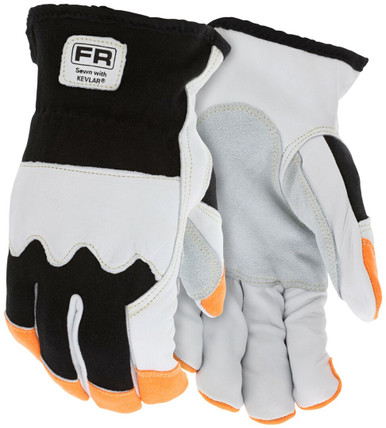 MCR Safety 906DPHK Mechanics Gloves, ANSI A5, Goatskin PalmLeather drivers glove MCR Safety lists as arc rated (an ASTM F1506 arc rating, not a shock rating)
Why the words cause confusion. Three different things get called “electrical”. A rubber insulating glove is rated to a use voltage and proof-tested; that is shock protection. An arc-rated glove or garment has an ATPV from the ASTM F1959 arc test; that is burn protection from an arc flash, and it does nothing against current through the hand. A dielectric pair of safety glasses or a face shield bracket has no metal parts, so it will not conduct if it touches a live part; it is not a rated insulator either. MCR Safety makes the second and third, not the first. The nitrile question is its own guide, linked below: a thin nitrile glove is an insulator in the dictionary sense and has no voltage rating in the regulatory sense.
The three products, and what each one is rated for
As the standards define them.
What MCR Safety makes for electrical work, and what it does not
- Not made: rubber insulating gloves or sleeves. None of the 1,392 MCR Safety listings on this site is an ASTM D120 glove; the rubber insulating gloves we carry are from other manufacturers, in the guides linked below.
- Arc-rated leather gloves: a few drivers and welding styles MCR Safety lists as “Arc Rated”, with the ATPV on the product page, for the arc flash hazard only.
- Dielectric eyewear: 32 glasses, goggles and face shield brackets listed as dielectric (no metal parts), including the 98 over-the-glass frame and the 101 bracket.
- FR and arc-rated clothing: the Tingley FR and Summit Breeze lines, ATPV 8.6 to 21.2 cal/cm², CAT 2, for the arc flash hazard; see the NFPA 70E guides.
- Everything else in the MCR Safety line, including the nitrile and PVC coated gloves, is ordinary hand protection under 1910.138 with no electrical rating.
Why electricians wear rubber gloves, and what Portwest’s arc flash gloves are
Electricians wear rubber insulating gloves because rubber does not conduct, and the ASTM D120 gloves are made and proof-tested to hold a stated voltage (Class 00 at 500 V AC up to Class 4 at 36,000 V), with leather protectors over them and the 1910.137 testing schedule behind them; no work glove, leather, knit or coated, carries a voltage rating. Portwest makes no rubber insulating gloves. Its Portwest Arc Flash Gloves (A780, A784, A783) are a different thing: aramid and glass-fiber knits with an ATPV of 9.5, 12 and 33 cal/cm² tested to ASTM F2675 and placed in NFPA 70E category 2 or 3, worn for the arc-flash thermal hazard, not for shock. Portwest states them as arc rated and cut rated; it does not state a voltage, and the product pages say exactly that.
29 CFR 1910.137; ASTM D120; ASTM F2675; NFPA 70E-2024, 130.7(C)(7) and (10); Portwest product pages and US data sheets for the styles shown (documents.portwest.com), fetched Nov 7 2026Questions people ask
Do electric gloves exist?
Yes: rubber insulating gloves to ASTM D120, in classes 00 to 4 by voltage, worn with leather protectors and tested every six months under 1910.137. They are a distinct product from work gloves.
Which gloves are safe for working with electricity?
Only rubber insulating gloves of the class rated for the voltage, with leather protectors, on circuits that are energized; where the circuit is de-energized and locked out, the hand hazard is the ordinary one and 1910.138 applies.
Do electricians use special gloves?
For shock, rubber insulating gloves with leather protectors; for arc flash, arc-rated or heavy-duty leather gloves per NFPA 70E Table 130.7(C)(15)(c); for the rest of the day, ordinary work gloves.
Does MCR Safety make electrical gloves?
No rubber insulating gloves. It lists a few leather gloves as arc rated and its eyewear as dielectric (no metal parts); neither is shock protection.
Are nitrile gloves insulated against electricity?
They have no voltage rating. See the guide on nitrile gloves and electricity for what the material does and why it is not electrical protection.
How are electrical gloves rated?
By voltage class under ASTM D120: Class 00 (500 volts AC maximum use), Class 0 (1,000 V), Class 1 (7,500 V), Class 2 (17,000 V), Class 3 (26,500 V) and Class 4 (36,000 V), each proof-tested at a higher voltage. OSHA 1910.137 requires the class marking, leather protectors over the rubber, an air test before each use and electrical retesting at set intervals.
Will nitrile gloves prevent electric shock?
No. A nitrile disposable or coated glove carries no ASTM D120 voltage class and is not an insulating glove; only rubber insulating gloves made and tested to ASTM D120 and maintained under 1910.137 protect against shock. Portwest’s arc flash gloves carry an ATPV (an arc rating), which is a burn rating, not a voltage rating.
Which type of gloves are used for electrical work?
Two products together: rubber insulating gloves of the voltage class the exposure calls for, worn under leather protectors, for shock; and arc-rated gloves or leather protectors for the arc flash hazard under NFPA 70E. For the rest of the day electricians wear ordinary work gloves, which have no electrical rating.
Will leather gloves protect you from electrical shock?
No. A leather work glove has no voltage rating; the leather protector worn over a rubber insulating glove protects the rubber from cuts and punctures, and the rubber is the insulation. The leather gloves MCR Safety lists as “Arc Rated” carry an arc rating (heat) under ASTM F1506, not a voltage rating.
Will nitrile or rubber gloves protect against electric shock?
Only a rubber insulating glove made and tested to ASTM D120 and worn with leather protectors; disposable nitrile, coated nitrile and PVC work gloves have no voltage rating and are not electrical protection, whatever the material’s resistivity. The guide on nitrile gloves and electricity explains why.
What type of gloves must a mechanic wear when working on high-voltage cables?
Rubber insulating gloves of the ASTM D120 class rated for the voltage (Class 0 covers up to 1,000 V a.c., which is where most vehicle high-voltage systems fall), with leather protectors over them, tested on the 1910.137 schedule; NFPA 70E adds arc-rated clothing where the arc flash risk assessment calls for it. Work gloves are for the rest of the job.
Do electrical gloves really work?
To their class: each rubber insulating glove is proof-tested at the ASTM D120 voltage for its class before sale and electrically retested every six months in service, and 1910.137 requires an air test and visual inspection before each day’s use. A glove that fails the inspection or is past its test date is taken out of service.
Why do electricians use rubber gloves?
Because rubber insulating gloves are the only hand protection made and tested to stop current: 1910.335(a)(1) requires electrical protective equipment where there are potential electrical hazards, and 1910.137 defines that equipment as rubber insulating gloves (and sleeves, blankets and mats) proof-tested at voltage. Leather protectors go over them to keep the rubber from being cut, and the arc flash rules add arc-rated clothing for the thermal hazard.
When should you wear rubber coated work gloves?
For grip and liquid resistance, never for electricity. A latex, nitrile or PVC coated knit is a general handling glove whose coating resists water, oil or abrasion; it carries no ASTM D120 class and must not be used on or near energized parts. The coated glove guide on this site sorts the coatings by what each one is for.
Related guides
Electrical insulating rubber glovesClasses 00 to 4 and the testing OSHA requiresHow often do electrical gloves have to be tested?The 1910.137 intervalsDo nitrile gloves conduct electricity?Rubber gloves and electrical shockRubber insulating gloves and leather protectorsWhen NFPA 70E requires themThe ratings, test results and standards shown here are the manufacturers' published values, reproduced as published. Nothing on this page is a recommendation by Bayshore Safety that any product is suitable for a particular task, hazard or workplace. Selecting safety products and protective equipment is the responsibility of the end user and the employer, based on their own hazard assessment and the regulations that apply to their work. Confirm every value on the manufacturer's own documentation before use.