
What is EN 166, and how does it compare with ANSI Z87.1? The European eye protection marks explained
EN 166 is the European standard for personal eye protection: it sets the optical, mechanical and marking requirements for safety spectacles, goggles and face shields, and the lens and frame are marked with a string of codes (manufacturer, optical class 1 to 3, mechanical strength S, F, B or A, and field-of-use letters) rather than the Z87 and Z87+ marks of ANSI/ISEA Z87.1. EN 170 and EN 172 are the companion filter standards: EN 170 for ultraviolet filters (scale numbers 2-1.2 to 2-5, or 2C- for filters with good color recognition) and EN 172 for sunglare filters for industrial use (5- and 6- scale numbers). Several Bouton Optical and UVEX items on this site list EN 166 beside ANSI Z87.1 in the manufacturer’s data; the ANSI mark is the one the US rule, 29 CFR 1910.133, calls for.
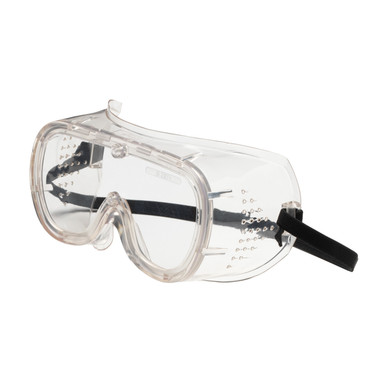 Bouton Optical 440 Basic 248-4400 Safety Goggles, ANSI Z87.1, Direct VentEyewear the manufacturer lists to ANSI Z87.1 and EN 166/170/172 (PIP data)
Why both marks appear on one pair. The two systems test for the same hazards in different ways. ANSI/ISEA Z87.1 has two impact levels: Z87 (basic impact, a 1-inch steel ball dropped from 50 inches) and Z87+ (high impact, a quarter-inch steel ball at 150 feet per second for spectacles plus a 500-gram pointed weight dropped from 50 inches). EN 166 grades mechanical strength on a finer scale: S for increased robustness (a 22 mm ball dropped from 1.3 m), F for low-energy impact (a 6 mm ball at 45 m/s), B for medium energy (120 m/s, goggles and face shields) and A for high energy (190 m/s, face shields only). A manufacturer selling the same frame in both markets tests it both ways and lists both, which is what the Standards line on the product pages below shows.
How to read an EN 166 marking
The order the standard uses on a lens and a frame.
ANSI/ISEA Z87.1 and EN 166 side by side
| What is tested | ANSI/ISEA Z87.1-2020 | EN 166 / EN 170 / EN 172 |
|---|---|---|
| Basic impact | Z87: 1 in (25.4 mm) steel ball dropped from 50 in (1.27 m) | S: 22 mm steel ball dropped from 1.3 m |
| High impact | Z87+: 6.35 mm ball at 150 ft/s (45.7 m/s) for spectacles, 250 ft/s goggles, 300 ft/s face shields; plus a 500 g pointed weight from 50 in | F: 6 mm ball at 45 m/s; B: 120 m/s (goggles, face shields); A: 190 m/s (face shields) |
| Optical quality | Prescription and plano requirements in section 5; no class number on the mark | Optical class 1, 2 or 3 on the mark |
| Splash, dust, gas | D3 splash, D4 dust, D5 fine dust marks | Field-of-use 3, 4, 5 |
| UV filter | U followed by a scale number (U6 is the common clear-lens mark) | EN 170 scale number 2-x or 2C-x |
| Sunglare | L followed by a visible-light scale number | EN 172 scale number 5-x or 6-x |
| Welding filter | W followed by the shade number | EN 169 shade number |
| Anti-fog | X | N |
| Anti-scratch | no mark | K |
The two systems are not formally equivalent; a product marked to both has been tested to both. The US rule, 29 CFR 1910.133(b)(1), accepts eye protection complying with ANSI/ISEA Z87.1-2010, Z87.1-2003 or Z87.1-1989 (R1998), or shown to be equally effective.
ANSI/ISEA Z87.1-2020 sections 5, 7 and 9; EN 166:2001 clause 9; EN 170:2002; EN 172:1994; 29 CFR 1910.133(b)(1); PIP Rich Product Data, October 2026.
Portwest’s dual-marked eyewear
Portwest’s US eyewear pages list ANSI Z87.1+ and EN 166 together on most styles, with EN 170 (UV filter) on clear lenses and EN 172 (sunglare filter) on smoke and polarized lenses; three styles (PS32, PW32, UPW33) list EN ISO 16321 instead of EN 166 and two add AS/NZS 1337.1. No Portwest style lists a CSA mark on its US page.
Portwest product pages and US data sheets for the styles shown (documents.portwest.com), fetched Nov 7 2026The CE and CSA marks as Radians defines them
Radians’ product icons page defines the marks its eyewear carries: the ANSI Z87.1+ logo for products that meet the Z87.1+ requirements; UVA/UVB for 99.9 percent UVA and UVB protection; anti-fog and hard coat where those coatings are available; polarized lenses that eliminate reflective glare hitting the lens flat and part of the glare at other angles; CSA for the Canadian Z94.3 eyewear requirements; CE for European standards; VO Ballistic for products that pass the MIL-PRF-31013 military ballistic test; and foam for foam-lined frames. On this site the Standards line on each eyewear page lists ANSI Z87.1 or Z87.1+ and, where Radians prints them, CSA Z94.3, MIL-PRF ballistic and the D3 splash and D4 dust marks.
Radians Product Technologies page (radians.com/resources/product-technologies, radians.com, fetched Nov 8 2026)Questions people ask
What is the EN 166 standard?
The European standard for personal eye protection: optical, mechanical and marking requirements for spectacles, goggles and face shields, with the mechanical grades S, F, B and A and field-of-use numbers on the mark.
Is EN 166 the same as Z87.1?
No. They test the same hazards with different methods and marks; a product listed to both, as the Bouton Optical and UVEX items above are in PIP’s data, has passed both. The US rule names Z87.1.
What do EN 170 and EN 172 mean on a lens?
EN 170 is the ultraviolet filter standard (scale numbers 2-1.2 to 2-5, 2C- for good color recognition); EN 172 is the sunglare filter standard for industrial use (5- and 6- scale numbers).
What does F mean on safety glasses?
EN 166 low-energy impact: a 6 mm steel ball at 45 m/s. B is medium energy (120 m/s) and A is high energy (190 m/s); T after the letter means the test was passed at temperature extremes.
Which mark does OSHA require?
29 CFR 1910.133(b)(1) names ANSI/ISEA Z87.1 (2010, 2003 or 1989 editions) or equally effective protection; the Z87 vs Z87+ guide explains the US marks.
What is the OSHA standard for eye protection?
29 CFR 1910.133 (and 1926.102 for construction): eye and face protection where there are flying particles, molten metal, liquid chemicals, acids or caustics, chemical gases or vapors or harmful light, with side protection against flying objects, and protectors that comply with ANSI/ISEA Z87.1. An EN 166 mark on its own does not satisfy the rule; Portwest’s dual-marked eyewear carries the Z87 mark beside it.
Is EN 166 still valid?
EN 166:2001 is still the harmonized European standard for personal eye protection and is the mark on current CE-marked eyewear; the ISO 16321 series is its planned replacement and some makers, Portwest among them, already list ISO 16321 beside EN 166 on newer styles. The US rule reads the ANSI/ISEA Z87.1 mark regardless.
What is the current ANSI standard for safety glasses?
ANSI/ISEA Z87.1-2020 is the current edition. OSHA 1910.133(b)(1) incorporates the 2010, 2003 and 1989 editions by reference and accepts protectors shown to be equally effective, so eyewear marked to the 2015 or 2020 edition is accepted in practice; the mark on the frame does not change by edition (Z87 or Z87+).
What does EN 166 mean on glasses?
That the eyewear was tested to the European standard: the mark string carries the manufacturer’s symbol, an optical class (1, 2 or 3), a mechanical strength letter (S, F, B or A) and field-of-use numbers, and the filter scale numbers come from EN 170 (UV) or EN 172 (sunglare). MCR Safety lists EN 166 beside Z87+ and CSA Z94.3 on many of its styles.
Which ANSI standard should be stamped on safety eyewear?
Z87.1, shown as the mark Z87 (basic impact) or Z87+ (high impact) with the manufacturer’s mark, on every protector OSHA 1910.133 accepts. The standard number itself is not printed; the Z87 mark is the stamp, and filter lenses add their U, L or W scale numbers.
The ratings, test results and standards shown here are the manufacturers' published values, reproduced as published. Nothing on this page is a recommendation by Bayshore Safety that any product is suitable for a particular task, hazard or workplace. Selecting safety products and protective equipment is the responsibility of the end user and the employer, based on their own hazard assessment and the regulations that apply to their work. Confirm every value on the manufacturer's own documentation before use.