
What do S1, S1P, S3, S3S and S7 mean on safety boots? The EN ISO 20345 codes next to the ASTM F2413 label
They are the European safety footwear classes under EN ISO 20345, printed on many boots beside the US ASTM F2413 code. SB is the base: a 200 joule toe cap (about 147 foot-pounds) that also resists 15 kN of compression. S1 adds a closed heel, antistatic sole, energy absorption in the heel and a fuel-and-oil-resistant outsole; S1P is S1 with a penetration-resistant midsole; S2 is S1 with an upper that resists water penetration and absorption; S3 is S2 with the penetration-resistant midsole and a cleated outsole. The 2022 edition split the midsole letter by what was tested: P is a steel insert tested with a 4.5 mm nail, PL a non-metal insert tested with the 4.5 mm nail, PS a non-metal insert tested with a 3 mm nail, so S1PS and S3S mean a non-metal midsole passed the small-nail test. S4 and S5 are the all-polymer or rubber boot versions of S1 and S3, and the 2022 edition added S6 and S7 for a whole boot that resists water penetration (S2 and S3 with the water test on the whole boot). Portwest prints the EN code with its ASTM code on the same page, for example ASTM F2413-24 I C SD35 PR SR and EN ISO 20345:2022 S3S HRO SR FO SC LG.
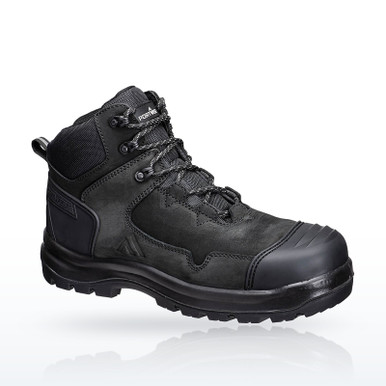 Portwest CompositeLite FD04 Safety Boots, Composite ToeEN ISO 20345:2022 S3S beside ASTM F2413-24, as Portwest states (Portwest data)
Why the European code says more than the US one in one line. The ASTM F2413 label lists tests the boot passed one letter at a time; the EN ISO 20345 class bundles a set of them into a letter-and-number code, then adds extra letters for the rest. An S3 boot has, by definition, the toe cap, the closed heel, antistatic and energy-absorbing properties, fuel-oil resistance, the water-resisting upper, the midsole and the cleated sole; the US label for the same boot might read I C SD PR SR, with the water resistance and heel energy absorption not on the US label at all because F2413 has no such tests. The two codes also measure differently: the European toe test is 200 joules, the US 75 foot-pounds (about 102 joules), the European puncture test 1,100 newtons, the US 270 pounds (about 1,200 newtons). A boot that carries both has passed both; a boot with only the European code has no US rating, and a US buyer whose contract asks for F2413 cannot read it from an S3.
The classes
EN ISO 20345:2022, what each one bundles.
The extra letters, as they appear on Portwest’s pages
- HRO: outsole resists contact heat at 300 °C for one minute. FO: outsole resists fuel oil. SR: slip resistance (the 2022 edition made it a marked test; SR means tested on a ceramic tile with glycerine, the harder of the two conditions).
- CI and HI: cold and heat insulation of the sole. Portwest lists CI on the FD95 and FT05.
- SC: scuff cap over the toe. LG: ladder grip, a sole designed for ladder rungs. Both are on the FD04 and FT05.
- ESD: electrostatic discharge footwear to EN 61340, a tighter resistance band than the standard’s antistatic (A) requirement; Portwest lists ESD on the FC18 and FC19.
- EN ISO 20347 and the O codes (OB, O4, O7S): occupational footwear with no toe cap, the European counterpart to ASTM F2892. Portwest’s soft-toe FW90, FC26 and FT20 carry those.
- AS 2210.3: the Australian/New Zealand safety footwear standard, on the FW83.
Questions people ask
What does S1P mean on a boot?
EN ISO 20345 class S1 (200 J toe cap, closed heel, antistatic, energy-absorbing heel, fuel-oil-resistant outsole) plus a penetration-resistant midsole. In the 2022 edition S1P has a steel insert; S1PL and S1PS have non-metal inserts tested with a 4.5 mm or 3 mm nail.
What is the difference between S1P and S3?
S3 adds what S2 adds (an upper that resists water penetration and absorption) and a cleated outsole; both have the toe cap and the midsole. S3S is S3 with a non-metal midsole tested with the 3 mm nail.
Is S3 the same as ASTM F2413?
No. S3 is a European class bundling several tests; F2413 is the US standard with its own toe, puncture and electrical tests and letter codes. A boot that carries both, as Portwest’s S3 and S3S boots do, has passed both; one with only S3 has no US rating.
What does S7 mean?
New in EN ISO 20345:2022: an S3 boot whose whole construction, not only the upper, passed the water penetration test (WR). Portwest lists S7 on the FW57 and FT05.
What do HRO, FO, SR and LG mean?
Additional markings: HRO is a heat-resistant outsole (300 °C), FO fuel-oil resistance, SR slip resistance on the harder test condition, LG ladder grip, SC scuff cap, CI cold insulation, ESD electrostatic discharge footwear.
What is S1, S2 and S3 in safety shoes?
The three everyday EN ISO 20345 classes above the SB base: S1 adds a closed heel, antistatic sole, heel energy absorption and a fuel-and-oil-resistant outsole; S2 is S1 with an upper that resists water penetration and absorption; S3 is S2 with a penetration-resistant midsole and a cleated outsole. S1P is S1 with the midsole but without the water-resistant upper.
What is the S rating on safety boots?
The EN ISO 20345 class code: SB, S1, S1P, S2, S3 (and S4, S5 for all-rubber or polymer boots, S6, S7 for water-resistant whole footwear in the 2022 edition), each a set of features the boot passed, with extra letters (HRO, FO, SR, CI, LG) for additional tests. Portwest prints the code on each boot page beside the US ASTM F2413 label.
What are the ASTM standards for work boots, and how do they line up with the S codes?
ASTM F2413 (performance) and F2412 (test methods) are the US standards; the label reads I/C for the toe plus EH, PR, Mt, SD and SR. The EN ISO 20345 code is a bundle: an S3 boot has a 200 joule toe (close to the F2413 75 foot-pound test), a penetration-resistant midsole (PR) and a water-resistant upper, so one Portwest label can read S3 beside ASTM F2413 I/C EH PR.
Are waterproof work boots actually waterproof, and how can you tell?
By the code: S2 and S3 uppers pass the EN ISO 20345 water penetration and absorption test on the leather (WRU), which keeps rain and puddles out for the test duration but is not a sealed boot; S6 and S7, new in the 2022 edition, add WR, a test of the whole boot in water, which is the closest the standard comes to 100 percent waterproof. Portwest lists the class on each boot, and the US label has no waterproof code at all.
What is the difference between water resistant and waterproof boots?
In the European code, water resistant is the upper (WRU, in S2 and S3 boots: the leather resists penetration and absorption for 60 minutes of flexing) and waterproof is the whole boot (WR, in S6 and S7: the assembled boot is flexed in water with no leak). ASTM F2413 tests neither, so a US boot’s waterproof claim is the manufacturer’s own.
Does ASTM F2413-18 mean steel toe?
No. F2413 is the performance standard and the I/C on the label means the toe cap passed the impact and compression tests; the cap can be steel, composite or alloy and the label does not say which. The product page does; Portwest’s Steelite boots are steel toe and its CompositeLite boots non-metallic.
The ratings, test results and standards shown here are the manufacturers' published values, reproduced as published. Nothing on this page is a recommendation by Bayshore Safety that any product is suitable for a particular task, hazard or workplace. Selecting safety products and protective equipment is the responsibility of the end user and the employer, based on their own hazard assessment and the regulations that apply to their work. Confirm every value on the manufacturer's own documentation before use.