
Bayshore Safety & Industrial Supplies Guide
First aid kit items and what each is used for: the 10, 12, 15, 20, 25 and 30-item lists, what is usually in a first aid box, what is not allowed in a kit, where to store the box, how to set up a kit, and why a kit matters at home and at work
The item list that counts is the one in ANSI/ISEA Z308.1-2021, because it is the one OSHA’s 1910.151 Appendix A points to and the one every workplace kit is filled to: adhesive bandages, adhesive tape, antibiotic application, antiseptic, a breathing barrier, a burn dressing, burn treatment, a cold pack, eye coverings, eye and skin wash, a first aid guide, hand sanitizer, exam gloves, a roller bandage, scissors, sterile pads, trauma pads, a triangular bandage, a tourniquet and a foil blanket: 20 kinds of item, which is why "20 items in a first aid kit" is the most useful of the lists people search. The 10-item list is the same list with the bandages, dressings and gloves at the top; the 25 and 30-item lists add the Class B splint and the supplementary items (tweezers, a splinter remover, sting relief, medications, an instant cold pack, a flashlight). This page gives each item’s use as the Red Cross first aid pages and the manufacturer’s labels state it.
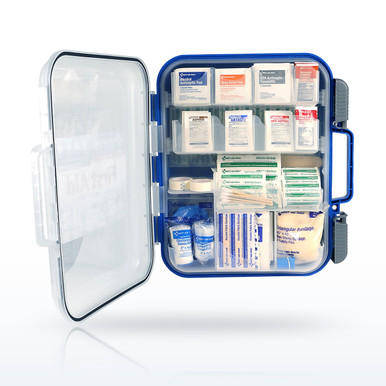 First Aid Only 91300 Bulk First Aid Kit, 50 Person Bulk Clear Front, 272 PiecesFirst Aid Only prints a 50 person bulk kit with 272 pieces behind a clear front, with a banded tourniquet, triangular sling, three types of medications, scissors and a cold pack
Why "what is it for" is the better question. A list of twenty names is not a kit anyone can use; a list of twenty jobs is. Most of the questions in this cluster ask for a count (10 items, 12, 15, 20, 25, 30) and the rest ask what is "usually" in a box, what is not allowed, where to keep it, and why bother. The answers are the same list read three ways: by the Z308.1 fill that OSHA points to, by the Red Cross care step each item serves, and by the First Aid Only kits that carry it, with the unit boxes to build or restock one. The what-should-be-in-a-first-aid-kit guide linked below has the Z308.1 counts and sizes; this page is about use.
The Z308.1-2021 items and what each is used for
| Item (Z308.1-2021 minimum size) | Class A / Class B count | What it is for (the Red Cross care step or the label) |
|---|---|---|
| Adhesive bandages, 1 x 3 inch | 16 / 50 | Small cuts and scrapes that bleed little; fingertip and knuckle shapes for the hand |
| Adhesive tape, 2.5 yards | 1 / 2 | Holds a gauze pad or dressing on the skin beside the wound |
| Antibiotic application, 1/57 oz | 10 / 25 | First Aid Only’s packets: "helps prevent infection in minor cuts, scrapes and burns" |
| Antiseptic, 1/57 oz | 10 / 50 | Cleaning the skin around a minor wound; BZK wipes or alcohol prep pads |
| Breathing barrier | 1 / 1 | A CPR mask or face shield with a one-way valve for rescue breaths |
| Burn dressing, gel soaked, 4 x 4 inch | 1 / 2 | The non-adhesive cover for a cooled burn (Red Cross: cover loosely with a clean, dry, non-adhesive dressing) |
| Burn treatment, 1/32 oz | 10 / 25 | Burn gel or burn cream packets for minor burns |
| Cold pack, 4 x 5 inch | 1 / 2 | Bruises, sprains and swelling: Red Cross, 20 minutes at most, wrapped in a thin dry towel |
| Eye covering with means of attachment | 2 / 2 | Sterile eye pads and strips to cover an injured eye |
| Eye and skin wash, 1 oz / 4 oz | 1 / 1 | Flushing dust, debris or a splash from the eye or skin on the way to a station or clinician |
| First aid guide | 1 / 1 | The printed steps, in the kit, for the person who did not take the course |
| Hand sanitizer, 1/32 oz | 6 / 10 | The first aider’s hands before and after, when there is no sink |
| Medical exam gloves | 2 pair / 4 pair | The PPE 1910.151 Appendix A and 1910.1030 call for whenever blood is possible |
| Roller bandage, 2 inch x 4 yards (Class B adds a 4 inch) | 1 / 2 + 1 | Holds a dressing on and gives moderate compression |
| Scissors | 1 / 1 | Cutting tape, gauze and clothing away from a wound |
| Splint, 4 x 24 inch (Class B only) | 0 / 1 | Immobilizing a wrist, forearm or ankle (Red Cross: in the position found, joints above and below) |
| Sterile pad, 3 x 3 inch | 2 / 4 | The dressing that goes on an open wound before pressure and a bandage |
| Trauma pad, 5 x 9 inch | 2 / 4 | Heavy bleeding: a thick absorbent dressing for direct pressure |
| Triangular bandage, 40 x 40 x 56 inch | 1 / 2 | A sling open, a cravat folded to tie a splint or hold a dressing |
| Tourniquet | 1 / 1 | Life-threatening bleeding from an arm or leg, 2 to 3 inches above the wound (trained rescuer) |
| Foil blanket, 52 x 84 inch | 1 / 1 | Keeps a person from getting cold while waiting for EMS (Red Cross: keep them from getting cold or overheated; give care for shock) |
Source: ANSI/ISEA Z308.1-2021 minimum fill as First Aid Only’s "Understanding OSHA & ANSI 2021" document lists it; American Red Cross Learn First Aid pages (redcross.org)
The questions, one by one
What are 20 items typically found in a first aid kit?
The twenty rows in the table: that is the Z308.1-2021 list, and First Aid Only’s ANSI document prints the same twenty for its Class A kits (16 adhesive plastic bandages, a burn dressing, 10 BZK antiseptic towelettes, a cold pack, a conforming gauze roll, a CPR face shield, an emergency blanket, 1 ounce of eyewash, a first aid guide, first aid tape, 10 first aid and burn cream packets, 10 hand sanitizer packets, 4 nitrile exam gloves, scissors, 2 sterile eye pads, 2 sterile gauze pads, 2 trauma pads, a triangular bandage, 10 triple antibiotic ointment packets, and a tourniquet in the 2021 kits).
What are 10 items typically found in a first aid box, and what are their uses?
The ten most used, from the same list: adhesive bandages (small cuts), sterile gauze pads (the dressing on a wound), a roller bandage (holds it on), tape, antiseptic wipes (clean the skin), antibiotic ointment (minor cuts and scrapes, per the label), exam gloves (your protection), a CPR face shield (rescue breaths), a burn dressing (a cooled burn), and a cold pack (bruises and sprains). The Class A vs Class B guide linked below has the "10 items" answer in Z308.1 terms; this is the same ten by job.
What are the 12 and 15 important items in a first aid kit?
Twelve adds the triangular bandage (slings) and scissors to the ten; fifteen adds trauma pads (heavy bleeding), eye pads (an injured eye) and eyewash (a splash or dust). Every one of them is a Z308.1 line; the counts are the only thing that change between Class A and Class B.
What are 25 or 30 items in a first aid kit?
Past the twenty Z308.1 lines, kits add the supplementary items the standard leaves to the employer’s assessment: a padded splint (required in Class B), tweezers and a splinter remover, sting relief wipes, hydrocortisone cream, finger cots, an instant cold pack in the larger size, moleskin, a bleeding control kit, medications in two-tablet packets (aspirin, non-aspirin, ibuprofen, antacid, allergy), and for a vehicle or site a flashlight, a whistle and a poncho. First Aid Only’s 25-person contractor kit prints 131 pieces and its 50-person bulk kit 272, counting every bandage.
What is usually in a first aid box at home, and what are the essential medical supplies for a home urgent care kit?
The same core: bandages in several sizes, gauze pads and a roll, tape, antiseptic wipes, antibiotic ointment, gloves, scissors and tweezers, a cold pack, a thermometer and the household’s own medications. The Red Cross home kit First Aid Only builds (720007, "five types of bandages") and the 219-piece emergency preparedness kit are the ready-made versions; the ready.gov list for a disaster kit adds water, food, a radio and a flashlight, on the 72-hour kit guide linked below. "Urgent care kit" is a retail name for a larger home kit; the items are these.
What is not allowed in a first aid kit?
Nothing is forbidden by Z308.1 or OSHA; the limits come from elsewhere. Prescription medications belong to the person, not the kit; over-the-counter medications are allowed and most employers keep them in individually wrapped two-tablet packets (the medications guide linked below has OSHA’s position); anything expired comes out at inspection; and loose, unwrapped items are out of a construction kit, where 1926.50(d) requires "individual sealed packages for each type of item". Ice, butter and the home remedies the Red Cross rules out for burns are not kit items either.
Where should a first aid box be stored?
Where it can be reached in the minutes that matter: 1910.151(b) says "readily available" and 1926.50(d)(1) "easily accessible"; OSHA’s letters read near proximity for serious hazards as 3 to 4 minutes. In practice that is mounted on a wall at the work area, marked, at eye height, not locked (OSHA’s January 2007 letter says a locked cabinet fails the rule if the supplies are not available when needed), and in a vehicle or weatherproof case on a jobsite. The how-many-kits guide linked below covers placement by site.
How do you set up a first aid kit, or make a mini first aid kit?
Start from the Z308.1 list for a workplace and from the Red Cross home list for a house; buy a filled kit of the class and size for the headcount or build one from unit boxes (the band has them); add the supplementary items the site’s hazards call for (burn care for a kitchen, a bleeding control kit for blades and saws, eyewash for dust and chemicals); put the first aid guide and the emergency numbers in it; and set the check date. A mini kit for a pocket or a glove box is a travel kit: a few bandages, gauze, tape, wipes, ointment and gloves in a zip bag, which is what First Aid Only’s trifold travel kit is.
Why is it important to have a first aid kit at home and at work?
At work, because 1910.151(b) requires adequate first aid supplies readily available and because OSHA 3317 says the supplies "must be adequate, should reflect the kinds of injuries that occur, and must be stored in an area where they are readily available for emergency access". At home, for the same reason without the rule: the Red Cross first aid steps all end in "give care", and care needs gloves, a dressing and a bandage within reach. The kit is also where the guide lives for the person who has not taken the course.
What is included in a PPE kit, and what does PPE stand for?
Personal protective equipment. A PPE kit for a first aider is the 1910.1030(d)(3) set that 1910.151 Appendix A names: gloves, a gown, a face shield or mask, and eye protection, plus a CPR barrier; First Aid Only’s BBP apparel pack with a CPR mask is that kit in one box. A PPE kit for a job (hard hat, glasses, gloves, vest) is a different thing and belongs to the PPE guides.
What is a highly rated first aid kit?
For a workplace, one labeled to ANSI/ISEA Z308.1-2021 with the class and type on the label and the contents list on the page; the Class A and Class B kits in the band are those. Ratings and reviews are not something this page offers; the class, the count and the contents are what a buyer can check.
What medications are usually in a first aid kit?
In First Aid Only’s larger kits and its medication station: aspirin, extra-strength non-aspirin (acetaminophen), ibuprofen, antacid and allergy tablets in individually wrapped two-tablet packets (the PhysiciansCare line), plus sting relief and hydrocortisone cream. Z308.1 lists analgesics among the supplementary items; the medications guide linked below has OSHA’s position on employer-provided medication.
In plain words
- Twenty kinds of item in a Z308.1-2021 kit; the 10, 12 and 15 lists are the top of it, the 25 and 30 lists add the Class B splint and the supplementary items.
- Each item serves a Red Cross care step: dressing and pressure, bandage, cool and cover a burn, cold on a sprain, sling, tourniquet, warmth for shock, gloves and a barrier for you.
- Not allowed: nothing by rule; expired items come out, prescriptions stay with their owner, construction kits need sealed packages.
- Store it where it is reached in minutes, marked, not locked.
- Set one up from the Z308.1 list, add what the site’s hazards call for, put the guide and numbers in, date the check.
Questions people ask
What are 20 items typically found in a first aid kit?
The twenty Z308.1-2021 lines: adhesive bandages, tape, antibiotic, antiseptic, breathing barrier, burn dressing, burn treatment, cold pack, eye coverings, eyewash, first aid guide, hand sanitizer, gloves, roller bandage, scissors, sterile pads, trauma pads, triangular bandage, tourniquet, foil blanket.
What are 10 items in a first aid box and their uses?
Adhesive bandages (small cuts), gauze pads (the dressing), roller bandage (holds it), tape, antiseptic wipes (clean skin), antibiotic ointment (minor cuts), gloves, CPR shield, burn dressing, cold pack.
What are 12 or 15 items in a first aid kit?
The ten plus a triangular bandage and scissors; then trauma pads, eye pads and eyewash.
What is not allowed in a first aid kit?
No rule forbids items; expired supplies come out, prescriptions stay with the owner, and construction kits need individually sealed packages (1926.50(d)).
Where should a first aid box be stored?
Readily available at the work area, marked, not locked, reachable within the 3 to 4 minutes OSHA reads as near proximity for serious hazards.
How do I set up a first aid kit?
Start from the Z308.1 list (or the Red Cross home list), add items for the site’s hazards, include the guide and numbers, and date the check.
Why is a first aid kit important at home?
Every Red Cross first aid step ends in giving care, and care needs gloves, a dressing and a bandage within reach.
What is usually in a first aid box?
Bandages, gauze, a roll, tape, antiseptic, ointment, gloves, scissors, tweezers, a cold pack and a guide; a workplace box adds the full Z308.1 list.
What is in a PPE kit for first aid?
Gloves, gown, face shield or mask and eye protection (1910.1030(d)(3)), plus a CPR barrier.
What medications are usually in a first aid kit?
Aspirin, non-aspirin, ibuprofen, antacid and allergy tablets in two-tablet packets in the larger First Aid Only kits; Z308.1 lists analgesics as supplementary.
What are 25 or 30 items in a first aid kit?
The twenty Z308.1 lines plus the splint, tweezers, splinter remover, sting relief, hydrocortisone, finger cots, moleskin, a bleeding control kit, medications, and for a vehicle a flashlight, whistle and poncho.
How to make a mini first aid kit?
A few bandages, gauze, tape, wipes, ointment and gloves in a zip bag; First Aid Only’s trifold travel kit is the ready-made one.
Related guides
What should be in a workplace first aid kit?The Z308.1 minimum fillANSI Z308.1 Class A vs Class B first aid kitsWhat is in each fillHow many first aid kits does a workplace need?And where they goFirst aid kit refillsHow often to check and restockWhat is first aid under OSHA?When a trained first aid provider is requiredThe ratings, test results and standards shown here are the manufacturers' published values, reproduced as published. Nothing on this page is a recommendation by Bayshore Safety that any product is suitable for a particular task, hazard or workplace. Selecting safety products and protective equipment is the responsibility of the end user and the employer, based on their own hazard assessment and the regulations that apply to their work. Confirm every value on the manufacturer's own documentation before use.
© 2026 Bayshore Safety & Industrial Supplies, Inc. All rights reserved. This guide may not be copied or republished without written permission.