
Bayshore Safety & Industrial Supplies Guide
Gauze pads and gauze rolls: the sizes, 8-ply vs 12-ply, sterile vs non-sterile, when to use sterile gauze, whether gauze goes directly on a wound, how to keep it from sticking, what a gauze wrap is called, and where to buy gauze
Gauze comes as pads and as rolls. Pads are the dressing: 2 x 2, 3 x 3 and 4 x 4 inch squares, 8-ply or 12-ply, sold sterile in sealed envelopes for an open wound or non-sterile in bulk for cleaning skin and padding. Rolls are the bandage: conforming (stretch) gauze 2, 3 or 4 inches wide by 4 or 5 yards, wound over the pad to hold it. Sterile gauze goes on an open wound; non-sterile gauze goes around it or on unbroken skin. Plain gauze does stick to a weeping wound or a burn, which is why kits also carry non-adherent pads; ANSI/ISEA Z308.1-2021 puts two 3 x 3 inch sterile pads and a 2 inch roller in a Class A kit, four pads and a 2 inch plus a 4 inch roller in Class B.
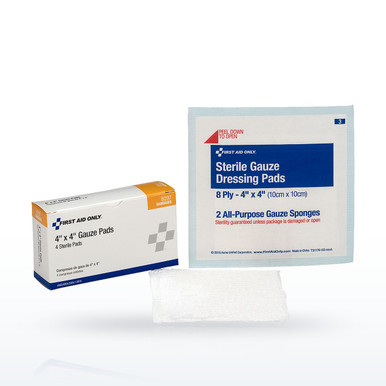 First Aid Only B207 4 in x 4 in Sterile Gauze Pads, 4 per BoxFirst Aid Only prints 8-ply, 100 percent gauze, 4 x 4 inch, sterile, not made with natural rubber latex, 4 per box
Why gauze is two products. The same word covers the square that goes on the cut and the roll that goes around the hand, and they are bought, stored and used differently. A pad is single-use and sterile when it touches an open wound; a roll is an ordinary bandage that may be sterile (the SmartCompliance refill rolls are) or non-sterile (the shelf rolls are) because it holds the pad rather than touching the wound. The questions people ask run to the sizes (which square for which cut, how wide a roll), the ply count, sterile against non-sterile, the sticking problem, and whether a pharmacy sells it. This page answers them with the figures First Aid Only prints on each box and the care steps the Red Cross wounds page states, and sends the heavy-bleeding items (Z-fold packing gauze, NuStat and Celox hemostatic gauze, trauma pads) to their own guides.
Gauze sizes and what each is for
Sizes and ply are as printed on the First Aid Only boxes; the kit counts are the Z308.1-2021 minimums.
The questions, one by one
What is the difference between normal gauze and sterile gauze?
The gauze is the same weave; the difference is the package. Sterile gauze is sealed in an envelope after sterilization and stays sterile until the envelope is opened, which is why First Aid Only prints "packaged in sterile envelopes" and "removed without re-opening the wound" on its pads. Non-sterile gauze is clean but not sterilized and is sold in bulk sleeves for cleaning skin around a wound, padding a splint, or wrapping over a sterile pad. The rule in the kit: the layer that touches an open wound is sterile.
When should you use sterile gauze, and should gauze go directly on a wound?
A sterile pad goes directly on an open wound as the dressing: the Red Cross care step for a wound is to place a dressing on it and apply direct pressure, and for bleeding that soaks through, to add a pad on top rather than remove the first one. Plain gauze on a weeping wound or a burn will dry into the wound and pull when it is removed, so for those a non-adherent pad goes against the wound and the gauze pad goes over it. Non-sterile gauze stays off the wound bed.
How do you keep gauze from sticking to a wound?
Use a non-adherent pad as the first layer: First Aid Only’s 2 x 3 and 3 x 4 inch non-adherent pads are described as "absorbs without adhering to wound, ease of removal minimizes trauma to wound site", and the A235 pads add adhesive edges so no tape is needed. For a burn the kit item is a gel-soaked burn dressing, which is made not to stick (the burn guide linked below). When a plain gauze pad has already dried on, the Red Cross wounds page does not give a soaking method; a dressing that will not lift without tearing the wound is a reason to see a clinician.
How do you bandage a wound with gauze?
As the Red Cross wounds page states it: check the scene and put on gloves, place the sterile pad on the wound, apply direct pressure until the bleeding stops, then wrap a roller bandage over the pad, starting below the wound and working up, with enough tension to hold the pad and not so much that the fingers or toes beyond it go cold or pale (the page’s circulation check). Tape the end, or use the Red Cross "bandage splitting" method: tear the last length of the roll into two tails, pass one under the limb and tie them. The bandaging guide linked below has the full sequence.
What sizes are available for gauze rolls and gauze pads?
Rolls in the First Aid Only line: 2 inch x 4 yards, 2 inch x 5 yards, 3 inch (SmartCompliance refill), 4 inch x 4 yards and 4 inch x 5 yards, plus 2 inch sterile stretch rolls and the 18 x 36 inch compress. Pads: 2 x 2, 3 x 3 and 4 x 4 inch sterile, with an assorted 2 x 2, 3 x 3 and 4 x 4 box (I228). The widths follow the limb: 2 inch for hands and wrists, 3 inch for forearms, 4 inch for legs and the head.
What is 8-ply vs 12-ply gauze?
Ply is the number of gauze layers folded into the pad: an 8-ply pad is eight layers, a 12-ply pad twelve, and the higher ply holds more fluid and cushions more. First Aid Only prints 8-ply, 100 percent gauze on its 2 x 2 and 4 x 4 inch unit boxes and 12-ply on the SmartCompliance sterile gauze pad refill. Either meets the Z308.1 "sterile pad" line; the standard sets the size, not the ply.
What are gauze dressings used for in first aid?
Three jobs: covering a wound (the dressing), absorbing blood and fluid (pads and the 5 x 9 inch trauma pad), and cleaning (non-sterile pads with an antiseptic). First Aid Only’s boxes say "suited for cleaning wounds and applying medication or antiseptic" and "can be stacked for extra protection". Rolls hold the dressing and give moderate compression.
What is a gauze pad vs a gauze swab vs a gauze sponge?
The same square under three names: "pad" is the first aid word, "swab" the British word, "sponge" the surgical word, and a surgical sponge usually carries an X-ray-detectable thread so it can be counted. The 4 x 4 inch 8-ply pad in a first aid kit is not a surgical sponge and is not meant for the mouth; a dental office buys its own.
What can I use in place of gauze pads?
Any clean, absorbent, lint-free material held with pressure: the Red Cross bleeding page names "gauze or a t-shirt" for direct pressure when there is nothing else. For a kit the substitute is a non-adherent pad or a trauma pad, both of which are gauze-based. Cotton balls and paper towels shed fibers into a wound and are not a dressing.
Is non-woven gauze better, and will it stick?
Non-woven gauze is a bonded polyester-rayon sheet rather than a cotton weave; it lints less and holds more fluid for its thickness, and it sticks less than loose cotton gauze but it is not non-adherent. First Aid Only’s triangular bandage comes in both muslin and non-woven; its pads are 100 percent cotton gauze.
Can you buy gauze from a pharmacy, and how much does it cost?
Yes; every pharmacy sells sterile gauze pads and rolls, and so do we. First Aid Only’s unit boxes are the first aid kit sizes (a 4 x 4 inch 4-pack, a 3 x 3 inch 8-pack, a 2 x 2 inch 6-pack), the 10-count cartons and the 100-count SmartCompliance refills are the cabinet sizes, and the current price is on each row in the band. A kit refill is cheaper per pad than a pharmacy box because the pads are packed for the cabinet, not the shelf.
How do you tape a gauze pad in place?
Two strips of first aid tape across the pad, each running onto skin on both sides, with the pad larger than the wound by an inch all round. For a joint or a hand a cohesive wrap holds better than tape; for sensitive skin the non-adherent pad with its own hypoallergenic adhesive edges saves the tape. The tape guide linked below covers paper, cloth and waterproof tapes.
Is gauze the same as a bandage, and what is a conforming gauze bandage?
A gauze pad is a dressing; a gauze roll is a bandage. "Conforming gauze bandage" is the roll: First Aid Only describes it as "uniform weave of cotton and polymer yarns gives the latex-free gauze sufficient stretch to conform to most areas", "for moderate compression", with "fast woven edges" that "minimize lint and eliminate loose threads".
What is kaolin gauze?
Hemostatic gauze impregnated with kaolin, a clay that speeds clotting; QuikClot is the brand most people mean. First Aid Only’s hemostatic gauze is NuStat (cellulose and silica-based fibers) and Celox (chitosan); the hemostatic guide linked below covers them. None of them replaces the sterile pad in a Class A kit; they are the bleeding-control add-on.
Gauze in the First Aid Only line, as the boxes print it
| Item | Size | Ply and material | Sterile | Count | Z308.1-2021 line |
|---|---|---|---|---|---|
| 3-002 | 2 x 2 inch pad | 8-ply, 100 percent gauze, latex-free | Yes, sterile envelopes | 6 per box | Sterile pad (Class A 2, Class B 4, minimum 3 x 3 inch) |
| AN206 / AN206-10 | 3 x 3 inch pad | 100 percent gauze | Yes | 8 per box; 10 boxes per carton | Sterile pad, 3 x 3 inch |
| B207 | 4 x 4 inch pad | 8-ply, 100 percent gauze, latex-free | Yes | 4 per box | Sterile pad (larger than minimum) |
| FAE-5013 | Sterile gauze pads, SmartCompliance refill | 12-ply, 100 percent gauze, latex-free | Yes | As printed | Sterile pad |
| B204 / H245 | 2 inch x 4 yard conforming roll | Cotton and polymer weave, latex-free | No | 1 per box; 12 per box | Roller bandage 2 inch x 4 yards (Class A 1, Class B 2) |
| 51018 / 5-6600 | 4 inch x 4 yard conforming roll | Cotton and polymer weave, latex-free | No | 1; 12 per box | Roller bandage 4 inch (Class B 1) |
| 5-600 | Sterile stretch gauze, 4 sizes | Cotton and polymer weave, latex-free | Yes | 1 per box | Roller bandage |
| 3-00 | 18 x 36 inch gauze compress | Gauze | As printed | 2 per box | Supplementary |
| 3-601 / 3-605 | 2 x 3 and 3 x 4 inch non-adherent pads | Non-stick face, latex-free | Yes | 10 per box; 2-count | Supplementary (burns and weeping wounds) |
| AN205 / J236 | 5 x 9 inch trauma pad | Absorbent with moisture barrier, latex-free | Yes | 1; 10 per box | Trauma pad 5 x 9 inch (Class A 2, Class B 4) |
Source: First Aid Only product pages and documents (firstaidonly.com); ANSI/ISEA Z308.1-2021 minimum fill as First Aid Only’s "Understanding OSHA & ANSI 2021" document and our Z308.1 rule page list it
In plain words
- Pads are the dressing (2 x 2, 3 x 3, 4 x 4 inch); rolls are the bandage (2, 3, 4 inch by 4 or 5 yards).
- Sterile on the wound; non-sterile around it. The envelope is the difference, not the weave.
- 8-ply is eight layers; 12-ply is thicker. Z308.1 sets the size (3 x 3 inch minimum), not the ply.
- Plain gauze sticks to a weeping wound or burn: a non-adherent pad goes first, or a gel-soaked burn dressing.
- Red Cross: pad, direct pressure, add a pad on top if it soaks through, roller bandage over it, check circulation.
- Class A: 2 sterile pads and 2 trauma pads and a 2 inch roller. Class B: 4 of each pad and a 2 and a 4 inch roller.
- Packing and hemostatic gauze are for life-threatening bleeding, not the everyday dressing.
Questions people ask
What is the difference between sterile and non-sterile gauze?
The package: sterile pads are sealed after sterilization for an open wound; non-sterile gauze is clean bulk gauze for cleaning, padding and wrapping over a sterile pad.
Should gauze go directly on a wound?
A sterile pad does, as the Red Cross dressing step; a weeping wound or burn gets a non-adherent pad first so the gauze does not dry into it.
How do I stop gauze sticking to a wound?
Put a non-adherent pad against the wound and the gauze over it; for burns use a gel-soaked burn dressing.
What sizes do gauze rolls come in?
In this line 2, 3 and 4 inches wide by 4 or 5 yards; 2 inch is the Class A roller, 4 inch the Class B addition.
What sizes do sterile gauze pads come in?
2 x 2, 3 x 3 and 4 x 4 inch; Z308.1 calls for 3 x 3 inch or larger.
What is 8-ply gauze?
Eight layers of gauze folded into one pad; 12-ply is thicker and more absorbent.
Can you buy gauze from a pharmacy?
Yes; kit-sized unit boxes and 100-count cabinet refills are cheaper per pad than pharmacy packs.
What is a gauze wrap called?
A conforming or stretch gauze roll, also roller gauze.
Is an elastic bandage the same as gauze?
No; an elastic bandage is a heavier stretch weave for compression and support; gauze rolls hold a dressing.
What is a non-adherent dressing and how do you put it on?
A pad with a non-stick face; the non-stick side goes against the wound, then gauze or tape over it.
What is an ABD pad used for?
An abdominal pad is a thick absorbent dressing for a large or heavily draining wound; the first aid line’s equivalent is the 5 x 9 inch trauma pad.
How many gauze pads does an ANSI kit need?
Class A: 2 sterile pads 3 x 3 inch and 2 trauma pads 5 x 9 inch; Class B: 4 of each.
Related guides
What should be in a workplace first aid kit?The Z308.1 minimum fillBleeding control kits and tourniquetsWhat Stop the Bleed and Z308.1 sayHow to treat a burn at workFirst aid and burn dressingsFingertip and knuckle bandagesHow to apply themFirst aid kit refillsHow often to check and restockThe ratings, test results and standards shown here are the manufacturers' published values, reproduced as published. Nothing on this page is a recommendation by Bayshore Safety that any product is suitable for a particular task, hazard or workplace. Selecting safety products and protective equipment is the responsibility of the end user and the employer, based on their own hazard assessment and the regulations that apply to their work. Confirm every value on the manufacturer's own documentation before use.
© 2026 Bayshore Safety & Industrial Supplies, Inc. All rights reserved. This guide may not be copied or republished without written permission.