
What are the gloves called that you can’t cut through? Cut-resistant gloves, the levels in the trade’s words, and why none is cut-proof
They are called cut-resistant gloves, and the trade grades them by the ANSI/ISEA 105 cut level printed on the back of the hand, A1 to A9. There is no glove rated cut-proof: the level is the grams of force a blade needed to cut through the material in the ASTM F2992-15 test, and a sharp enough edge with enough force gets through any of them. MCR Safety pairs the levels with the words buyers use: A2 and A3 for light and light-to-medium cut hazards, A4 for medium, A5 for medium-to-heavy, A6 for heavy, A7 for high, A8 for very high and A9 for extreme cut hazards (6,000 grams and over). The fibers behind the levels are HPPE (MCR Safety’s HyperMax), aramid (Kevlar and MCR Safety’s ARX), Dyneema and steel or glass cores, knitted into a shell and usually coated for grip. “Kevlar gloves”, “steel mesh gloves” and “level 5 gloves” are the other names the question comes in; the level is what they have in common.
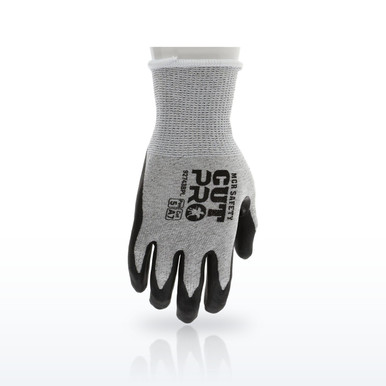 MCR Safety Cut Pro 92743BP Cut Resistant Gloves, ANSI A7, Bi-Polymer CoatedANSI A9, the highest cut level, as MCR Safety rates it (MCR Safety data)
Why “cut-proof” is the wrong word, and what the right one tells you. The ANSI test does not ask whether a blade can get through; it measures how much weight on a moving blade it takes to cut through 20 mm of travel, and the level is the band that gram figure falls in. An A4 glove was cut at between 1,500 and 2,199 grams; an A9 held past 6,000. That is why a knife held hard will cut an A4 and a box cutter dragged lightly will not. Metal mesh gloves for meat cutting are a different product, outside the knit scale, and still not stab-proof: the ANSI puncture level, a separate rating, covers the probe test, and needle-stick resistance is a third rating again. The employer picks the level from the hazard assessment 1910.138 and 1910.132(d) require, and the glove page shows the manufacturer’s level, never more.
The levels in the words the trade uses
MCR Safety’s hazard phrase for each ANSI/ISEA 105 level, with the gram band.
The other names the question comes in
- “Kevlar gloves”: aramid fiber gloves; MCR Safety’s Kevlar styles run A2 to A9 depending on the knit and its ARX styles A4 to A7, and Kevlar also carries contact heat resistance.
- “Steel mesh” or “chainmail gloves”: metal gloves for knife work in meat and fish cutting, a different product from the knit scale; not in the MCR Safety line.
- “Level 5 gloves”: the old 2005 scale had levels 1 to 5; its level 4 (1,500 to 3,499 grams) spans today’s A4 to A6 and its level 5 (3,500 grams and up) sits at A6 and above, and the A levels are what manufacturers print now.
- “Dyneema gloves” and “HPPE gloves”: polyethylene fiber gloves; MCR Safety’s HyperMax runs A2 to A9, its Dyneema Diamond A2 to A6.
- “Cut-resistant sleeves”: the same fibers knitted into a sleeve, rated on the same scale; MCR Safety’s sleeves run A2 to A8.
- What none of them are: puncture-proof or needle-proof; those are separate ANSI ratings on the same label.
ANSI/ISEA 105 cut levels with MCR Safety’s hazard wording
| Level | Grams to cut (ASTM F2992-15) | MCR Safety’s wording |
|---|---|---|
| A1 | 200 to 499 | Not recommended for cut |
| A2 | 500 to 999 | Light cut hazards |
| A3 | 1,000 to 1,499 | Light to medium cut hazards |
| A4 | 1,500 to 2,199 | Medium cut hazards |
| A5 | 2,200 to 2,999 | Medium to heavy cut hazards |
| A6 | 3,000 to 3,999 | Heavy cut hazards |
| A7 | 4,000 to 4,999 | High cut hazards |
| A8 | 5,000 to 5,999 | Very high cut hazards |
| A9 | 6,000 and over | Extreme cut hazards |
Source: MCR Safety, “Sleeve Cut Protection” guide, pages 3–4; the gram bands are the standard’s.
Portwest’s highest levels
Portwest’s A9 gloves on this site are the A793 needle-resistant glove (puncture level 5, EN 388 3X44F), the A680 and the Portwest CTP CT69; its A8 is the CT90 sleeve. Each prints the EN 388 letter F beside the A level, and none is called cut-proof: Portwest states the level the glove reached in the test and nothing more.
Portwest product pages and US data sheets for the styles shown (documents.portwest.com), fetched Nov 7 2026What Radians states about reinforced shells
Radians publishes its own version of the ANSI/ISEA 105 table on its hand protection knowledge base, with the grams range for each level and the kinds of work it groups under light, medium and heavy cut hazards, and it lists the EN 388 ISO 13997 letters A to F beside them in grams and newtons. The same page explains the shell side: HPPE on its own reaches A2 to A3, fiberglass in the yarn raises it to A3, stainless steel to A5 or higher, Kevlar gives high cut levels and is flame resistant, Dyneema Diamond uses embedded micro fibers it says strengthen the fiber up to two times, and its own TEKTYE yarn reaches A4 without glass fiber or stainless steel. Radians adds a caution about glass and steel reinforced shells: over time those fibers break, which can irritate the skin and leaves the glove, at the point of the break, closer to A2 than A4. Each Radians cut glove page on this site carries the tested grams for that style.
Radians Knowledge Base, Hand Protection Solutions (radians.com/kb-hand-protection, radians.com, fetched Nov 8 2026)ANSI/ISEA 105 cut levels as Radians tabulates them (grams to cut through, and the work it lists for each)
| Level | Grams (Radians table) | Radians groups the hazard as | Work Radians lists |
|---|---|---|---|
| A1 | 200–499 | Light | material handling, assembly, maintenance, packaging, warehouse, general purpose, construction |
| A2 | 500–999 | Light / medium | the A1 list plus metal handling and appliance manufacturing |
| A3 | 1,000–1,499 | Light / medium | as A2 |
| A4 | 1,500–2,199 | Medium | bottle and light glass handling, canning, drywall, electrical, carpet installation, HVAC, paper production, automotive assembly, metal handling and stamping, packaging, warehouse, appliance manufacturing |
| A5 | 2,200–2,999 | Medium | as A4 |
| A6 | 3,000–3,999 | Medium / heavy | as A4 |
| A7 | 4,000–4,999 | Medium / heavy | the A4 list plus meat processing |
| A8 | 5,000–5,999 | Heavy | as A7 |
| A9 | 6,000 and up | Heavy | as A7 |
Source: Radians Knowledge Base, Hand Protection Solutions (radians.com/kb-hand-protection, radians.com, fetched Nov 8 2026). The grams figure on each Radians cut glove page on this site (the "ANSI Cut Grams" line) is the tested value for that style.
More questions people ask
What is a cut rating on gloves?
Cut-resistant gloves, rated A1 to A9 under ANSI/ISEA 105. None is cut-proof; the level is the grams of force on a blade it took to cut through in the test.
Answers from the sources named above and in the byline.Questions people ask
What is the highest ANSI cut level for gloves?
A9: 6,000 grams and over on the ASTM F2992-15 test. MCR Safety calls it the level for extreme cut hazards and lists A9 styles in its Cut Pro line.
Are Kevlar gloves cut-proof?
No. Kevlar is an aramid fiber with good cut and heat resistance; a Kevlar glove carries an ANSI level like any other, and MCR Safety’s run A2 to A9 by the knit.
What are cut 5 gloves called now?
A rating from the 2005 edition of the standard, which had levels 1 to 5; level 5 meant 3,500 grams and up, which sits at A6 and above on the current A1 to A9 scale. Manufacturers print the A level now.
Do cut-resistant gloves stop punctures?
Cut and puncture are separate ratings on the ANSI label (puncture 1 to 5 on the probe test; needle-stick separately). A high cut level does not mean a high puncture level.
What are the different levels of cut-resistant gloves?
Nine under ANSI/ISEA 105: A1 (200 to 499 grams), A2 (500 to 999), A3 (1,000 to 1,499), A4 (1,500 to 2,199), A5 (2,200 to 2,999), A6 (3,000 to 3,999), A7 (4,000 to 4,999), A8 (5,000 to 5,999) and A9 (6,000 and up). European gloves show the EN 388 letter A to F from the same straight-blade test.
What are the most cut-resistant gloves?
By the published scale, gloves rated ANSI A9 (6,000 grams of blade load and up) or EN 388 cut letter F (30 newtons and up). They are knit from HPPE, aramid or steel and glass core yarns; Portwest’s highest levels are listed in its section above, and the band shows each glove at the level its manufacturer publishes. None is cut-proof.
Can Kevlar gloves stop a knife?
Up to the level printed on them. Kevlar (aramid) gloves run from A2 to A9 depending on the knit, and the level is the grams of load a straight blade needed to cut through; a stab or a sawing cut with enough force gets through any knit, and puncture is a separate rating.
What is a cut rating on gloves?
Cut-resistant gloves, rated A1 to A9 under ANSI/ISEA 105. None is cut-proof; the level is the grams of force on a blade it took to cut through in the test.
What are cut-proof gloves made of?
There is no cut-proof glove; the cut-resistant ones are knitted from HPPE (MCR Safety’s HyperMax, Dyneema), aramid (Kevlar, MCR Safety’s ARX) and proprietary spun yarns (Hero), usually with glass fiber or stainless steel strands wrapped inside the yarn to reach A4 and above, and coated for grip. Steel mesh (chainmail) gloves for knife work are a separate metal product.
What gloves will thorns not go through?
That is puncture, a separate ANSI/ISEA 105 rating (levels 1 to 5, 10 to 150 newtons on a blunt probe) from the cut level; a thorn is closer to the needle-stick test (ASTM F2878) that fine points are rated on. Leather palms and heavy nitrile dips publish the higher puncture levels; read the puncture level on the product page, not the cut level.
What is the difference between A1 and A2 cut-resistant gloves?
A1 is 200 to 499 grams of cutting load, a level MCR Safety does not pair with any cut hazard; A2 is 500 to 999 grams, “light cut hazards”. Both are the bottom of the nine-level scale; A4 (1,500 grams) is where most jobsite specifications start.
What are cut-resistant gloves called?
Cut-resistant gloves, cut-level gloves, or by the fiber: Kevlar gloves, HPPE gloves, Dyneema gloves, steel-core gloves. Manufacturers also use series names (MCR Safety Cut Pro, PIP MaxiCut, G-Tek PolyKor, Radians Axis). Whatever the name, the rating is the ANSI/ISEA 105 level printed on the back of the hand, A1 to A9.
What do Kevlar gloves protect against?
Cuts and heat together. Kevlar is a para-aramid that resists a blade (plain Kevlar knits run about A2 to A4, Kevlar with steel or glass cores higher) and does not melt, tolerating brief contact with hot parts, which is why cut-rated gloves for welding, foundry and glass work are usually aramid. They are not puncture-proof or needle-proof; those are separate ANSI ratings.
The ratings, test results and standards shown here are the manufacturers' published values, reproduced as published. Nothing on this page is a recommendation by Bayshore Safety that any product is suitable for a particular task, hazard or workplace. Selecting safety products and protective equipment is the responsibility of the end user and the employer, based on their own hazard assessment and the regulations that apply to their work. Confirm every value on the manufacturer's own documentation before use.