
Does OSHA allow stickers on hard hats? What the manufacturer states, the reverse-donning arrow, and the markings a hat has to carry
OSHA’s rules (29 CFR 1910.135 and 1926.100) require a hard hat that meets ANSI/ISEA Z89.1 and say nothing about stickers; the answer comes from the manufacturer’s use instructions, which OSHA holds the employer to. PIP’s published answer: some self-adhesive stickers may be used if they are not metallic and the adhesive does not damage the shell’s composition, placed at least a half inch from the helmet’s edge, never used to cover a defect, and the shell inspected inside and out when stickers are applied. The same sheet gives the inspection list, the five-year shell and twelve-month suspension replacement figures, and the reverse-donning arrow that marks a hat tested to be worn backward.
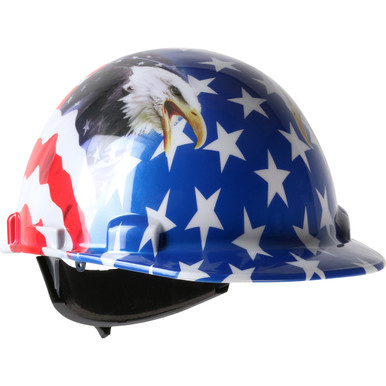 PIP Dom 280-HP341R-USA Hard Hats, Type I Class E, HDPE ShellType I Class E hard hat with the manufacturer’s inside markings (PIP data)
Why it comes up. Stickers carry the company logo, the certification record and the trade on a crew’s hats, and the worry is the two things a sticker can do: hide a crack and, on a Class E or G hat, add something conductive or something that attacks the shell. The manufacturer’s answer separates those: no metallic stickers, an adhesive that does not damage the shell, a half inch clear of the edge, and never over a defect. The inspection the sheet describes (cracks, dents, gouges, holes or tears in the shell; fading or brittleness; frayed or cut suspension straps; cracks or tears in the suspension; a damaged wheel or slip ratchet) is the daily check that a sticker must not get in the way of.
The manufacturer’s answers, as published
PIP Hard Hat FAQs, 11/2024.
What the rules themselves say
OSHA sets the standard and the maintenance duty; the manufacturer sets the use rules:
- 29 CFR 1910.135(b)(1) and 1926.100(b): the helmet must comply with ANSI Z89.1-2009, 2003 or 1997, or be shown to be equally effective. Neither paragraph mentions stickers, paint or markings added by the user.
- OSHA’s general PPE rule, 1910.132(a), requires equipment to be maintained in a sanitary and reliable condition; a sticker that hides a crack is a maintenance failure, which is the manufacturer’s reason for the never-over-a-defect rule.
- The Class E and G proof tests (20,000 and 2,200 volts in the manufacturer’s sheet) are run on the shell as made; anything added to it is the user’s responsibility, which is why the manufacturer limits stickers to non-metallic ones with a shell-safe adhesive.
- Paint is not covered by the PIP sheet; the shell materials guide explains why solvents matter to HDPE and polycarbonate shells.
More questions people ask
Am I allowed to put stickers on my hard hat, and how do I get them to stick?
The manufacturer’s instruction decides, and the ones quoted above are the pattern: small stickers, placed away from the brim edge, not covering a crack or dent and not so many that the shell cannot be inspected, with the caution in Z89.1 that metallic markers (some reflective tapes, foil labels, hot stamps) on a Class G or E shell need the manufacturer’s authorization. OSHA’s letter of interpretation says the same: stickers are acceptable when the manufacturer allows them and they do not hide damage. To make them stick, clean the shell with mild soap and water and dry it; no solvents, which attack the plastic. Studson sells its own reflective kit pre-cut for the SHK-1 (Safe Reflections Inc. material, hi-vis, SOLAS, blue, green and red versions) and does not publish a separate sticker policy, so the Z89.1 cautions and the inspection rule are what apply.
What size are hard hat stickers, what do 1,000 stickers cost, and where do you get good ones?
Hard hat stickers run from about 1 inch (union, certification and “safety first” decals) to 2 or 3 inches (company logos on the front) to the strips of a reflective kit; sizes are set by the printer, not a standard. Bulk custom stickers are priced by the printer by quantity, material (vinyl, reflective) and size, and a quote for a thousand depends on all three, so we do not print a figure. The sticker that was tested on the shell is the manufacturer’s own kit, cut for the model: Studson, JSP, PIP and Dynamic kits are listed above and on the brands guide.
Answers from the sources named in the byline; Studson figures from the Studson product pages and spec sheets, fetched Nov 10 2026.Questions people ask
Does OSHA allow stickers on hard hats?
OSHA’s hard hat paragraphs do not address stickers; the employer is held to the manufacturer’s instructions. PIP’s published answer allows non-metallic stickers with a shell-safe adhesive, a half inch from the edge, never over a defect.
Can a sticker affect the electrical class?
The manufacturer excludes metallic stickers for that reason; the Class E and G tests are run on the shell as manufactured.
Can you wear a hard hat backward?
Only a hat marked with the reverse-donning arrow, which means it passed the Z89.1 tests in both positions (PIP FAQ Q3); the suspension is turned, not the shell alone.
How often should a hard hat be replaced?
The manufacturer states most makers set the shell at 5 years and the suspension at 12 months from the in-service date as maximums, sooner on inspection, and immediately after an impact or penetration.
What has to be printed inside a hard hat?
Manufacturer’s name, date of manufacture, testing legend, Type and Class, approximate size range; optional LT, HT, HV and the reverse-donning arrow (PIP FAQ Q6 and Q7).
Does OSHA allow hats under hard hats?
OSHA's rules do not mention them; the manufacturer's instructions do, and OSHA holds the employer to them. The manufacturers' position is that nothing may sit between the suspension and the head that changes how the suspension fits or that fills the clearance in the crown: a ball cap with a button or a hood is out, a thin liner or skull cap made for hard hats is accepted by most manufacturers. PIP's FAQ sheet and the how-to-wear guide on this site cover it.
Do stickers affect a hard hat's rating?
Not when the manufacturer's conditions are kept: non-metallic stickers with an adhesive that does not attack the shell, placed at least a half inch from the edge, never over a defect, with the shell inspected inside and out when they are applied. A metallic sticker can conduct on a Class E or G shell, and a sticker over a crack hides what the inspection has to find. Paint is a separate question answered by the shell material guide.
Am I allowed to put stickers on my hard hat?
If the manufacturer allows it: small, away from the edge, not hiding damage, and no metallic markers on a Class G or E shell without authorization.
How do I get stickers to stick to a hard hat?
Clean the shell with mild soap and water and dry it; never a solvent, which attacks the plastic.
What are the standard sizes of helmet stickers?
About 1 inch for decals, 2 to 3 inches for logos, strips for reflective kits; the printer sets them, no standard does.
How much do 1,000 stickers cost?
Priced by the printer by quantity, material and size; we quote only the manufacturers’ pre-cut kits, which are priced on their rows.
Can you modify a hard hat?
Only with accessories the manufacturer lists; drilling, cutting, gluing or painting the shell is ruled out by Z89.1’s user appendix and the manufacturers’ instructions.
Does Studson allow stickers on the SHK-1?
Studson sells its own pre-cut reflective kit for the SHK-1 and publishes no separate sticker policy, so the Z89.1 cautions and the inspection rule apply.
Does MSA allow paint or stickers on a V-Gard?
MSA says paint should never be used on any of its helmets except Thermalgard and Skullgard, because it may attack other shells; MSA’s own imprinting ink becomes part of the shell once cured (24 to 48 hours). For stickers, MSA’s label and the Z89.1 cautions above apply.
The ratings, test results and standards shown here are the manufacturers' published values, reproduced as published. Nothing on this page is a recommendation by Bayshore Safety that any product is suitable for a particular task, hazard or workplace. Selecting safety products and protective equipment is the responsibility of the end user and the employer, based on their own hazard assessment and the regulations that apply to their work. Confirm every value on the manufacturer's own documentation before use.