
Bayshore Safety & Industrial Supplies Guide
Hemostatic gauze: what QuikClot and Celox are, how hemostatic dressings are used, wound packing, whether QuikClot stops arterial bleeding, what medics and EMTs use to stop bleeding, Israeli bandages, pressure dressings and shelf life
Hemostatic gauze is gauze that carries a clotting agent: kaolin (QuikClot Combat Gauze), chitosan (Celox) or cellulose and silica fibers (NuStat, the pad First Aid Only sells). It is packed into a deep wound and held with firm pressure, and the Red Cross external-bleeding page puts it in its care steps: "place dressing on wound, use a hemostatic dressing if available, apply steady, firm pressure directly over wound". OSHA’s June 2019 bleeding-control letter states that under the 2015 Red Cross and Heart Association guidelines "hemostatic dressings may be used where direct pressure or tourniquets cannot be used" and that a first aider adequately trained under 1910.151(b) is trained in direct pressure, hemostatic dressings and tourniquets. What medics and EMTs use is the same three things in the Stop the Bleed order: pressure, packing, tourniquet. The military did not stop using QuikClot; it moved from the first-generation granules to the gauze form, which is what Combat Gauze is.
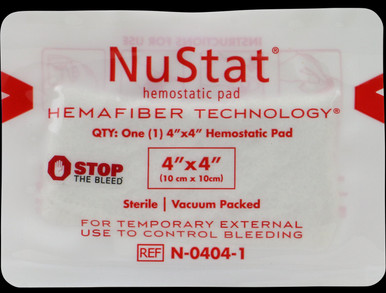 First Aid Only 91196-10 Nustat Hemostatic Gauze Pads 4 in x 4 in 10 per BagFirst Aid Only prints NuStat hemostatic gauze pads, 4 x 4 inch, a blend of cellulose and silica-based hemostatic fibers, 10 per bag
Why a 4 x 4 inch pad costs what it does. Plain gauze soaks up blood; hemostatic gauze makes it clot. The agent in the gauze (kaolin, chitosan or NuStat’s fiber blend, which First Aid Only describes as working "independently of the body’s normal clotting mechanisms to clot blood even where normal clotting is slow or impaired") is what you pay for, and it is why the pad belongs in the bleeding control kit beside the tourniquet rather than in the everyday first aid cabinet. The questions people ask about it are mostly about brands and the military (QuikClot, Celox, Combat Gauze, what medics carry), about how to use it, and about whether it is safe for civilians to buy; this page answers them with the Red Cross and Stop the Bleed steps, OSHA’s 2019 letter, and the statements First Aid Only prints on its NuStat, Celox and Z-fold products.
How a hemostatic dressing is used, as the Red Cross and Stop the Bleed state it
Red Cross: direct pressure and a tourniquet (if trained) for life-threatening limb bleeding; wound packing (if trained) for the scalp, neck, shoulder, groin and back, or a limb with no tourniquet. Stop the Bleed: A, alert 911; B, find the bleeding; C, compress.
- Alert: call 911, know your location, follow the operator. Your safety first; wear gloves if you can.
- Bleeding: find the source. Look for continuous bleeding, large-volume bleeding and pooling; clothing can hide it. Check arms and legs, neck, armpits and groin, and the body.
- Compress with pressure: apply direct pressure to the wound with just enough gauze or cloth to cover it; if pressure stops the bleeding, keep it on until help arrives.
- Compress with packing: for a deep wound where surface pressure is not enough, pack gauze (hemostatic gauze if available) tightly into the wound until it stops the bleeding, then hold pressure until help arrives. Do not remove the packing; put a dressing over it and press.
- Compress with a tourniquet: for life-threatening limb bleeding, 2 to 3 inches above the wound, not over the elbow or knee, tightened until the bleeding stops, never removed by you; a second tourniquet may be needed. Tourniquets hurt.
- Stay with the person, keep them from getting cold or overheated, watch for shock, and hand over to EMS with the time the tourniquet went on.
The questions, one by one
What is QuikClot, and is QuikClot the same as Combat Gauze?
QuikClot is a brand of hemostatic products whose agent is kaolin, a clay that activates the clotting cascade; QuikClot Combat Gauze is its gauze form, a 3 inch by 4 yard Z-folded strip impregnated with kaolin, and it is what the military and EMS carry under that name. So Combat Gauze is a QuikClot product, and "QuikClot" in a conversation about medics usually means Combat Gauze. First Aid Only’s hemostatic line is NuStat (fiber-based) and Celox (chitosan); the band has them with the statements the manufacturer prints.
Why did the army stop using QuikClot?
It did not stop; it changed form. The first QuikClot was a granular zeolite poured into a wound, which generated heat and was hard to remove; the next generation was kaolin, and the gauze form (Combat Gauze) replaced the granules in the military’s tactical combat casualty care guidelines, where it remains the hemostatic dressing of record. The "stopped using" story is the granules; the gauze is still issued. We do not sell QuikClot and we state this as general background, not as a manufacturer statement.
Can QuikClot stop arterial bleeding?
Hemostatic gauze is made for exactly that: a deep wound with bleeding that direct pressure alone cannot control, packed to the source and held. The Red Cross and Stop the Bleed order still applies: pressure first, packing with hemostatic gauze where pressure fails or cannot be applied, and a tourniquet for a limb. First Aid Only prints that its NuStat pad "is designed to promote rapid blood coagulation in the event of a traumatic wound involving an arterial bleed" and that "applying the pad and applying pressure" is the method; no hemostatic works without the pressure.
How do you use hemostatic dressings and apply Combat Gauze?
As in the steps above: expose the wound, wipe away pooled blood to find the bleeding vessel, pack the gauze into the wound against the source, feeding it in until the cavity is full, then hold firm direct pressure for the time the product’s instructions state (the Stop the Bleed course says hold until help arrives), then bandage over it with a pressure dressing. Do not pull the packing out to check. The Red Cross restricts wound packing to the trained rescuer; a Stop the Bleed class is 90 minutes.
Is Celox safe to use, and where should you not use Celox or QuikClot?
Celox is chitosan, derived from shellfish shell, and First Aid Only prints on its Celox products that it "stops even serious bleeding in seconds" and is "sterile, waterproof, easy-open packaging for single use". Hemostatic gauze is packed into wounds of the limbs, neck, armpit, groin and trunk wall; it is not for the chest cavity, the abdomen (where the bleeding is internal), the eye or the airway, and it is not a substitute for a tourniquet on a limb when one is available. Shellfish allergy is the question people ask about chitosan; the manufacturer’s labeling is the statement to read.
What do military medics and EMTs use to stop bleeding?
The same three tools, in the same order Stop the Bleed teaches civilians: direct pressure, wound packing with hemostatic gauze, and a windlass tourniquet, plus a pressure dressing (an Israeli bandage or an elastic pressure strap) over the packing and a chest seal for a penetrating chest wound. That is what the First Aid Only bleeding control kits in the band carry: a windlass tourniquet, hemostatic gauze, a Hema-Seal trauma dressing or Israeli bandage, a chest seal, gloves, shears and a marker for the tourniquet time.
What is an Israeli bandage, how does it work, and why is it called that?
A pressure dressing with its own elastic wrap: a sterile pad, an elastic bandage sewn to it, a plastic pressure bar that the wrap passes through so the bandage turns back on itself and presses the pad into the wound, and a closure bar so no pins or tape are needed. First Aid Only prints "pressure applicator bar to apply direct pressure, closure bar to avoid pins and tape, quick and easy self-application" on its 91152. It is called Israeli because it was developed by an Israeli military medic and first issued by the Israel Defense Forces; "emergency bandage" and "trauma bandage" are the generic names.
When do you use a tourniquet vs an Israeli bandage?
The Red Cross: direct pressure for any external bleeding, and a tourniquet for life-threatening bleeding on an arm or leg when direct pressure does not control it or cannot be applied. The Israeli bandage is a pressure dressing: it keeps direct pressure on after your hands come off, it goes over packing, and it holds the wound once a tourniquet is on. So on a limb with spurting blood the tourniquet goes on first; the Israeli bandage dresses the wound after, or is the pressure tool where a tourniquet cannot go (the trunk, the neck held by hand, the groin).
What are trauma dressings and trauma pads?
Thick absorbent dressings for heavy bleeding: First Aid Only’s 5 x 9 inch trauma pad is "an absorbent dressing with a moisture barrier component" that "helps to stop heavy bleeding", and Z308.1-2021 puts two of them in a Class A kit and four in Class B. The Hema-Seal is an 8 x 10 inch trauma pad sewn into a 4 inch x 4 yard gauze roll, "an all-in-one efficient response to major wounds"; the Hema-Flex compresses are the same idea in 2, 3, 4 and 5 x 9 inch sizes, "sustained graduated compression, latex-free". A trauma dressing is a pressure dressing without a clotting agent; hemostatic gauze is the clotting agent without the dressing; a kit carries both.
How do you stop a cut from bleeding without bandages?
Direct pressure with whatever clean cloth you have, held without lifting; the Red Cross bleeding page quotes its advisor: "that might be direct pressure with your hands or available materials like gauze or a t-shirt". Elevate if it does not hurt. For a finger, First Aid Only’s T-Ring finger tourniquet is a ring that applies the pressure for you (remove within 60 minutes, as its sheet states). WoundSeal powder is the other kit answer for a minor cut: First Aid Only prints "stops bleeding in 15 to 30 seconds and forms a protective seal".
What is a hemostatic agent, and what are the types?
Anything that speeds clotting at a wound. In first aid: kaolin (QuikClot), chitosan (Celox), the cellulose and silica fibers in NuStat, the hydrophilic polymer and potassium ferrate in WoundSeal powder, and SEAL hemostatic spray (First Aid Only: "applies directly to the wound, providing a protective barrier and reducing bleeding"). Surgical hemostats (Surgicel, absorbable gelatin, thrombin) are operating-room products. "Hemostat" is also the name of the locking forceps (Kelly forceps, which First Aid Only sells) surgeons clamp vessels with; it is the same word for a different tool.
How long does QuikClot or hemostatic gauze last, and can civilians buy it?
Each package carries an expiration date from its manufacturer; First Aid Only prints a 5-year shelf life on its Z-fold compressed packing gauze, and the hemostatic products carry the date on the pouch. Anyone may buy hemostatic gauze; it is not a prescription product, and the Stop the Bleed program exists so that bystanders carry and use it. Check the dates with the kit inspection and replace a pouch that has been opened or is past date.
How do you apply a pressure dressing, and how do you pack a wound after surgery?
A pressure dressing for first aid: pad over the wound (or over the packing), the wrap wound firmly over it, the Israeli bandage’s bar turned to press, the end secured, and the circulation check beyond it. Packing a surgical wound is wound care under a clinician’s instruction, not first aid; the gauze is the same product, the method is the surgeon’s.
In plain words
- Hemostatic gauze: gauze with a clotting agent (kaolin in QuikClot, chitosan in Celox, fiber in NuStat). Packed into a deep wound and held with pressure.
- Order: pressure, packing, tourniquet (Stop the Bleed); hemostatic dressing where pressure or a tourniquet cannot be used (OSHA’s 2019 letter, the 2015 guidelines).
- Combat Gauze is QuikClot in gauze form; the military replaced the granules, not the brand.
- Israeli bandage: a pressure dressing with its own wrap and pressure bar. Trauma pad: a thick absorbent dressing (Class A 2, Class B 4).
- Pack and hold; never pull packing out. Leave the tourniquet on; note the time.
- Dates are on the pouch; replace opened or dated gauze. Anyone may buy it; a Stop the Bleed class teaches it.
Questions people ask
What is QuikClot?
A brand of hemostatic products whose agent is kaolin; Combat Gauze is its gauze form. First Aid Only’s hemostatic gauze is NuStat (fiber-based) and Celox (chitosan).
Why did the army stop using QuikClot?
It did not; it moved from the early granules to the gauze form (Combat Gauze), which it still issues.
Can QuikClot stop arterial bleeding?
Hemostatic gauze packed to the source and held with pressure is made for bleeding that pressure alone cannot control; a tourniquet is still the tool for a limb.
How do you use a hemostatic dressing?
Find the source, pack the gauze tightly into the wound, hold firm pressure until help arrives, dress over it, never remove the packing (Red Cross and Stop the Bleed; trained rescuers).
What do EMTs and medics use to stop bleeding?
Direct pressure, hemostatic gauze packing, a windlass tourniquet, a pressure dressing and a chest seal; the same contents as a bleeding control kit.
What is an Israeli bandage?
A pressure dressing with a sewn-on elastic wrap, a pressure bar and a closure bar, developed for the Israel Defense Forces; First Aid Only sells a 4 inch version.
When is a tourniquet used instead of an Israeli bandage?
For life-threatening limb bleeding that pressure does not control; the Israeli bandage keeps pressure on a wound, including over packing or after a tourniquet.
Is Celox safe?
Celox is chitosan; First Aid Only prints its statements on each pack; it is single-use and sterile. Shellfish allergy is the labeling question to read.
What are trauma pads?
Thick absorbent dressings for heavy bleeding; 5 x 9 inch in the Z308.1 kit, two in Class A and four in Class B.
How long does hemostatic gauze last?
Until the expiration date printed on the pouch; First Aid Only prints a 5-year shelf life on its Z-fold packing gauze.
Can civilians buy hemostatic gauze?
Yes; it is sold without prescription, and Stop the Bleed trains bystanders to use it.
Does OSHA require hemostatic gauze?
OSHA’s 2019 letter says general industry must have the Class A bleeding items, and Class B items including tourniquets where serious injuries are likely; hemostatic dressings are part of adequate first aid training under the 2015 guidelines.
The ratings, test results and standards shown here are the manufacturers' published values, reproduced as published. Nothing on this page is a recommendation by Bayshore Safety that any product is suitable for a particular task, hazard or workplace. Selecting safety products and protective equipment is the responsibility of the end user and the employer, based on their own hazard assessment and the regulations that apply to their work. Confirm every value on the manufacturer's own documentation before use.
© 2026 Bayshore Safety & Industrial Supplies, Inc. All rights reserved. This guide may not be copied or republished without written permission.