Home › Guides › Roofing tools › Hex keys, wire brushes and pliers
Guide · Hand tools · Hex keys, wire brushes, locking pliers and clamps

What is the smallest Allen wrench, and when do you use a steel vs brass wire brush? Hex key sizes in inches and mm and how to tell which you need, hex vs Torx, wire brush bristles for steel, stainless and paint, locking pliers and sheet metal clamps

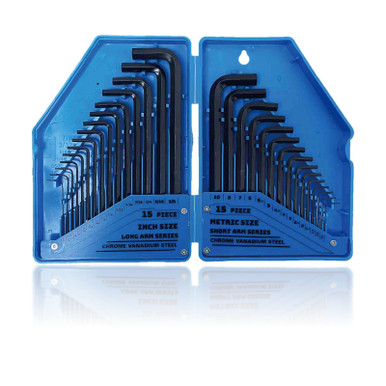
Hex keys (Allen keys, Allen wrenches, L-keys) come in two series that look alike and do not interchange: inch sizes from 0.028 inch up to 1/2 inch (0.050, 1/16, 5/64, 3/32, 7/64, 1/8, 9/64, 5/32, 3/16, 7/32, 1/4, 5/16, 3/8 are the common set) and metric from 0.7 mm to 19 mm (1.5, 2, 2.5, 3, 4, 5, 6, 8, 10 the common set); a 30-piece set like ours carries both. The smallest in a standard set is 0.050 inch or 1.5 mm; smaller keys to 0.028 inch and 0.7 mm exist for electronics and optics. To tell which you need, the key must fill the socket with no rock: a loose fit means the other series or the next size. A wire brush is chosen by bristle: carbon steel for rust, scale, weld spatter and paint on steel; stainless steel on stainless and aluminum so no carbon steel is left behind to rust; brass on anything softer than brass, on threads, and where sparks or scratches are not wanted; nylon for cleaning without scratching. A "wire brush finish" on metal is the brushed texture a rotary wire brush leaves. Locking pliers (the lock-jaw, vise-grip-type pliers) clamp and hold; the sheet-metal version has wide flat jaws for holding laps while they are riveted or seamed.
Bayshore Safety. Industrial safety, roofing tools and jobsite supplies since 2017. · Current as of November 2026 · the C&R product data on this site (30-piece hex key set; wire brush by the dozen; 10 in adjustable pliers; 6-in-1 ratcheting screwdriver by the display of 10; 8 and 9 in locking sheet metal clamps and the Make-it-Clamp stainless strap and clamp kits in 10, 55 and 100 ft with 20-count fastener packs); the hex key size series (inch: 0.028, 0.035, 0.050, 1/16, 5/64, 3/32, 7/64, 1/8, 9/64, 5/32, 3/16, 7/32, 1/4, 5/16, 3/8, 1/2; metric 0.7 to 19 mm) and the set-screw and socket-cap sizes they fit; the wire brush trade’s bristle grades (carbon steel, stainless, brass, nylon)
C&R AW-832 Hex Key SetC&R AW-832 Hex Key SetThe product data lists the AW-832 as a 30-piece hex key set

The small tools that stop a job. A set screw with no key that fits, a rusted bracket that needs cleaning before the primer, a lap of flashing that will not stay put while it is drilled: the hex key set, the wire brush and the locking clamp are the tools that handle those, and they are the ones people ask about by name. The cards below cover hex keys (sizes, smallest, names, how to tell the size, what to use instead, hex vs Torx), wire brushes (steel vs brass vs stainless, the finish, stripping paint, cleaning stainless, what to avoid), locking pliers and clamps (the names, the sheet-metal version, the strap clamp kit) and the ratcheting screwdriver. Tin snips, Torx bits and rivets have their own guides linked below.

Hex keys, brushes and pliers, question by question

Sizes are the standard inch and metric series; the tools listed are from the product data on this site.

What is the smallest Allen wrench, and what sizes are available for L-keys?In a standard set, 0.050 inch (inch series) or 1.5 mm (metric); below that, 0.035 and 0.028 inch and 1.27, 0.9 and 0.7 mm keys are made for electronics, optics and model work and come in micro sets. Full series: inch 0.028, 0.035, 0.050, 1/16, 5/64, 3/32, 7/64, 1/8, 9/64, 5/32, 3/16, 7/32, 1/4, 5/16, 3/8, 7/16, 1/2, 9/16, 5/8, 3/4; metric 0.7, 0.9, 1.27, 1.5, 2, 2.5, 3, 4, 5, 6, 7, 8, 10, 12, 14, 17, 19. Our 30-piece set carries the working range of both. L-keys are the bent-bar keys; T-handles give more torque and reach; ball-end keys enter the socket at an angle for reaching around obstructions and are not for final tightening; folding sets keep the keys together; hex sockets and bits put the hex on a ratchet or a driver.
Is there a difference between an Allen key and a hex key, and why is it called an Allen wrench?None in the tool; Allen is the brand name (the Allen Manufacturing Company, which produced the hex socket screw and its key in the 1910s) that became the generic name in the US, and hex key is the generic. Hex wrench, L-wrench, L-key and Allen key all mean the same bent hexagonal bar; a hex socket or hex bit is the same drive on a different handle.
How do you tell what size Allen wrench you need, and how do I know my Allen key size?By fit: the right key slides into the socket with light friction and no rock; a key that goes in loose is the next size down in the other series (a 5/32 key in a 4 mm socket, or 3/16 in 5 mm, are the classic near-misses that round a socket) and a key that will not enter is too big. If the screw is known, the socket size follows the screw: #4 socket cap screws take 3/32, #6 take 7/64, #8 take 9/64, #10 take 5/32, 1/4 take 3/16, 5/16 take 1/4, 3/8 take 5/16; M3 takes 2.5 mm, M4 3, M5 4, M6 5, M8 6, M10 8, M12 10. Set screws take smaller keys than cap screws of the same thread. Measure a key across the flats with calipers to read its size; 5/32 is 3.97 mm and 4 mm is 0.157 inch, which is how close the two series run.
What is a 5/32 Allen key in mm, and what is the difference between Torx and hex?5/32 inch is 3.97 mm, so a 4 mm key is 0.03 mm larger and fits a 5/32 socket slightly loose; 1/8 is 3.18 mm (a 3 mm key is loose, 3.2 does not exist), 3/16 is 4.76 mm (5 mm is too big), 1/4 is 6.35 mm (6 mm loose), 5/16 is 7.94 mm (8 mm too big). Torx is a six-lobed star drive and hex is six flat sides; a hex key jammed into a Torx recess, or a Torx bit into a hex socket, turns the screw once and ruins the recess (the Torx guide linked below covers the Torx sizes).
What can I use instead of an Allen key?A hex bit of the right size in a screwdriver handle or a drill; a hex socket on a ratchet; a Torx bit one size up driven in as a last resort (it will damage the socket); a flat screwdriver that spans two flats, which rounds the socket. The real answer is a set in the truck: a 30-piece set covers both series and costs less than one rounded set screw costs in time. Who makes a good set is not something we rate; what matters is that the keys are hardened (S2 or chrome vanadium), the size is stamped on each key and both series are present.
When do you use a steel vs brass wire brush, and can you use a wire brush on stainless?Carbon steel bristles for the hard jobs on steel: rust and mill scale, weld spatter, flux, old paint and roof cement on steel, cleaning a flashing before primer, concrete off tools. Stainless steel bristles on stainless and aluminum: a carbon steel brush leaves iron particles embedded in the surface that rust in a week and stain the metal, so on stainless only a stainless or brass brush, and never a brush that has touched carbon steel. Brass bristles (softer than steel) for cleaning threads, spark plugs, soft metals, gun bores and anywhere a scratch or a spark is a problem; brass does not spark, which matters near fuel. Nylon or natural bristles for cleaning without scratching. Our wire brush is the carbon steel shoe-handle brush sold by the dozen, the one that cleans tools and steel.
What is a wire brush finish, and can a wire brush strip paint?A wire brush (brushed) finish is the fine directional texture a rotary wire wheel or cup brush leaves on steel or aluminum: it hides scratches, takes paint and primer well and is the look of brushed metal; it is produced with the brush and then coated or clear-coated. Stripping paint: a hand wire brush takes off loose and flaking paint, rust and chalk, which is the surface prep most primers require (the primer label says "remove loose paint and rust"); it does not remove sound paint, which needs a scraper, heat or a stripper (the scraper guide linked below). A cup brush on an angle grinder strips a flat steel surface fast and throws wire; eye and face protection and gloves are the rule, and the bristles that break off are what the goggles are for.
When using wire brushes, what should you avoid, and how do you make one?Avoid: a carbon steel brush on stainless or aluminum (contamination); a rotary brush above its rated rpm (wires fly); brushing toward yourself or without eye protection; a wire brush on painted sheet metal you want to keep (it scratches through); brushing a surface that will be welded with a brush that has touched galvanizing or paint; and using a brush as a hammer (the wood handle splits). Making one at home is a bundle of wire in a handle and is not worth the trouble; a dozen hand brushes cost what one trip to buy wire does. Where to buy: any hardware store singly, and from us by the dozen.
What are the pliers that lock called, and what are lock-jaw pliers used for?Locking pliers; the original brand name became the generic term for them (the VG8R and VG9R in our line are that pattern in 8 and 9 inch), and lock-jaw pliers, vise pliers and mole grips (UK) mean the same tool. A screw in the handle sets the jaw opening and a lever locks the jaws closed with a toggle so they hold without hand pressure: clamping two pieces for welding or drilling, holding a rounded or broken bolt to turn it, pulling a nail or a staple, holding a hot part, as a temporary handle, and in sheet-metal work the wide flat-jaw version (our 8 inch CR8 locking sheet metal clamps) holds a flashing lap or a hem flat and aligned while it is riveted, screwed or seamed. The four main types of pliers, for the record: slip-joint, tongue-and-groove (channel-type, our 10 inch adjustable pliers), needle-nose and linesman’s; locking pliers are a fifth. Pump pliers and channel-type pliers are the same tongue-and-groove design.
What is a strap clamp kit, and what is it for on a roof?A stainless steel banding strap on a reel (10, 55 or 100 feet) with separate screw-type clamp fasteners (20 to a pack): cut the strap to length, feed it through a fastener, and tighten the screw with a nut driver to make a hose clamp of any diameter. On a roof and in a shop it clamps vent-pipe boots, flexible duct, exhaust hose, round ductwork, posts, pipe insulation and anything round that a stock hose clamp does not fit. Our Make-it-Clamp kits are that system, with replacement strand and fastener packs.
Why would you want a ratcheting screwdriver, and is it worth it?A ratcheting screwdriver turns a screw without lifting the bit out of the recess between strokes, which is faster in a tight spot and easier on the wrist; a 6-in-1 ratcheting screwdriver (ours by the display of 10) carries two Phillips, two slotted and two nut-driver sizes in the handle, so it is the one driver in a roofer’s pouch for the gutter screws, the vent fasteners and the compressor. Worth it for anyone who drives screws by hand; not a substitute for a cordless driver on a crew that drives hundreds a day.

Hex keys, brushes and pliers in plain words

  • Inch and metric hex keys look alike and do not interchange; 5/32 and 4 mm, 3/16 and 5 mm are the near-misses that round sockets.
  • Smallest in a standard set: 0.050 inch or 1.5 mm; micro keys go to 0.028 inch and 0.7 mm.
  • The right key fills the socket with no rock; a loose key is the other series.
  • Steel wire brush for rust, scale and paint on steel; stainless brush on stainless and aluminum; brass on threads and soft metal and where sparks matter.
  • A wire brush removes loose paint and rust (primer prep); sound paint needs a scraper or stripper.
  • Eye protection with any wire brush; broken wires fly.
  • Locking pliers clamp without hand pressure; the flat-jaw version holds sheet-metal laps for riveting.
  • A strap clamp kit makes a hose clamp of any diameter from stainless banding and screw fasteners.

Questions people ask

What is the smallest Allen wrench?

0.050 inch or 1.5 mm in a standard set; 0.028 inch and 0.7 mm in micro sets for electronics.

What is a wire brush finish?

The fine directional brushed texture a rotary wire brush leaves on metal, often clear-coated as a finish.

What is another name for a hex key?

Allen key, Allen wrench, hex wrench, L-key or L-wrench.

What sizes are available for L-keys?

Inch from 0.028 to 3/4 inch and metric from 0.7 to 19 mm; a 30-piece set carries the working range of both.

When to use steel vs brass wire brush?

Steel on steel for rust, scale and paint; brass on threads, soft metals and where sparks or scratches matter; stainless on stainless and aluminum.

What can I use instead of an Allen key?

A hex bit or hex socket of the same size; anything else damages the socket.

Can I use a wire brush to clean stainless steel?

Only a stainless or brass brush that has never touched carbon steel; a steel brush leaves particles that rust.

How do I use a hex key?

Seat it fully in the socket with no rock, turn with the long arm for torque or the short arm for speed, and never use a ball end for final tightening.

How do you tell what size Allen wrench you need?

By fit, with no rock in the socket, or from the screw size (#10 cap screw takes 5/32, M6 takes 5 mm).

Is there a difference between an Allen key and a hex key?

No; Allen is the brand name that became generic.

When using wire brushes, what should you avoid?

Carbon steel on stainless or aluminum, rotary brushes over their rpm, brushing without eye protection, and brushing painted metal you want to keep.

Why is a hex wrench called an Allen wrench?

After the Allen Manufacturing Company that produced the hex socket screw and its key in the 1910s.

How do you use a wire brush?

Strokes along the grain of the metal with moderate pressure, eye protection on, and the brush kept to one metal.

What is a 5/32 Allen key in mm?

3.97 mm; a 4 mm key is slightly larger and fits loose.

What are the pliers that lock called?

Locking pliers (also lock-jaw or vise-type pliers); the sheet-metal version has wide flat jaws.

What are the four types of pliers?

Slip-joint, tongue-and-groove, needle-nose and linesman’s; locking pliers are the fifth.

What is the difference between pump pliers and channel locks?

None; both are tongue-and-groove adjustable pliers under different names.

Can I use a wire brush to strip paint?

It removes loose and flaking paint and rust for primer prep; sound paint needs a scraper, heat or stripper.

Is a ratcheting screwdriver worth it?

For hand-driving screws in tight spots, yes; a 6-in-1 ratcheting driver covers Phillips, slotted and nut-driver sizes in one handle.

What are lock jaw pliers used for?

Clamping, holding rounded bolts, pulling nails, holding hot parts, and holding sheet-metal laps for riveting.

The ratings, test results and standards shown here are the manufacturers' published values, reproduced as published. Nothing on this page is a recommendation by Bayshore Safety that any product is suitable for a particular task, hazard or workplace. Selecting safety products and protective equipment is the responsibility of the end user and the employer, based on their own hazard assessment and the regulations that apply to their work. Confirm every value on the manufacturer's own documentation before use.

Setting up a roofing crew or a shop?Call (925) 215-7337 or email us the trades, the crew size and the quantities and we will quote tools and supplies by the case, with the part numbers listed. We sell nationwide.
All roofing tools
How to buyCard, purchase order or invoice terms; quotes on request; agencies and institutions welcome.
Live Service & SupportReal people who know the products, Monday to Friday 7:30am to 4pm Pacific. 925-215-7337
We DeliverWe ship nationwide. Parcel and LTL freight to job sites and businesses across the U.S.