
Is a putty knife a scraper, and what do you use instead of one? Putty knives vs scrapers vs taping knives, flexible and stiff blades, razor scrapers and single-edge blades, carbide scrapers, scraping paint and roofing adhesive, and sharpening
A putty knife is a narrow (1-1/4 to 4 inch) flexible or stiff blade for applying and smoothing filler; a scraper is the same shape with a stiff, usually beveled blade for removing material; the trade sells both under both names and a stiff putty knife is a scraper. A wide putty knife (6 inches and up) is a taping knife or joint knife and is for drywall mud; a drywall knife is the same thing. For removing paint, glue, roofing adhesive and gasket material the real tools are a long-handled floor scraper with a replaceable 4 or 8 inch blade, a razor scraper with single-edge blades for glass and smooth surfaces, and a carbide scraper for paint on wood. Instead of a putty knife, a flexible scraper, a plastic spreader, a margin trowel or an old credit card spreads filler; a stiff putty knife, a razor scraper or a 5-in-1 tool removes it.
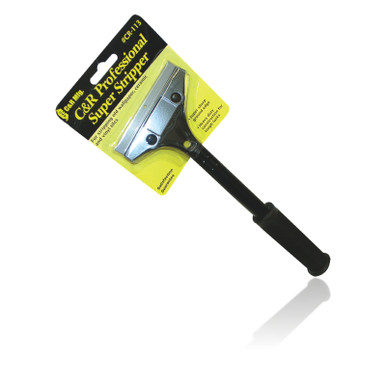 C&R CR-113 Heavy Duty Scraper, 4 inThe product data lists the CR-113 as a heavy-duty scraper with a 4 in blade and a 12 in handle
Sorting the knives. There is a putty knife on every truck and it is used for everything, which is why people ask whether it is a scraper, what the wide one is called, what to use instead, and how to get the dried spackle and rust off it. The honest division is by blade stiffness and width: flexible blades spread, stiff blades scrape, narrow blades fill, wide blades tape. Past the putty knife are the tools built to remove things: razor scrapers with disposable single-edge blades, floor and roof scrapers with replaceable heavy blades, carbide pull scrapers, and the 5-in-1 painter’s tool. The cards below take the questions as they are asked, including the roofing uses (old adhesive, butyl, mastic and coating on metal and membrane).
Putty knives and scrapers, question by question
Blade sizes and counts are from the product data on this site; the stiff vs flexible and width conventions are the trade’s.
Scrapers in plain words
- Flexible blade spreads; stiff blade scrapes. A stiff putty knife is a scraper.
- Narrow (1-1/4 to 4 in) fills; wide (6 to 14 in) tapes. The wide one is a taping, joint, drywall or broad knife.
- Drywall knives are curved so the center lays mud proud and the edges feather.
- Floor and roof scrapers take 4 and 8 inch replaceable blades for adhesive, mastic, coating and ice.
- Razor scraper and single-edge blades for glass, tile and smooth metal; new blade for glass, wet, low angle.
- Carbide pull scraper for paint on wood; heat gun first on thick paint.
- Clean blades wet, flex off dried mud, steel-wool the rust, oil the steel.
- Sharpen scrapers like a chisel on the bevel; square a spreader with a file.
Questions people ask
What is a good paint scraper for wood?
A carbide pull scraper, drawn toward you at a low angle after a heat gun on thick paint; it holds an edge far longer than steel.
What can I use instead of a putty knife?
A plastic spreader, margin trowel, taping knife or stiff card to spread; a razor scraper, 5-in-1 tool or chisel to scrape.
Is a putty knife a scraper?
A stiff one is; a flexible one is a spreader. The trade sells both under both names.
What is a wide putty knife called?
A taping knife, joint knife, drywall knife or broad knife.
How do I use a paint scraper?
Heat thick paint, keep the edge sharp, pull a carbide scraper toward you at a low angle, push a putty-knife scraper under a lifted edge.
What can you use instead of a paint scraper?
A stiff putty knife, a 5-in-1 tool, a razor scraper on smooth surfaces, a heat gun and chisel, or a sander.
What is the purpose of a taping knife in drywall?
To spread joint compound in a controlled thickness and feather its edges; 6, 10 and 12 inch for the three coats.
How do you wash a putty knife?
Scrape it on the bucket rim, wipe, rinse before the compound sets; soak dried mud in warm water.
How to get dried spackle off a putty knife?
Soak it in warm water, flex the blade so the spackle cracks, and scrape it with another knife.
How to remove rust from a putty knife?
Steel wool or a wire brush, fine sandpaper, a wipe of light oil; a vinegar soak for heavy rust.
What is the standard putty knife width?
1-1/2 inch is the common filler knife; 3 inch the general scraper; 6 inch and up are taping knives.
How to sharpen a putty knife?
Square a spreader with a file; sharpen a scraper on its bevel like a chisel and remove the burr.
Why are drywall knives curved?
So the center lays compound slightly proud while the edges feather to nothing.
What is a scraper blade used for?
Lifting adhesive, mastic, coating, paint and ice with a long-handled floor or roof scraper.
What size knife to tape drywall?
6 inch to bed the tape, 8 to 10 to cover it, 12 to feather the finish.
Is a taping knife the same as a drywall knife?
Yes; both names mean the wide flexible blade for joint compound.
Can you cut through drywall with a knife?
With a utility knife, by scoring and snapping; not with a drywall or putty knife.
What is a scraper used for in the kitchen?
That is a bench scraper or dough scraper, a different tool from the paint and floor scrapers here.
Why use a carbide scraper?
It holds an edge ten to twenty times longer than steel on paint and wood.
What is the difference between a drywall knife and a putty knife?
Width and flex: a drywall knife is 6 inches and wider and flexible for feathering mud; a putty knife is 1-1/4 to 4 inches for filling and scraping.
Related guides
Hook blades and utility bladesWhich blade cuts shingles, felt and membraneRoof cement, sealant and primerASTM D4586 and D41, and removing tarTrowelsMargin, pointing, notched and roofing trowelsHex keys, wire brushes and locking pliersSizes, bristles and clampsOSHA safety glasses requirementsWhat 1910.133 saysThe ratings, test results and standards shown here are the manufacturers' published values, reproduced as published. Nothing on this page is a recommendation by Bayshore Safety that any product is suitable for a particular task, hazard or workplace. Selecting safety products and protective equipment is the responsibility of the end user and the employer, based on their own hazard assessment and the regulations that apply to their work. Confirm every value on the manufacturer's own documentation before use.