
What is the strongest pop rivet, and what does a hand rivet gun do? How a blind rivet sets, rivet sizes and grip range, aluminum vs steel vs stainless, hand vs lever vs pneumatic riveters, rivets vs screws vs welds, and setting a rivet without a gun
A pop rivet (blind rivet) is a hollow rivet body with a mandrel through it: the rivet is pushed through a drilled hole from one side, the rivet gun grips the mandrel and pulls, the mandrel’s head flares the far end of the body against the back of the work, and the mandrel snaps off at a notch, leaving a set rivet that was installed with access to one side only, which is the point. A hand rivet gun (hand riveter) is the plier-style tool that does the pulling; lever (long-arm) riveters multiply force for 3/16 and 1/4 inch rivets, and pneumatic riveters do hundreds an hour. Strength comes from material and diameter: a 1/8 inch aluminum rivet shears at about 200 lb, a steel one at about 400, a stainless one at about 500, and 3/16 inch rivets roughly double those; structural (closed-end and multi-grip) rivets are the strongest blind rivets. Rivets are the fastener for gutters, downspouts, flashing laps, duct and sheet-metal trim; screws hold where they must be removed and welds hold structure.
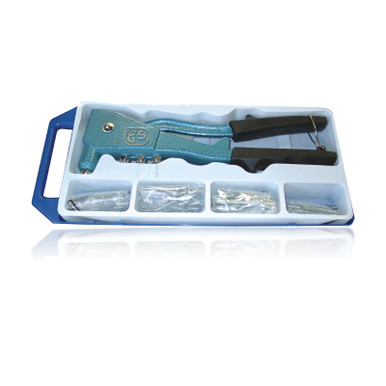 C&R PT-RIVOT Pop Rivet GunThe product data lists the PT-RIVOT as a pop rivet gun
Why sheet-metal roofing work uses rivets. A gutter seam, a downspout strap, a drip-edge lap and a flashing joint are thin metal with no access to the back, and a blind rivet is the fastener that works from the front and does not back out the way a sheet-metal screw can. The cards below answer the questions as asked: what a hand riveter does, the types of rivet guns, whether a given rivet gun is good, how to use one, rivet sizes and the strongest rivet, whether a rivet is as strong as a weld and why riveting is not used in structures any more, plastic rivets, the pneumatic and cordless tools, setting a rivet without a gun, and opening a rivet. The seamers, folding tools and clamps that go with sheet-metal work are in the band below with their own cards.
Rivets and riveters, question by question
Rivet designations and drill sizes are the ones printed on rivet packs; tool data is from the product pages on this site.
Rivets in plain words
- A blind (pop) rivet sets from one side: push it through the hole, the gun pulls the mandrel, the far end flares, the mandrel snaps.
- Rivet size: diameter in 32nds and grip in 16ths (4-4 is 1/8 inch with a 1/4 inch grip); drill the hole the size on the pack.
- Strongest: stainless, then steel, then aluminum; structural rivets over standard; bigger diameter over smaller.
- Hand gun for 1/8 and 5/32; lever gun for 3/16 and 1/4; pneumatic or cordless for production.
- A rivet is not a weld: it carries shear, not tension; use enough of them.
- Plastic trim rivets have their own tool; a metal gun does not fit.
- Remove a rivet by drilling the head off with a bit the shank size.
- Seamers bend hems, folding tools make long bends, locking clamps hold the lap while you drill and rivet.
Questions people ask
Are the import rivet guns any good?
We do not rate other sellers’ tools; a hand riveter is a simple tool and ours sets 1/8 to 3/16 inch rivets with the nosepiece that matches the mandrel.
What is the strongest type of pop rivet?
Stainless steel structural rivets at the largest diameter the work allows; a 1/4 inch structural rivet carries 1,000 to 1,700 lb in shear.
Why is riveting no longer used?
In steel structures, welding and high-strength bolts replaced it after the 1940s; blind rivets remain the standard fastener in sheet metal.
What are the different types of rivet guns?
Hand plier, lever long-arm, lazy-tong, pneumatic and cordless riveters, plus rivet nut tools for threaded inserts.
Is a rivet as strong as a weld?
No; a weld is a continuous fused joint and a rivet is a point fastener in shear.
How do hand rivet guns work?
The nosepiece grips the mandrel and the handles pull it until the rivet body flares behind the work and the mandrel snaps.
What is the difference between a rivet and a pop rivet?
A solid rivet needs both sides to set; a pop (blind) rivet sets from one side with a pulled mandrel.
Can you use a metal rivet gun on plastic rivets?
No; plastic push rivets are set by hand or with a plastic rivet plier.
Can you use a rivet gun on a gutter?
Yes; 1/8 inch aluminum rivets are the gutter and downspout fastener.
What is a hand riveter used for?
Fastening gutters, downspouts, flashing laps, duct, trim and sheet-metal repairs from one side.
What are the smallest rivets you can get?
3/32 inch diameter in standard blind rivets; micro rivets smaller for electronics.
What can I use instead of a rivet gun?
A bolt and nut, a sheet-metal screw, or a solid rivet peened against a backing block; the locking-pliers trick sets one rivet badly.
How do you install a pop rivet without a tool?
Hold the body with a nut stack over the mandrel and pull the mandrel with locking pliers; it works once and flares poorly.
What tool can I use to open rivets?
A drill bit the size of the shank through the head, or a rivet removal bit with a stop collar.
What is a pneumatic rivet gun for?
Setting one rivet per trigger pull from shop air, hundreds an hour, in duct, trailer and gutter production.
What does a pneumatic rivet gun do?
An air cylinder pulls the mandrel instead of your hands; the rivet sets the same way.
Related guides
Tin snips vs aviation snipsThe handle colors and what they cutTorx bits, nut setters and bit holdersThe common sizes and what each doesDrill bit sizesTap drills, HSS vs cobalt, drilling metal and concreteHex keys, wire brushes and locking pliersSizes, bristles and clampsOSHA safety glasses requirementsWhat 1910.133 saysThe ratings, test results and standards shown here are the manufacturers' published values, reproduced as published. Nothing on this page is a recommendation by Bayshore Safety that any product is suitable for a particular task, hazard or workplace. Selecting safety products and protective equipment is the responsibility of the end user and the employer, based on their own hazard assessment and the regulations that apply to their work. Confirm every value on the manufacturer's own documentation before use.