Home › Guides › Roofing tools › Tin snips and aviation snips
Guide · Sheet metal tools · Snips, aluminum snips and industrial scissors

What do tin snips cut, and what should not be cut with them? Tin snips vs aviation snips, the red, green and yellow handle code, left, right and straight cut, steel, stainless, galvanized, aluminum and vinyl, and how to sharpen snips

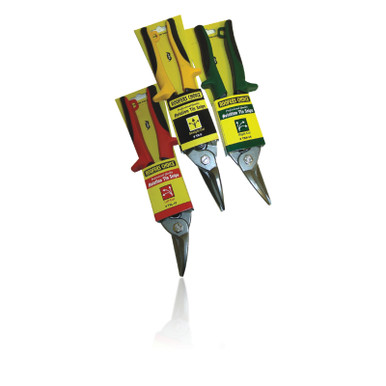
Tin snips cut sheet metal: mild and galvanized steel up to about 18 gauge (around 0.05 inch), aluminum and copper flashing, and soft materials like vinyl siding, roofing felt, screen, plastic sheet and strapping. They should not be cut into anything hardened or thick — bolts, nails, wire rope, spring steel, hardened screws, thick stainless — because the jaws chip and spring. Aviation snips are tin snips with compound leverage and spring-return handles in three cuts: red handles cut left curves, green cut right, yellow cut straight. Straight-pattern tin snips are the long plain-jaw shears for long straight cuts in light metal.
Bayshore Safety. Industrial safety, roofing tools and jobsite supplies since 2017. · Current as of November 2026 · the C&R snip product data on this site (TS-5 straight, TSL-10 left and TSR-15 right aviation snips; red left-cut and green right-cut offset snips; SPS-10 and SPS-12 straight-pattern tin snips; ALSNIP-13 aluminum snip with replacement teeth; 10 and 13 in industrial stainless scissors); the handle color convention the snip manufacturers print on the tools (red = left cut, green = right cut, yellow = straight); sheet steel gauge thicknesses as published in the Manufacturers’ Standard Gauge table
C&R TS-5 Aviation Tin Snips, 3 versionsC&R TS-5 Aviation Tin Snips, 3 versionsThe product data lists the TS-5 family as aviation tin snips in straight, left and right cut versions

Why there are three colors. Sheet metal does not want to be cut: the waste side has to curl out of the way while the jaws advance, and which side curls depends on the cut. A left-cut snip (red) curls the waste to the right so the tool can follow a curve to the left; a right-cut snip (green) does the opposite; a straight snip (yellow) is for cuts with little curve. A roofer trimming drip edge, step flashing, valley metal and ridge cap meets every one of the questions below: what snips cut, what they must not cut, whether they cut stainless or galvanized, how aviation snips differ from the old straight-pattern tinner’s snips, how to use them without a ragged edge, and what to do with aluminum, vinyl and plastic.

Snips, question by question

Gauge thicknesses are from the Manufacturers’ Standard Gauge table; the color code is the one printed on the handles across the trade.

Do tin snips cut metal, and what material should not be cut with them?They cut sheet metal: mild steel to about 18 gauge (0.0478 in), galvanized to about 20–22 gauge comfortably, aluminum to about 0.06 in, copper and brass flashing, lead and zinc. Do not cut hardened or round stock: nails, screws, bolts, wire rope, welding rod, spring steel, piano wire or rebar tie wire. Those chip the edge or spring the pivot, and once the jaws no longer meet the snip tears instead of shears. Thick or hardened steel is a job for a hacksaw, a reciprocating saw with a metal blade or an angle grinder, covered in the saw-blade guide linked below.
What is the difference between tin snips and aviation snips?Tin snips (tinner’s snips, straight-pattern snips) are a plain two-piece shear: long jaws, long handles, no spring, cutting by direct leverage. They make long, straight or gently curved cuts in light sheet and are the tool for trimming a long run of flashing. Aviation snips add a compound hinge that multiplies hand force, serrated jaws that grip the sheet, spring-open handles and a latch; they cut heavier gauge with less effort and are made in left, right and straight versions for curves. The name comes from their origin in aircraft sheet-metal work. Most roofers carry a pair of aviation snips in two colors and a straight-pattern snip for the long cuts.
What do the red, green and yellow handles mean?Red: left cut, the waste curls to the right, for curving left or for right-handed users cutting a circle counterclockwise. Green: right cut, the mirror. Yellow: straight cut, slight curves either way. The code is a trade convention that the snip manufacturers follow so a pair can be picked from a bucket by color. Offset snips (our red left and green right offset pair) raise the handles above the sheet so knuckles clear the metal on long cuts.
What is the difference between left, right and straight aviation snips, and which do I need?Which way the cut can turn and which side the waste goes. For most roofing flashing one left and one right pair covers every curve; a straight pair is the third. A rule that helps: use the snip whose color matches the direction you want to turn, and let the waste strip curl up on the other side. For a straight cut in heavy gauge, the straight (yellow) snip has the widest jaw and the least tendency to wander.
How do you use snips without a ragged edge?Open the jaws fully and cut with the back two thirds of the blade, never closing the tips completely on a cut that continues; closing the tips leaves the small nicks that cut hands later. Keep the top blade on the line and let the waste curl away from the finished piece. For a long cut, let the sheet ride up over the lower handle. Wear cut-resistant gloves on the hand holding the sheet; the edges of fresh-cut galvanized are what A4 to A6 gloves are rated for (see the glove guide linked below).
Will tin snips cut stainless steel and galvanized steel?Galvanized steel: yes, the zinc coating does not change the cut; galvanized flashing and drip edge are what aviation snips are bought for. Stainless: thin stainless (26–24 gauge, as used in some flashings) cuts with aviation snips but dulls the edge faster because stainless work-hardens; 22 gauge and heavier stainless is better cut with a shear or an abrasive wheel. Use the straight snip, full jaw, and expect to sharpen sooner.
How do you cut aluminum with tin snips, and what is an aluminum snip?Aluminum flashing, drip edge, soffit and gutter coil cut cleanly with any aviation snip; the metal is soft and the risk is denting, not dulling, so support the sheet and cut with a steady stroke. An aluminum snip is a different tool: a long-handled, wide-jawed shear with replaceable serrated teeth made for cutting aluminum siding, soffit and coil stock in long straight runs without distorting it. Our 13 in aluminum snip takes replacement teeth, which is why siding crews use it: the jaws are renewed instead of sharpened.
Do tin snips cut plastic and vinyl siding?Yes. Vinyl siding, J-channel, PVC trim, plastic sheet, screen, roofing felt, synthetic underlayment and strapping all cut with aviation snips; vinyl cuts cleanly when it is warm, and cracks when it is cold, so a utility knife score-and-snap or a fine-tooth saw is the alternative on a cold day. A miter saw with a fine (or reversed) blade is the siding crew’s tool for square cuts in quantity; snips are for the notches and fits.
What is the tool for cutting sheet metal, and what else cuts it?For hand work: aviation snips for curves and notches, straight-pattern snips and aluminum snips for long cuts. For production: a hand or bench shear, a nibbler, a double-cut electric shear. For heavy gauge: a hacksaw or reciprocating saw with a fine metal blade, or an abrasive cutoff wheel, covered in the saw-blade guide. Industrial stainless steel scissors (10 and 13 in) cut membrane, fabric, felt, underlayment and foil-backed tape without the jaw drag of snips.
How do you sharpen tin snips?Snips shear, so only the bevel face is touched: hold the file or stone at the existing bevel angle (about 85 degrees to the flat face) and stroke along it, a few passes, never on the flat inside face, which must stay flat for the blades to meet. Tighten the pivot nut if the jaws spread. Serrated aviation jaws are usually replaced rather than sharpened; the aluminum snip has replaceable teeth for the same reason.
Why are they called aviation snips, and what are red-handle tin snips used for?The compound-leverage design was developed for aircraft sheet-metal work in the 1940s and the name stayed. Red-handle snips are left-cut aviation snips: the pair used to cut a left-hand curve, or by a right-handed user to cut a circle out of a sheet.

Snips in plain words

  • Tin snips cut sheet metal and soft sheet goods; never nails, screws, wire, bolts or hardened steel.
  • Mild and galvanized steel to about 18 gauge; aluminum and copper flashing freely; thin stainless with faster dulling.
  • Red = left cut, green = right cut, yellow = straight. Pick the color for the direction the cut turns.
  • Aviation snips: compound leverage, serrated jaws, spring handles, three cuts. Straight-pattern snips: plain long jaws for long cuts.
  • Cut with the back two thirds of the jaw and do not close the tips on a continuing cut.
  • Aluminum snips are long shears with replaceable teeth for siding, soffit and coil.
  • Vinyl and plastic cut with snips when warm; score and snap or saw when cold.
  • Sharpen only the bevel face; keep the flat face flat; tighten the pivot.

Questions people ask

What material should not be cut with tin snips?

Hardened or round stock: nails, screws, bolts, wire rope, spring steel and thick or heavy-gauge steel. They chip the edge and spring the pivot.

Do tin snips cut metal?

Yes: mild and galvanized sheet steel to about 18 gauge, aluminum, copper, brass, lead and zinc flashing.

How do you use a snips tool?

Open the jaws fully, cut with the back two thirds of the blade, keep the top blade on the line, let the waste curl away and do not close the tips on a continuing cut.

Do tin snips cut plastic?

Yes: vinyl siding, PVC trim, plastic sheet, screen, felt and underlayment, cleanest when the material is warm.

What is the difference between tin snips and aviation snips?

Tin snips are plain long-jaw shears for long cuts; aviation snips add compound leverage, serrated jaws and spring handles and come in left, right and straight cut.

Do aviation snips cut metal?

Yes, and more easily than plain tin snips because of the compound leverage; they are the standard roofing flashing tool.

What is the difference between left, right and straight aviation snips?

Which way the cut can curve and which side the waste curls to: red left, green right, yellow straight.

Will tin snips cut stainless steel?

Thin stainless flashing, yes, with faster dulling; 22 gauge and heavier stainless is a job for a shear or abrasive wheel.

Can you cut galvanized steel with tin snips?

Yes; galvanized drip edge, step flashing and valley metal are what aviation snips are bought for.

How do you cut aluminum with tin snips?

Support the sheet and cut with a steady full-jaw stroke; aluminum is soft and dents rather than dulls. Long runs of siding and coil are cut with an aluminum snip.

What are red handle tin snips used for?

Left-hand cuts and curves; the waste curls to the right.

What is the difference between red and green tin snips?

Red cuts left, green cuts right; they are mirror images.

What tool is used to cut sheet metal?

Aviation snips for curves and notches, straight-pattern and aluminum snips for long cuts, shears and nibblers for production, saws and abrasive wheels for heavy gauge.

How do you sharpen tin snips?

File or stone only the bevel face at its existing angle, leave the flat face alone and tighten the pivot nut.

Why are they called aviation snips?

The compound-leverage design came from aircraft sheet-metal work in the 1940s.

Can I use tin snips to cut vinyl siding?

Yes, for notches and fits; for square cuts in quantity a fine-blade miter saw is faster, and vinyl cracks when cut cold.

The ratings, test results and standards shown here are the manufacturers' published values, reproduced as published. Nothing on this page is a recommendation by Bayshore Safety that any product is suitable for a particular task, hazard or workplace. Selecting safety products and protective equipment is the responsibility of the end user and the employer, based on their own hazard assessment and the regulations that apply to their work. Confirm every value on the manufacturer's own documentation before use.

Setting up a roofing crew or a shop?Call (925) 215-7337 or email us the trades, the crew size and the quantities and we will quote tools and supplies by the case, with the part numbers listed. We sell nationwide.
All roofing tools
How to buyCard, purchase order or invoice terms; quotes on request; agencies and institutions welcome.
Live Service & SupportReal people who know the products, Monday to Friday 7:30am to 4pm Pacific. 925-215-7337
We DeliverWe ship nationwide. Parcel and LTL freight to job sites and businesses across the U.S.