
How many times can you wear a disposable coverall, and what does it cost per wear?
Once, when the job falls under an OSHA substance standard or the garment has been contaminated or damaged, and there is no published rule that says otherwise for anything else. The asbestos construction standard treats worn coveralls as contaminated clothing to be bagged in sealed, impermeable, labeled containers, and allows laundering only under controls that keep fibers below the limits. The lead standard requires clean clothing at least weekly, daily above 200 micrograms per cubic meter, removed only in the change area into a closed container, never shaken or blown clean. The bloodborne pathogens standard requires a garment penetrated by blood to be removed immediately or as soon as feasible and all PPE removed before leaving the work area. The manufacturers say single use: International Enviroguard states PyroGuard CRFR is designed for single use and should not be washed or re-used, and DuPont does not recommend washing Tyvek 400 for reuse. Cost per wear is the case price divided by the case count: on today’s prices, about $1.62 for a polypropylene suit, $3.10 for SMS and $4.32 for a hooded MicroGuard MP; prices change.
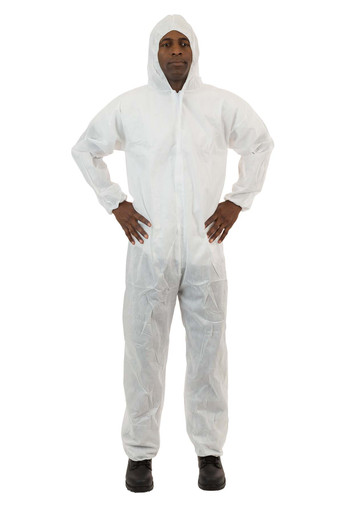 Enviroguard 2225 Disposable White SMS Coverall with Hood, Elastic Wrist and AnkleThree-layer SMS with hood and storm flap, 25 to a case. About $3.10 a wear at today’s case price.
Why is the answer usually once? A disposable coverall is a barrier that is thrown away with whatever it stopped. The rules that govern contaminated clothing are written around that: the suit comes off in a controlled place, goes into a bag or container, and is either laundered under conditions that keep the contaminant from getting out or disposed of. None of them sets a number of wears, because the point of the garment is that the contaminant leaves with it. Where the job has no regulated contaminant and the suit is clean and intact at the end of the shift, no rule we can cite says you cannot put it back on; what the manufacturer says is that the garment is single-use and that a torn, punctured or worn suit is finished.
29 CFR 1926.1101(i)(2) and (i)(3); 1926.62(g)(2)(iv) and (v); 1910.1030(d)(3)(vii) and (viii); International Enviroguard Seam Safety Guide disclaimer.What do the OSHA standards say about worn coveralls?
The clothing paragraphs that decide when a suit is done.
Can you reuse a disposable coverall?
Not after a regulated exposure, and not after it has been contaminated or damaged. On an asbestos or lead job the suit is contaminated clothing by definition and goes into the container when it comes off; the lead standard’s weekly and daily clean-clothing rule and the asbestos standard’s laundering controls are written for launderable clothing, and a disposable suit meets both by being disposed of. Under the bloodborne pathogens standard a penetrated garment is removed immediately. The manufacturer’s position is single use: International Enviroguard’s catalog says PyroGuard CRFR is designed for single use and should not be washed or re-used, and its seam guide tells the end user to stop using a garment if the fabric becomes torn, punctured or worn. DuPont says Tyvek 400 is limited-use and does not recommend washing it for reuse. Nothing in those documents gives a number of wears for a clean, intact suit on an unregulated job, so we do not either; that is the employer’s call under its hazard assessment.
29 CFR 1926.1101(i)(2) and (i)(3); 1926.62(g)(2); 1910.1030(d)(3)(vi); International Enviroguard Industrial Catalog (PyroGuard CRFR) and Seam Safety Guide disclaimer; DuPont Tyvek 400 TY122S product page; 29 CFR 1910.132(d)(1).Can you wash a disposable coverall?
The manufacturers say no. International Enviroguard states that PyroGuard CRFR should not be washed or re-used, and publishes no wash instructions for any of its disposable lines; DuPont does not recommend washing Tyvek 400 for reuse. There is a practical reason as well as a regulatory one: the barrier in a microporous or film coverall is a thin laminate, and the manufacturer’s FR treatment on PyroGuard FR is a phosphate-based retardant applied to the fabric. Neither is sold as surviving a wash, and no washed-garment test is published. Where OSHA allows laundering of contaminated clothing, it allows it under controls, for clothing built to be laundered; a disposable coverall is not that clothing.
International Enviroguard Industrial Catalog (PyroGuard CRFR) and PyroGuard FR sell sheet (phosphate-based fire retardant); DuPont Tyvek 400 TY122S product page; 29 CFR 1926.1101(i)(2)(i).Can you take a coverall off at lunch and put it back on?
On a regulated job, the removal rules apply every time the suit comes off. Lead clothing is removed only in the change area and goes into the closed container; asbestos clothing is bagged; bloodborne pathogen PPE comes off before leaving the work area and goes into the designated container. A suit that has been through that is contaminated clothing, not a suit on a hook. On an unregulated job the question is whether the suit is still clean and intact, and the employer’s program answers it. The garment features that matter if a suit is taken off and put back on are the ones that make doffing clean: a storm flap over the zipper, thumb loops that keep the sleeve under the glove, and a zipper pull you can work with gloves on, which ViroGuard 2 and ChemSplash 2 have.
29 CFR 1926.62(g)(2)(iv) and (v); 1926.1101(i)(3); 1910.1030(d)(3)(vii) and (viii); International Enviroguard ViroGuard 2 and ChemSplash 2 sell sheets (garment features).How long do disposable coveralls last in storage?
International Enviroguard publishes no numeric shelf life for its coveralls. The one statement it makes is for the vacuum-sealed 8015VPK vend pack, which it says has a long shelf life because the air-tight packaging seals the coverall off from contaminants. DuPont suggests using Tyvek 400 garments within five years of receipt if properly stored. Store cases dry, out of sunlight and off the floor, and rotate them; a coverall that has yellowed, gone brittle or lost its elastic is a coverall the manufacturer’s own disclaimer tells you not to wear.
International Enviroguard product data, style 8015VPK; DuPont Tyvek 400 TY122S product page (shelf life); International Enviroguard Seam Safety Guide disclaimer.What does a disposable coverall cost per wear?
The case price divided by the suits in the case, since each suit is one wear. Today’s store prices at the base size in each line, rounded; prices change, so check the product page, and larger sizes in some lines cost more.
| Style | Features | Case price | Suits per case | Cost per wear |
|---|---|---|---|---|
| 2012 Polypropylene | collar, elastic wrists, open ankles | $40.49 | 25 | $1.62 |
| 2225 SMS | hood, elastic wrists and ankles | $77.49 | 25 | $3.10 |
| 8115 ValuGuard MP | hood, elastic wrists and ankles | $68.49 | 25 | $2.74 |
| 8015 MicroGuard MP | hood, elastic wrists and ankles | $108.00 | 25 | $4.32 |
| 4028 Body Filter 95+ | hood, elastic wrists and ankles | $184.00 | 25 | $7.36 |
| 7015YS ChemSplash 1 | hood, serged seams | $80.99 | 12 | $6.75 |
| 7015YT ChemSplash 1 | hood, taped seams | $89.49 | 6 | $14.91 |
| 2407 ViroGuard | hood, storm flap | $217.00 | 25 | $8.68 |
| W2502 ViroGuard 2 | taped seams, storm flap, thumb loops | $358.00 | 25 | $14.32 |
| 9015 PyroGuard FR | hood, serged seams | $177.00 | 25 | $7.08 |
| 9115T PyroGuard CRFR | hood, taped seams | $225.00 | 6 | $37.50 |
| 7315GT ChemSplash 2 | hood, taped seams | $153.00 | 6 | $25.50 |
Two things the table shows. The jump from a polypropylene or SMS suit to a microporous one is a dollar or two a wear, and the jump to a chemical or biological suit with taped seams is the big one, because those styles pack six to a case and the fabric costs more. And the cheapest suit is not the cheapest wear if it tears at the crotch halfway through a shift and the crew is back through decon for a second one; the manufacturer’s roomier cuts and elastic backs are sold on exactly that cost-in-use argument. Match the suit to the hazard first, then buy the fewest cases that cover the crew.
International Enviroguard Industrial Catalog (MicroGuard MP: lower cost-in-use due to fewer rip-outs); ChemSplash 1 and ChemSplash 2 garment lists (6 and 12 per case).Questions people ask
How many times can you wear a Tyvek suit?
DuPont calls Tyvek 400 limited-use and does not recommend washing it for reuse; after an asbestos, lead or bloodborne pathogen exposure OSHA treats the suit as contaminated clothing to be bagged or disposed of (1926.1101(i)(3), 1926.62(g)(2)(v), 1910.1030(d)(3)(viii)).
Can you wash and reuse disposable coveralls?
The manufacturers say no: International Enviroguard states PyroGuard CRFR is designed for single use and should not be washed or re-used, and DuPont does not recommend washing Tyvek 400 for reuse. No washed-garment test data is published.
Does OSHA say how many times a coverall can be worn?
No standard gives a number. Asbestos and lead rules require contaminated clothing to be bagged or containered when removed, lead clothing to be clean at least weekly (1926.62(g)(2)(i)), and bloodborne pathogen garments penetrated by blood to be removed immediately (1910.1030(d)(3)(vi)).
What does a disposable coverall cost per wear?
Case price divided by suits per case. At today’s prices a polypropylene 2012 is about $1.62 a wear, an SMS 2225 about $3.10, a MicroGuard MP 8015 about $4.32 and a taped-seam ChemSplash 2 7315GT about $25.50; prices change.
Do disposable coveralls expire?
International Enviroguard publishes no numeric shelf life; DuPont suggests using Tyvek 400 within five years of receipt if properly stored. A coverall that is torn, punctured or worn should not be used, per the manufacturer’s disclaimer.
When should a coverall be replaced during a shift?
When it rips. OSHA’s asbestos standard requires the competent person to check worksuits at least once per shift and to mend or replace a ripped suit immediately (1926.1101(i)(4)); the manufacturer says a split garment should be replaced immediately.
The ratings, test results and standards shown here are the manufacturers' published values, reproduced as published. Nothing on this page is a recommendation by Bayshore Safety that any product is suitable for a particular task, hazard or workplace. Selecting safety products and protective equipment is the responsibility of the end user and the employer, based on their own hazard assessment and the regulations that apply to their work. Confirm every value on the manufacturer's own documentation before use.