
Bayshore Safety & Industrial Supplies Guide
How must compressed gas cylinders be stored? OSHA 1910.101, the CGA P-1 practices it incorporates, calibration gas cylinders, shelf life, inspection and disposal
OSHA’s rule for compressed gases in general industry is short. 29 CFR 1910.101(b) requires the in-plant handling, storage and use of all compressed gases in cylinders to follow Compressed Gas Association Pamphlet P-1, which OSHA incorporates by reference; 1910.101(a) requires each employer to determine by visual inspection that the cylinders under its control are in a safe condition, with inspections as the Department of Transportation’s hazardous materials regulations (49 CFR Parts 171 to 179) prescribe, or CGA C-6 and C-8 where those do not apply; and 1910.101(c) requires pressure relief devices per CGA S-1.1 and S-1.2. CGA P-1 is the document that says what storage looks like: cylinders upright and secured against falling, valve caps on when not in use, stored away from heat and ignition sources and from corrosive atmospheres, in a ventilated place, with flammable gases separated from oxidizers, full and empty cylinders marked and kept apart, and cylinders not stored where they can be struck or knocked over. The small, non-refillable calibration gas cylinders a gas detector program uses are compressed gas cylinders too: they travel as hazardous materials under 49 CFR, they are stored under P-1, and they carry one more date, the use-by month and year RKI Instruments prints on every cylinder, with shelf lives from 3 years for steel to 6 months for nitrogen dioxide in aluminum.
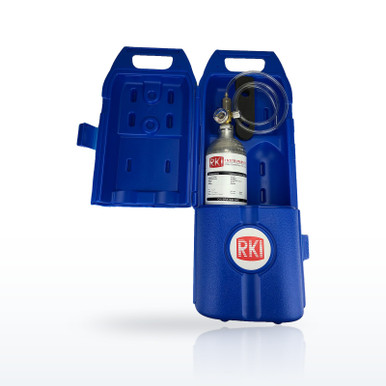 RKI Instruments 81-PAB-LV Calibration Kit, H2S/CO/LEL/O2 + CO2, for GX-3R ProFour-gas calibration kit: cylinder, regulator and case, with RKI’s shelf life printed on the cylinder
Why a calibration cylinder is treated like a welding cylinder. It is smaller and it is not refillable, but it is still a steel or aluminum vessel holding gas under pressure, and the four-gas mix inside carries a flammable gas at half its lower explosive limit, reduced oxygen and toxic gases in nitrogen. The rules follow the pressure and the contents, not the size: 1910.101 applies to compressed gases in cylinders without a size limit, the DOT rules govern the cylinder’s manufacture, marking and transport, and CGA P-1 governs how it sits on the shelf. The one way a calibration cylinder differs is its shelf life: the reactive gases inside (hydrogen sulfide, chlorine, ammonia, nitrogen dioxide) lose concentration as they react with the cylinder wall, so RKI prints a use-by date and OSHA’s bulletin on direct-reading monitors says to use certified, traceable gas before its expiration date. A cylinder past its date is not a storage problem; it is a calibration problem.
What 1910.101 requires, paragraph by paragraph
Storing calibration gas cylinders in a gas detection program
- Within the use-by date. RKI’s table: 3 years for any mixture in a 17, 34 or 103 L steel cylinder; 2 years for H2S, four-gas and SO2 mixes in 34 or 58 L aluminum; 18 months for ammonia, hydrogen cyanide, nitric oxide and phosphine; 1 year for hydrogen chloride and silane; 9 months for chlorine; 6 months for nitrogen dioxide. OSHA’s bulletin says to use certified traceable gas before its expiration date.
- Buy the size that will be used in time. At a fixed flow of 0.5 liters per minute a 34 L cylinder gives about 68 minutes of gas, roughly 60 one-minute bump tests; a 103 L cylinder three times that. A chlorine or NO2 cylinder bought in the large size is thrown away part full.
- Upright, capped and secured, away from heat: the same P-1 practices as any cylinder, in the kit’s case or a rack. Heat shortens the life of the reactive mixes and raises the pressure.
- Regulator off between uses, and the right regulator on: fixed flow (0.25 or 0.5 LPM) for a diffusion monitor, demand flow for a pumped one; RKI’s manual says to vent the regulator while fitting it to a toxic cylinder so air does not enter and dilute the gas.
- Mark the lot and the open date on the cylinder or the log; the bump test record carries the cylinder lot and expiration date, which OSHA’s bulletin asks for.
- Disposal: a non-refillable cylinder is emptied by venting the remaining gas in a safe, ventilated place away from ignition sources (the four-gas mix carries a flammable component), then recycled or discarded as the cylinder label and local rules direct; a cylinder with gas left in it remains a hazardous material. The cylinder manufacturer’s label and SDS carry the specific instruction.
Calibration gas shelf life, as RKI lists it
| Cylinder | Gas mixture | Shelf life (RKI warranty) |
|---|---|---|
| 17, 34 or 103 L steel | All mixtures | 3 years |
| 34 or 58 L aluminum | H2S in nitrogen | 2 years |
| 34 or 58 L aluminum | LEL / O2 / H2S / CO (four-gas) | 2 years |
| 34 or 58 L aluminum | SO2 in nitrogen | 2 years |
| 34 or 58 L aluminum | NH3 in nitrogen | 18 months |
| 34 or 58 L aluminum | Cl2 in nitrogen | 9 months |
| 34 or 58 L aluminum | HCl in nitrogen | 1 year |
| 34 or 58 L aluminum | HCN in nitrogen | 18 months |
| 34 or 58 L aluminum | NO in nitrogen | 18 months |
| 34 or 58 L aluminum | NO2 in nitrogen | 6 months |
| 34 or 58 L aluminum | PH3 in nitrogen | 18 months |
| 34 or 58 L aluminum | SiH4 in nitrogen | 1 year |
Source: RKI Instruments FAQ page (rkiinstruments.com/resources/faqs, rkiinstruments.com), "Do Calibration Gases Have a Shelf Life?". RKI states that every one of its cylinders is printed with a use-by month and year and should not be used past it.
Questions people ask
How must compressed gas cylinders be stored?
Under 29 CFR 1910.101(b), in accordance with CGA Pamphlet P-1, which OSHA incorporates by reference: upright and secured, valve caps on, away from heat and ignition sources, ventilated, flammables separated from oxidizers, full and empty marked and apart, and protected from being struck. Welding cylinders have added rules in 1910.253.
What are the safety precautions of a gas cylinder?
Inspect it visually (1910.101(a)), store and handle it per P-1, keep the relief device maintained (1910.101(c)), use the right regulator, never use the valve as a handle or drag or drop the cylinder, and for calibration gas use it before the printed date.
How often do compressed gas cylinders need to be inspected?
1910.101(a) requires visual inspection by the employer to the extent it can show the cylinder is in a safe condition, and inspections as the DOT regulations prescribe for the cylinder type; refillable cylinders carry a DOT requalification date stamped on the shoulder. Non-refillable calibration cylinders are inspected visually and used before their use-by date.
What is an appropriate device to secure a compressed gas cylinder in storage?
A chain, strap or bracket to a wall or a cylinder cart or rack, holding the cylinder upright so it cannot fall, as P-1 describes; a small calibration cylinder is kept in its kit case or a rack.
How do you dispose of gas cylinders?
A refillable cylinder goes back to the gas supplier. A non-refillable calibration cylinder is vented empty in a safe, ventilated place away from ignition, then recycled or discarded as the label and local rules direct; a cylinder still holding gas is a hazardous material.
What are the different sizes of compressed gas cylinders?
For calibration gas the catalog sizes are 34, 58, 103 and 116 liters of gas in steel or aluminum; RKI lists 17, 34 and 103 L steel and 34 and 58 L aluminum. Welding and industrial cylinders are sized differently and governed by the supplier.
Does calibration gas go bad?
Yes, by the printed use-by date: RKI’s shelf lives run from 3 years (steel) to 6 months (nitrogen dioxide in aluminum), because the reactive gases react with the cylinder wall.
Is calibration gas hazardous?
The cylinder is a compressed gas and the mix carries a flammable component and toxic gases at ppm levels; in use the gas is released at 0.25 to 0.5 liters per minute into a calibration cap. It ships as a hazardous material by ground.
Can I store calibration gas in a vehicle?
P-1’s practices apply there too: secured, upright, away from heat; a hot cab shortens the life of a reactive mix and raises the pressure, and the kit case is how the cylinder travels.
What type of hazard is compressed gas?
A physical hazard under OSHA’s Hazard Communication Standard (gases under pressure), with the contents adding their own flammable or toxic hazard; the SDS for the mix lists them.
Does a GALAXY GX2 track the cylinder?
MSA’s electronic cylinder holder reads the RFID tag on MSA cylinders (gas type, concentration, lot, expiration, part number) and its pressure sensor warns at about 99 psi, turns the display red at about 49 psi and stops testing below 5 psi, as the GX2 quick start guide states.
What inlet pressure can a demand flow regulator take on a BW cylinder?
The MAX XT II manual: disposable cylinders 0 to 1,000 psig and refillable cylinders 0 to 3,000 psig (70 bar) with Honeywell BW’s demand flow regulator.
Related guides
What is calibration gas?Choosing the cylinderBump test vs calibrationWhat each does and how oftenHow to calibrate an RKI GX-Force or GX-3R ProStep by step from the manualsGas detector docking stationsWhat they doHow much does a gas detector cost?Single-gas, 4-gas, PID, sensors and calibration gasThe ratings, test results and standards shown here are the manufacturers' published values, reproduced as published. Nothing on this page is a recommendation by Bayshore Safety that any product is suitable for a particular task, hazard or workplace. Selecting safety products and protective equipment is the responsibility of the end user and the employer, based on their own hazard assessment and the regulations that apply to their work. Confirm every value on the manufacturer's own documentation before use.
© 2026 Bayshore Safety & Industrial Supplies, Inc. All rights reserved. This guide may not be copied or republished without written permission.