
How to calibrate an RKI GX-Force or GX-3R Pro step by step, what gas to use, how often, and does calibration gas go bad?
The RKI Instruments manuals split calibration into two steps: a fresh air adjustment (AIR CAL) in clean air with 20.9 percent oxygen, then a span adjustment (AUTO.CAL on the GX-Force, AUTO CAL on the GX-3R Pro) with a cylinder of known gas. On the GX-Force the span uses a demand flow regulator and tubing to the pump inlet; on the GX-3R Pro it uses the calibration cup pushed on with its “front” label facing the display and a 0.25 LPM fixed flow regulator. Both manuals say the same about frequency: bump test before each day’s use with a known concentration of each gas, and calibrate only if the instrument fails the bump test, citing IEC 60079-29-2; RKI’s FAQ adds that users who bump test daily can stretch the calibration cycle to 3 to 6 months, while users who do not should calibrate monthly. The gas is the four-gas mix the instrument is set for (methane, oxygen, H2S and CO in RKI’s kits), within the concentration limits the manuals list, and it does go bad: RKI gives steel cylinders of non-reactive mixtures a three-year shelf life and aluminum cylinders of reactive mixtures (H2S, SO2, NH3, Cl2, NO2) six months to two years, with a use-by date printed on every cylinder.
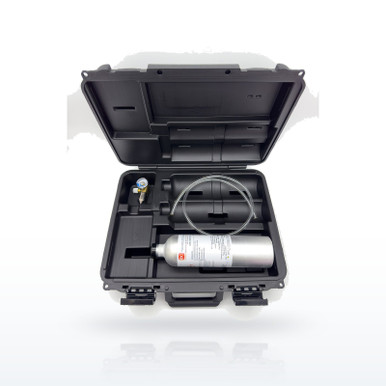 RKI Instruments 81-GX3RHSCO-LV Calibration Kit, H2S/CO/LEL/O2, for GX-3R ProFour-gas calibration kit (cylinder, regulator and case) RKI lists for the GX-3R and GX-3R Pro (RKI data)
Why the manual puts the bump test first. RKI’s two manuals open the maintenance chapter with the same sentence: bump test the instrument before each day’s use with a known concentration of each target gas, and the instrument does not need to be calibrated unless it does not pass the bump test. That is the ISEA position OSHA’s bulletin quotes, and it matches the bulletin’s three procedures: the bump test is a function check that the gas reaches the sensors and the alarms fire; the calibration check reads a known gas and compares; the full calibration adjusts the instrument to read the cylinder value. On an RKI instrument the bump test can be run in User Mode (BUMP) or by applying gas in Measuring Mode, and with auto-calibration on (the factory setting) a failed bump test rolls straight into a calibration while the gas is still flowing. The SDM-3R and SDM-Force stations do all of it automatically and keep the record. What follows is the manual’s sequence; the manual itself is the document to work from, and this page reproduces its steps, not a substitute for them.
GX-Force, from the operator’s manual
Chapter 5, User Mode and Calibration. The GX-Force is not a gas detector while in User Mode; take it to a non-hazardous location first.
GX-3R Pro, from its operator’s manual
From Chapter 5 of the GX-3R Pro manual and the SDM pages:
- Demand zero (fresh air): in clean air, the DEMAND ZERO item in Maintenance Mode or the AIR button in Measuring Mode zeroes the channels; AUTO ZERO can be set on or off.
- Set up: install the calibration cup, pushed all the way on, using its label and the imprinting so it sits in the correct orientation with the "front" label visible from the display side; connect the tubing from a 0.25 LPM fixed flow regulator to the cup's inlet.
- Vent the regulator while installing it on a toxic gas cylinder (H2S), turning the knob counterclockwise to open it as it goes on, to keep air from entering the cylinder and degrading the gas.
- Span (AUTO CAL): in User Mode place the cursor on GAS CAL, press POWER MODE, place the cursor on AUTO CAL and press POWER MODE; the display shows the gases assigned to Cylinder A and their values (confirm they match the cylinder label, manual page 87). Make sure the unit has been on at least 45 seconds, press POWER MODE, open the regulator, let the gas flow for 1 minute (2 minutes for ammonia), press POWER MODE and follow the pass/fail result; close the regulator, unscrew it, remove the cup and store the kit.
- CO2 ZERO CAL: the infrared CO2 sensor has its own zero step in the Gas Cal menu, run with the zero gas (nitrogen) from RKI's CO2 kits for 1 minute.
- Concentration limits: combustible 5 to 75 percent LEL; oxygen 0.0 to 17.0 percent; H2S 1.0 to 200.0 ppm; CO 15 to 2,000 ppm; hydrogen 25 to 2,000 ppm; ammonia 8 to 400 ppm; CO2 3,000 to 9,000 ppm or 1.00 to 4.00 percent; HCN 0.9 to 30.0 ppm; NO2 0.50 to 20.00 ppm; PH3 0.05 to 20.00 ppm; SO2 0.50 to 100.00 ppm.
- Or the dock: RKI's SDM-3R charges, calibrates and bump tests the GX-3R and GX-3R Pro and stores every record for USB upload or PC control of up to ten stations; the SDM-Force does the same for the GX-Force.
Calibration gas concentrations the RKI manuals accept
| Channel | GX-Force minimum | GX-Force maximum | GX-3R Pro minimum | GX-3R Pro maximum |
|---|---|---|---|---|
| Combustible gas | 1% LEL | 75% LEL | 5% LEL | 75% LEL |
| Oxygen | 0.0% | 17.0% | 0.0% | 17.0% |
| Hydrogen sulfide | 0.5 ppm | 200.0 ppm | 1.0 ppm | 200.0 ppm |
| Carbon monoxide | 12 ppm | 2,000 ppm | 15 ppm | 2,000 ppm |
| Hydrogen (for the H2-compensated CO sensor) | — | — | 25 ppm | 2,000 ppm |
| Ammonia | — | — | 8 ppm | 400 ppm |
| Carbon dioxide, ppm sensor | — | — | 3,000 ppm | 9,000 ppm |
| Carbon dioxide, percent sensor | — | — | 1.00% vol | 4.00% vol |
| Hydrogen cyanide | — | — | 0.9 ppm | 30.0 ppm |
| Nitrogen dioxide | — | — | 0.50 ppm | 20.00 ppm |
| Phosphine | — | — | 0.05 ppm | 20.00 ppm |
| Sulfur dioxide | — | — | 0.50 ppm | 100.00 ppm |
Source: RKI Instruments GX-Force operator's manual (PDF), Chapter 5, User Mode and Calibration, Table 12; RKI Instruments GX-3R Pro operator's manual (PDF), Chapter 5, User Mode and Calibration, calibration concentration limits
Calibration gas shelf life, as RKI lists it
| Cylinder | Gas mixture | Shelf life (RKI warranty) |
|---|---|---|
| 17, 34 or 103 L steel | All mixtures | 3 years |
| 34 or 58 L aluminum | H2S in nitrogen | 2 years |
| 34 or 58 L aluminum | LEL / O2 / H2S / CO (four-gas) | 2 years |
| 34 or 58 L aluminum | SO2 in nitrogen | 2 years |
| 34 or 58 L aluminum | NH3 in nitrogen | 18 months |
| 34 or 58 L aluminum | Cl2 in nitrogen | 9 months |
| 34 or 58 L aluminum | HCl in nitrogen | 1 year |
| 34 or 58 L aluminum | HCN in nitrogen | 18 months |
| 34 or 58 L aluminum | NO in nitrogen | 18 months |
| 34 or 58 L aluminum | NO2 in nitrogen | 6 months |
| 34 or 58 L aluminum | PH3 in nitrogen | 18 months |
| 34 or 58 L aluminum | SiH4 in nitrogen | 1 year |
Source: RKI Instruments FAQ page (rkiinstruments.com/resources/faqs, rkiinstruments.com), "Do Calibration Gases Have a Shelf Life?". RKI states that every one of its cylinders is printed with a use-by month and year and should not be used past it.
Questions people ask
How to calibrate step by step?
From RKI Instruments’ GX-Force manual: take the instrument to fresh air; hold AIR then POWER MODE until one beep to enter User Mode; scroll to GAS CAL and run the fresh air adjustment (AIR CAL); scroll to AUTO.CAL and check the cylinder values on the screen against the label; fit the demand flow regulator and tubing to the inlet with the unit on at least 45 seconds; apply gas for 1 minute; press POWER MODE and read pass or fail for each channel. The GX-3R Pro uses the calibration cup and a 0.25 LPM fixed flow regulator with the same two steps.
How to calibrate an RKI GX force?
AIR CAL in clean air, then AUTO.CAL with the four-gas cylinder through a demand flow regulator to the pump inlet, as the GX-Force manual’s Chapter 5 lays out; the concentration limits it accepts are combustible gas 1 to 75 percent LEL, oxygen 0 to 17 percent, H2S 0.5 to 200 ppm and CO 12 to 2,000 ppm.
How to calibrate a H2S meter?
The same two steps on the H2S channel: zero in clean air, then span with H2S calibration gas at a concentration the manual accepts (RKI: 1.0 to 200.0 ppm on the GX-3R Pro, 0.5 to 200 ppm on the GX-Force; the kits carry 25 ppm H2S in the four-gas mix). RKI’s manual says to vent the regulator while fitting it to a toxic cylinder so air does not enter; H2S cylinders in aluminum carry a 2-year shelf life.
How often should a bump test be performed?
Before each day’s use, with a known concentration of each gas, per both RKI manuals (citing IEC 60079-29-2), OSHA’s bulletin on direct-reading monitors and the ISEA statement; calibrate only if the bump test fails.
How often does an RKI monitor need calibration?
RKI’s FAQ: users who bump test daily can extend the calibration cycle to 3 to 6 months for instruments that pass; users who do not should calibrate monthly; a user may start weekly and lengthen the interval as adjustments stay small, which for most users ends between one and three months.
What are the three types of calibration?
In the manuals’ terms: the fresh air adjustment (zero), the span adjustment with calibration gas, and the bump test that checks both without adjusting. A docking station (SDM-3R, SDM-Force) runs all three automatically and stores the records.
Does calibration gas go bad?
Yes. RKI prints a use-by month and year on every cylinder: 3 years for steel cylinders, 2 years for aluminum H2S, four-gas and SO2 cylinders, 18 months for ammonia, HCN, nitric oxide and phosphine, 1 year for HCl and silane, 9 months for chlorine, 6 months for nitrogen dioxide.
How is a multi-gas detector calibrated?
All channels at once with a mixed cylinder: the manual accepts the cylinder values within the concentration limits in the table on this page, the display shows the gases assigned, and each channel passes or fails on its own. The CO2 channel on a GX-3R Pro has a separate CO2 ZERO CAL with nitrogen because outdoor air already holds about 400 ppm.
Is calibration gas hazmat?
In transport, yes: a compressed gas cylinder ships as a hazardous material under 49 CFR by ground. In use it is released at 0.25 to 0.5 liters per minute into the calibration cup or tubing; the SDS lists the hazards of the mix.
What is a calibration certificate?
A document RKI offers with a new instrument (part 90-CALCERT, requested at order) listing the model, part and serial numbers, the pre-shipment readings and the traceability of the gas used; RKI describes itself as an ISO 9001 company in the same FAQ answer.
The ratings, test results and standards shown here are the manufacturers' published values, reproduced as published. Nothing on this page is a recommendation by Bayshore Safety that any product is suitable for a particular task, hazard or workplace. Selecting safety products and protective equipment is the responsibility of the end user and the employer, based on their own hazard assessment and the regulations that apply to their work. Confirm every value on the manufacturer's own documentation before use.