
Bayshore Safety & Industrial Supplies Guide
How to use an eyewash station and safety shower, what a portable eyewash station costs, the clearance and height ANSI Z358.1 sets, what the lab eyewash is called, whether emergency eyewash is just water, eye wash cups, and how to rinse your eyes
To use an eyewash station: get to it within 10 seconds, push the paddle or pull the tray so the flow starts hands-free, hold both eyelids open with your fingers, put both eyes in the two streams, roll the eyes, and keep flushing for the full 15 minutes while someone calls for help and reads the chemical’s safety data sheet; the station is built to run that long (0.4 gallons a minute, tepid, as ANSI/ISEA Z358.1 sets it, which Cal/OSHA section 5162 adopts and OSHA’s letters rely on). The fluid in a plumbed station is potable water; a self-contained station is water with a preservative (First Aid Only’s 9 gallon station takes one 8 oz bottle of eyewash additive per fill) or a sterile saline; the personal bottle is a sterile isotonic buffered saline. The lab station is an eyewash or an eye/face wash, often combined with a drench shower. Z358.1 puts the nozzles 33 to 53 inches off the floor and at least 6 inches from any obstruction, the station within 10 seconds (about 55 feet) on the same level with nothing in the way. What a station costs is on the rows in the band; a gravity-fed 15 minute station is the item a site buys where no plumbing reaches.
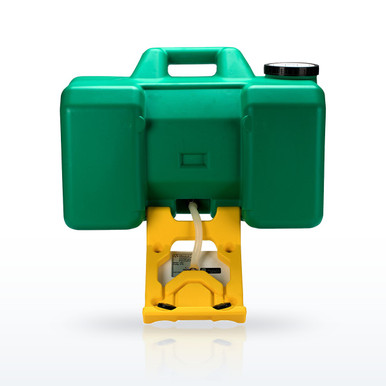 First Aid Only M7501 HAWS 15 Minute Eye Wash StationFirst Aid Only prints a HAWS 15 minute portable gravity-fed eyewash station, 9 gallon capacity, full-pattern flushing at 0.4 gallons per minute
Why the first 15 minutes are the station’s job and the next hour is the clinician’s. The live guides on this site cover when OSHA requires an eyewash and what the standard asks of the equipment; this one is about the person standing in front of it. The questions are practical: how to use it, how long, what is in it, how far from the wall, how high, what it is called in a lab, how much it costs, and what to do when the eye is still sore. The answers are the Z358.1 figures as First Aid Only’s own eyewash sheet and Cal/OSHA print them, the Red Cross eye injury steps, OSHA’s letters on bottles and bloodborne splashes, and the stations, bottles, cups and pads in the First Aid Only line with their printed figures. For a chemical splash, flushing starts before anything else and the SDS decides what comes next; for a speck of metal, the Red Cross says not to rub and to see a clinician if it does not rinse out.
How to use an eyewash station and safety shower
The Z358.1 sequence as the manufacturers and Cal/OSHA 5162 state it, with the Red Cross eye injury page for the first aid frame.
- Go at once; do not wait to take out contact lenses or wipe your face. The station is within 10 seconds (about 55 feet) and on the same level for that reason.
- Start the flow hands-free: push the paddle, pull the handle or drop the tray; Z358.1 stations open in one second or less and stay on without hands. The dust covers blow off with the flow.
- Hold both eyelids open with your thumbs and fingers and lower your face into the two streams so both eyes are flushed at once; roll the eyes up, down and side to side so the fluid reaches under the lids.
- Remove contact lenses while flushing, once the stream is running, if they come out easily.
- Flush for the full 15 minutes. A splash of a strong acid or alkali may need longer; the chemical’s safety data sheet (section 4) says so, and someone reads it while you flush.
- For a body splash, use the drench shower: pull the handle, stand under the full spray, and strip contaminated clothing while the water runs; 20 gallons a minute for 15 minutes is the Z358.1 figure.
- Get to a clinician or call 911 as the SDS and the Red Cross eye injury page direct; take the SDS with you. Do not rub the eyes, and do not stop early because the pain eases.
- Afterward, the station is checked, the self-contained unit is refilled with fresh fluid and additive, and the incident is recorded.
The questions, one by one
What is the eye wash station in a lab called?
An emergency eyewash station, or an eye/face wash when the heads are large enough to flush the face as well; combined with a drench shower it is a combination unit or a safety shower and eyewash. In Z358.1 the four kinds are plumbed eyewash, self-contained (gravity-fed) eyewash, eye/face wash, and personal wash unit (the bottle); the drench shower and the drench hose are the body equipment. "Eyewash fountain" is the older name for the plumbed bowl.
Is emergency eye wash just water, and which fluid is used for eye irrigation?
In a plumbed station it is potable water, tepid (60 to 100 °F); in a self-contained station it is water treated with a preservative so it stays clean between changes (First Aid Only: "add one bottle with every fill to help keep the water in your portable eyewash station clean, fresh and ready"), or a buffered saline cartridge; in a personal bottle it is sterile isotonic buffered saline, which First Aid Only prints on every bottle. Saline is closer to the eye’s own fluid and stings less, which is why the bottles carry it, but Z358.1 and OSHA accept potable water for the station, and tap water from a running faucet is better than nothing while someone reaches the station. The live saline guide linked below has the shelf life.
How do you rinse your eyes, use a sterile eye wash, or use an eye wash cup at home?
With a bottle: tilt the head back or to the side, hold the lid open, and squeeze a steady stream across the eye from the nose outward, letting it run off the outer corner, for as long as the bottle lasts; a 1 oz bottle is a rinse, a 32 oz bottle station runs a few minutes. With a cup: fill the cup with sterile saline, bend forward, press the cup to the eye socket so it seals, tip the head back and open the eye in the fluid, roll it, then bend forward again and discard the fluid. First Aid Only prints that its eye cups "conform to the shape of the eye and help hold it open" and sells them sterile singly and in tens. For a chemical splash the cup and the 1 oz bottle are only what you grab on the way to the station.
How much does an eye wash station cost?
The current prices are on the rows in the band: the gravity-fed 9 gallon 15 minute station, the double 32 oz and single 16 oz bottle stations sold by the case of six, the mobile station with two 16 oz bottles, and the 8 oz additive sold by the case of twelve. A plumbed station is the fixture plus the plumber; the self-contained 15 minute station is what most sites without a water line buy, and the bottle stations are the personal wash units that supplement it.
How much clearance is required around an eyewash station, and what is the standard height?
Z358.1 as Cal/OSHA 5162 and the manufacturers print it: nozzles 33 to 53 inches above the floor and at least 6 inches from the nearest wall or obstruction; the station within 10 seconds of the hazard on the same level, with a clear, unobstructed path and the area lit and marked with a highly visible sign. A shower head sits 82 to 96 inches up with a 20 inch spray pattern at 60 inches and the valve no more than 69 inches up. Nothing is stored in front of or under the station.
Where are eye wash stations required, and where should one be placed?
1910.151(c) and 1926.50(g): "where the eyes or body of any person may be exposed to injurious corrosive materials, suitable facilities for quick drenching or flushing of the eyes and body shall be provided within the work area for immediate emergency use"; OSHA’s letters (April 18 2002, June 1 2009, Feb 27 2007) say it uses Z358.1 as the guide to what suitable means, and the Nov 6 2020 letter extends the eye-flushing need to bloodborne splash hazards under 1910.1030. Placement is the 10-second rule: battery charging, chemical dispensing, plating, labs, the janitor’s chemical closet, the drum pump. The live requirements guide linked below has the full rule.
What is the purpose of an eye wash, and what does "eyewash" mean?
To dilute and wash a chemical, dust or foreign body out of the eye in the first seconds, before it burns the cornea, and to keep washing for the 15 minutes the standard sets so the chemical is gone, not just diluted. The Red Cross eye injury page’s care for a chemical in the eye is to flush with clean water for at least 15 minutes and get medical care. "Eyewash" as a figure of speech (a cover-up, as in baseball slang) has nothing to do with the station.
How many gallons is a 15 minute eye wash, and do eye wash stations require hot water?
Z358.1 sets 0.4 gallons a minute for 15 minutes, which is 6 gallons; a 9 gallon gravity station carries a margin, and the eye/face wash at 3 gallons a minute uses 45. Not hot: tepid, 60 to 100 °F, which for a plumbed unit means a mixing valve and for a self-contained unit means an insulated or heated location in winter and shade in summer; First Aid Only prints the 60 to 100 °F figure on its eyewash sheet.
Is using an eyewash station considered first aid, and what are the types of eyewash stations?
Yes: 29 CFR 1904.7 lists "cleaning, flushing or soaking wounds on the surface of the skin" and "removing foreign bodies from the eye using only irrigation or a cotton swab" as first aid, so an eyewash flush that ends there is not a recordable case; a clinic visit for a chemical burn is. The types: plumbed, self-contained (gravity-fed), eye/face wash, combination with shower, and the personal wash unit (bottle), which supplements but does not replace a station, as OSHA’s letters and Cal/OSHA 5162 both say.
How do I clean my eyewash station, and how often?
Plumbed units are activated weekly to flush the line and verify flow; self-contained units are inspected weekly and the fluid changed on the manufacturer’s schedule (with the additive at every fill), the tank and nozzles cleaned when it is drained; every unit is inspected annually against the standard. First Aid Only prints "check the water level at a glance" on its translucent station and "tamper evident breakaway seal" on the additive. The live station guide linked below has the checks.
Who carries eye wash, and what can I use instead of eye wash?
We do: bottles from 1 oz to 32 oz, bottle stations, the mobile station, the 15 minute gravity station and the additive, plus eye cups and eye pads; pharmacies sell the small bottles. Instead of eyewash, for a splash: running tap water at once, then the station; nothing else, and never a home mixture. The live bottles guide linked below covers what a bottle can and cannot do.
Are eye pads good, how long do you keep them on, and how do you get metal out of your eyes?
A sterile eye pad with adhesive strips is the kit’s cover for an injured eye on the way to care (two eye coverings in every Z308.1 kit); it is not a treatment and stays on only until the clinician sees the eye. A speck of metal or grit that rinses out with the bottle is first aid; one that does not, or anything embedded, is not: the Red Cross eye injury page says not to rub or try to remove an object stuck in the eye, to cover the eye and get medical care. Eye drops are a medication for irritation and are not eyewash.
In plain words
- Go in 10 seconds, start it hands-free, lids open, both eyes in the streams, roll them, 15 minutes, then the clinician with the SDS.
- Plumbed: potable tepid water. Self-contained: water plus additive or saline. Bottle: sterile saline, a supplement only.
- Z358.1: 0.4 gpm for 15 minutes, 60 to 100 °F, nozzles 33 to 53 inches up and 6 inches clear, 10 seconds and 55 feet, same level, lit and signed.
- Lab name: emergency eyewash, eye/face wash, or combination unit with a drench shower.
- Flushing is first aid under 1904.7; a chemical burn that needs a clinic is not.
- Cost: on the rows; the gravity 15 minute station is the no-plumbing answer.
Questions people ask
How do you use an eyewash station?
Reach it in 10 seconds, start it hands-free, hold both lids open, both eyes in the streams, roll the eyes, flush 15 minutes, then a clinician with the SDS.
What is the eyewash station in a lab called?
An emergency eyewash, an eye/face wash, or a combination unit when it has a drench shower.
Is emergency eyewash just water?
Plumbed stations run tepid potable water; self-contained ones use water with a preservative or saline; bottles carry sterile buffered saline.
How much does an eyewash station cost?
The gravity 15 minute station, the bottle stations, the mobile station and the additive are priced on their rows; a plumbed unit adds the plumber.
How much clearance does an eyewash station need?
Nozzles 33 to 53 inches off the floor and 6 inches from any obstruction, with a clear path and nothing stored in front (Z358.1).
How many gallons is a 15 minute eyewash?
Six: 0.4 gallons a minute for 15 minutes; a 9 gallon station carries a margin.
Do eyewash stations need hot water?
Tepid, 60 to 100 °F, not hot.
Is using an eyewash station first aid?
Yes under 1904.7 (flushing and removing a foreign body by irrigation); a clinic visit for a burn is medical treatment.
How do you use an eyewash cup?
Fill with sterile saline, seal it over the eye, tip the head back, open and roll the eye, bend forward and discard.
Where should an eyewash station be placed?
Within 10 seconds (about 55 feet) of the hazard on the same level, lit and signed, wherever corrosives can reach the eyes.
How often do I clean an eyewash station?
Plumbed: activated weekly; self-contained: inspected weekly, fluid and additive changed on the manufacturer’s schedule; all units inspected annually.
How do I get metal out of my eye?
Rinse with the bottle; if it does not come out or is embedded, do not rub, cover the eye and see a clinician, as the Red Cross states.
Related guides
OSHA eyewash station requirementsWhat 1910.151(c) and ANSI Z358.1 requireWhat is an eyewash station?When OSHA requires one, plumbed vs portableAre eyewash bottles OSHA compliant?What a personal wash unit can and cannot doEyewash saline solutionSterile saline vs tap water and shelf lifeANSI/ISEA Z358.1 Emergency Eyewash and Shower EquipmentThe rule pageThe ratings, test results and standards shown here are the manufacturers' published values, reproduced as published. Nothing on this page is a recommendation by Bayshore Safety that any product is suitable for a particular task, hazard or workplace. Selecting safety products and protective equipment is the responsibility of the end user and the employer, based on their own hazard assessment and the regulations that apply to their work. Confirm every value on the manufacturer's own documentation before use.
© 2026 Bayshore Safety & Industrial Supplies, Inc. All rights reserved. This guide may not be copied or republished without written permission.