
Howard Leight ear plugs compared: Max, Max Lite, Laser Lite, FirmFit, X-Treme, AirSoft, SmartFit and the rest, by NRR and material
Howard Leight is the hearing-protection brand in the PIP family, and every plug carries an EPA-labeled Noise Reduction Rating the manufacturer publishes: the polyurethane foam Max is NRR 33 and the Max Lite 30; Laser Lite 32 and the metal-detectable Laser-Trak 33; FirmFit (PVC foam) 30; X-Treme 32; TrustFit Plus 31 and TrustFit Trak 29; the reusable thermoplastic AirSoft 27, SmartFit 25 and Fusion 25; the vinyl Quiet 26; and the QB banded plugs 27. The NRR is the laboratory figure under ANSI S3.19; OSHA’s Appendix B method derates it in the field, which the NRR guide covers. Each style is sold uncorded or corded, by the box or by the case, and most in a refill bag for the HL400 dispenser.
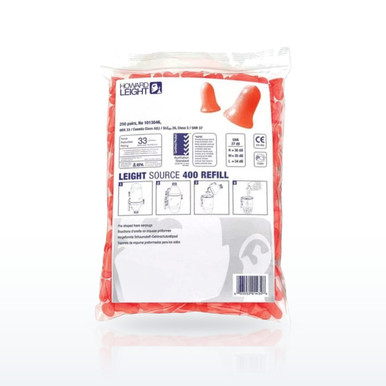 Howard Leight Maximum MXM-LS4-REFILL Ear Plugs, NRR 33, UncordedHoward Leight Max, NRR 33, polyurethane foam (PIP data)
Why the brand has a dozen plugs. The NRR is only one of the figures. Foam plugs differ in the foam (polyurethane in the Max and Laser Lite families, PVC in the FirmFit), in size (Max Lite is the smaller-ear version of Max), in shape (the T-shaped Max, the contoured Laser Lite, the push-in stem of TrustFit) and in whether a metal-detectable cord and bead is molded in (Laser-Trak, TrustFit Trak, Fusion Detectable) for food plants. The reusable plugs (AirSoft, SmartFit, Fusion) are thermoplastic elastomer with a flange or a stem, washable, and rated lower than the foam. The manufacturer’s data lists each of those columns per style and the product pages carry them; the table here is read from the same data.
The families, from the manufacturer’s data
NRR as labeled; material and reusability as PIP lists them.
What the NRR does and does not say
From the rule and the manufacturer’s data:
- The NRR is measured under ANSI S3.19-1974 in a laboratory with trained subjects and printed on the package as the EPA label requires (40 CFR Part 211 Subpart B).
- OSHA’s Appendix B to 1910.95 subtracts 7 dB from the NRR when the noise is measured in dBA; NIOSH goes further and derates foam plugs by 50 percent. A 33 NRR plug is credited at 26 dB by the OSHA method, 16.5 by NIOSH’s.
- A higher NRR plug worn loosely gives less protection than a lower one seated properly; the fit guide covers roll, pull and hold and the user check.
- Reusable plugs are rated lower than foam in this line (25 to 27 against 30 to 33) and are washed and reissued on the manufacturer’s interval; the replacement guide covers it.
- Who makes Howard Leight: the brand has been part of PIP (Protective Industrial Products) since 2025, and the product data on this site is PIP’s.
Questions people ask
Are Howard Leight ear plugs good?
This site does not rate brands. The manufacturer publishes an EPA-labeled NRR for every plug (25 to 33 across the line) and the material and reusability per style; those figures are in the band above and on each product page.
Which Howard Leight ear plug has the highest NRR?
Max (MXM) and Laser-Trak are labeled NRR 33 in the manufacturer’s data; Laser Lite and X-Treme are 32, TrustFit Plus 31, Max Lite and FirmFit 30.
What is the difference between Max and Max Lite?
The same polyurethane foam; Max Lite is the smaller size for smaller ear canals and is labeled NRR 30 against the Max’s 33.
Which Howard Leight plugs are metal detectable?
Laser-Trak, TrustFit Trak and Fusion Detectable carry a detectable cord and bead in the manufacturer’s data, for food and pharmaceutical plants.
Who makes Howard Leight ear plugs?
Howard Leight is a brand of PIP (Protective Industrial Products) since 2025; the data on this site is PIP’s.
What does NRR 33 mean in practice?
By OSHA’s Appendix B method, 33 − 7 = 26 dB of credited reduction against a dBA measurement; by NIOSH’s derating, half the NRR. The NRR guide shows the arithmetic.
Who makes Howard Leight, and who owns the brand?
Howard Leight is a hearing-protection brand founded in California in the 1970s, owned for years by Honeywell (through its Bacou-Dalloz and Sperian acquisitions) and part of PIP (Protective Industrial Products) since PIP's 2025 acquisition of Honeywell's personal protective equipment business. The plugs are made in PIP's own plants, and the product data on this site is PIP's. The Max, Laser Lite and SmartFit names did not change.
The ratings, test results and standards shown here are the manufacturers' published values, reproduced as published. Nothing on this page is a recommendation by Bayshore Safety that any product is suitable for a particular task, hazard or workplace. Selecting safety products and protective equipment is the responsibility of the end user and the employer, based on their own hazard assessment and the regulations that apply to their work. Confirm every value on the manufacturer's own documentation before use.