
Bayshore Safety & Industrial Supplies Guide
What is an IFAK? IFAK vs AFAK, what is in a trauma kit and what one costs, chest seals and when a vented seal is used, trauma shears vs bandage scissors, tourniquet placement and the windlass, and the bleeding control kits each state names
An IFAK is an individual first aid kit: the pouch a soldier, officer or worker carries for their own life-threatening bleeding, built around a windlass tourniquet, hemostatic or compressed packing gauze, a pressure dressing, a chest seal, gloves, shears and a marker. An AFAK is an advanced first aid kit, the larger version with more of each and sometimes airway items, carried by a medic or kept at a station. A trauma kit is the civilian name for either. What is in one follows the Stop the Bleed order (pressure, packing, tourniquet) plus the chest seal for a penetrating chest wound; the First Aid Only kits in the band print their contents, and the Bleeding Control By State sheet lists the kits built to the Texas, Illinois, California, Connecticut and other state rules. A tourniquet goes 2 to 3 inches above the wound and never over a joint; the windlass is the rod that tightens it.
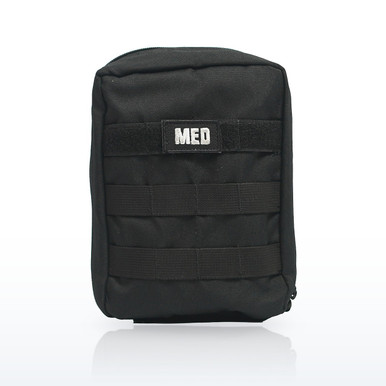 First Aid Only FA187B-ADV Bleeding Control Kit, Military IFAK BlackFirst Aid Only prints a military IFAK with 12 pieces of first aid and bleeding control items, built for EMS, first responders and industrial safety
Why the kit is a set, not a bag. The questions in this cluster are about names (IFAK, AFAK, trauma kit, med kit, jump bag), contents, prices and the parts (tourniquet, chest seal, shears), and they all come back to one list: the tools that stop life-threatening bleeding in the first minutes, in the order the Stop the Bleed course teaches them. The bag only matters for where it is carried: on a belt or drop leg for the person, in a pouch on the wall for a floor, in a cabinet for a building. This page gives the list, the Stop the Bleed and Red Cross steps for each tool, OSHA’s 2019 letter on which workplaces need Class B items and tourniquets, the state rules First Aid Only builds kits to, and the First Aid Only kits with their printed contents and current prices.
What is in a trauma kit or IFAK, item by item
The order is Stop the Bleed’s; the items are what First Aid Only prints in its kit contents.
The questions, one by one
What is the difference between an IFAK and an AFAK?
Size and who carries it. The IFAK (individual first aid kit) is one person’s kit for their own injuries, carried on the body, with one tourniquet, one packing gauze, one pressure dressing, a chest seal or two, gloves and shears; First Aid Only’s FA187 military IFAK lists 12 pieces and the FA142 tactical IFAK is the larger pouch. The AFAK (advanced first aid kit) is the medic’s or team’s kit with multiples of each item and, in military use, airway adjuncts; in a workplace the equivalent is the patrol trauma kit, the first responder kit (First Aid Only’s 91110 lists 172 pieces, "a windlass-style tourniquet, blood-stopping hemostatic gauze, glucose and a burn dressing") or the emergency response bag with its treatment packs.
What are the essential items in a trauma kit, and what should be in an IFAK?
The list above: a windlass tourniquet, hemostatic or compressed gauze for packing, a pressure dressing, a vented chest seal, nitrile gloves, shears, a marker, and instructions. Everything else (adhesive bandages, antiseptic, burn dressing, a blanket) makes it a first aid kit as well, which is what First Aid Only’s "First Aid and Bleeding Control" dual pack (91554) is. Marines and other units carry the same core set in their issued IFAKs; the brand of tourniquet is the service’s choice and we do not quote it.
Why is a tourniquet placed 2 to 3 inches above the wound, and what are the 5 steps of using one?
Stop the Bleed: "apply 2 to 3 inches above wound, do not place over the elbow or knee, tighten tourniquet until bleeding stops, do not remove the tourniquet, a second tourniquet may be required". The gap above the wound puts the strap on intact tissue and the artery above the injury; a joint would keep the strap from compressing the vessel. The five steps courses teach: expose the limb and find the bleeding; place the tourniquet 2 to 3 inches above the wound (high and tight on the limb if the wound cannot be seen); pull the strap tight and secure it; twist the windlass until the bleeding stops and lock it; note the time and do not loosen it. The Red Cross restricts the tourniquet to the trained rescuer.
What is the purpose of the windlass, what does a tourniquet actually do, and can it cause a blood clot?
The windlass is the rod: the strap alone cannot be pulled tight enough by hand to stop arterial flow, so the rod twists it tighter and a clip locks the rod. A tourniquet stops all blood flow below it, which is why it is for life-threatening bleeding only and why it stays on until a clinician removes it. The risks (nerve and tissue injury, clotting) are why the time goes on the marker and the tourniquet is not loosened; the Stop the Bleed position is that a tourniquet on a limb that is bleeding to death is worth those risks.
What tourniquet does the military use, and how do I make a DIY tourniquet?
Windlass tourniquets of the CAT and SOF-T type are the ones issued under tactical combat casualty care guidelines; First Aid Only lists "CAT windlass tourniquet" in its Illinois and Colorado kits and a windlass tourniquet in the rest. A belt, a cord or a rubber tourniquet from the kit is not a substitute: the Stop the Bleed course teaches direct pressure and packing when there is no tourniquet, and the Red Cross names wound packing "from a limb if no tourniquet is available". A triangular bandage with a stick as a windlass is the improvised version courses show for when nothing else exists.
Why do we use chest seals, when is a vented chest seal used, and can you fold them?
A penetrating chest wound can let air into the chest cavity with each breath, collapsing the lung; an occlusive seal stops that. A vented seal (First Aid Only’s 91194) lets air that is trapped inside escape through its channels while blocking air coming in, which is why it is the seal in current kits; an unvented seal is the older type and the one that has to be lifted ("burped") if pressure builds. The seal is applied to clean, dry skin over the wound on exhalation, and a second seal covers an exit wound. They are packaged flat and should stay flat; a folded seal creases its gel. First Aid Only lists the single seal and the 10-bag; the price is on the row.
Are bandage scissors the same as trauma shears, and what are trauma shears for?
Trauma shears are the 7 inch angled shears with a blunt lower tip that cut clothing, belts and boot laces away from a wound without cutting the person; First Aid Only prints "titanium-bonded, 5 times harder than stainless steel, curved blade to prevent cutting patient" on its 7 inch shears. Bandage scissors are the smaller Lister pattern (5.5 inch in First Aid Only’s line) with the same blunt tip, for cutting dressings and tape. A kit carries one or the other; the shears do both jobs.
How much does a trauma kit or an IFAK cost?
The current prices are on the rows in the band: the compact bleeding control kits in plastic bags, the state-rule kits in pouches, the military and tactical IFAKs, the patrol trauma kits and the 172-piece first responder kit. The price follows the contents: a windlass tourniquet and hemostatic gauze are the two items that move it, and a kit without a hemostatic (packing gauze only) sits lower.
Which states require bleeding control kits, and what goes in them?
First Aid Only’s Bleeding Control By State sheet (requirements current as of May 2026) lists states with mandated contents: Illinois (bandage shears, Z-fold compressed gauze, Israeli bandage, nitrile gloves, marker, CAT windlass tourniquet, Stop the Bleed booklet, hemostatic gauze pad), Florida, Connecticut (adds chest seals and an emergency blanket), Colorado, Indiana, Tennessee, Virginia and Washington, California and New Hampshire (Hema-Seal trauma dressing, shears, marker, gloves, CAT windlass tourniquet, booklet; the California kit cites AB 2260), Massachusetts and Missouri, and Texas; and states with general requirements (Arkansas, Georgia, Utah). The sheet is First Aid Only’s reading of each law; the statute itself governs, and the kits in the band are labeled by the rule they are built to.
Is a trauma kit required at work?
OSHA’s June 2019 letter interprets 1910.151 to require the Class A bleeding items (bandages, trauma pads, sterile pads) in general industry and the Class B items, "including tourniquets", where the workplace has a high risk of serious injuries, naming industries where amputations are likely; it also states that an adequately trained first aider is trained in direct pressure, hemostatic dressings and tourniquets under the 2015 guidelines. Z308.1-2021 puts a tourniquet in every Class A and B kit and lists bleeding control kits among the supplementary items for the employer’s assessment.
What is an emergency trauma bag or jump bag, and what is a med kit?
A jump bag is the EMS responder’s grab bag with trauma, airway and assessment gear; First Aid Only’s emergency response bags (the 91170 with six treatment packs and the Class B AED and first aid response bag with eight) are the workplace version, wall-mounted and carried to the scene. "Med kit" is the generic word for any of these; "IFAK" says it is carried on the person.
Are tourniquets legal, and what is another name for a tourniquet?
Yes; tourniquets are sold without restriction and are required contents of every Z308.1-2021 kit. Other names: windlass tourniquet, CAT (combat application tourniquet, a brand), SOF-T (a brand), SWAT-T (the stretch-wrap-and-tuck band), and the rubber tourniquet in a unit box, which is the venipuncture band and is not a bleeding-control tourniquet.
In plain words
- IFAK: one person’s bleeding kit, on the body. AFAK: the medic’s larger kit. Trauma kit: the civilian word for either.
- Inside: windlass tourniquet, packing gauze (hemostatic or compressed), pressure dressing, vented chest seal, gloves, shears, marker.
- Tourniquet 2 to 3 inches above the wound, not over a joint, tight until the bleeding stops, time written, never loosened.
- Vented chest seal for a penetrating chest wound; a second for the exit.
- Trauma shears cut clothing; bandage scissors cut dressings.
- OSHA’s 2019 letter: Class B items with tourniquets where serious injuries are likely. States: see the First Aid Only state sheet.
Questions people ask
What is the difference between an IFAK and an AFAK?
IFAK: one person’s kit carried on the body; AFAK: the larger medic or team kit with multiples and sometimes airway items.
What is in a trauma kit?
A windlass tourniquet, hemostatic or compressed packing gauze, a pressure dressing, a vented chest seal, gloves, shears, a marker and instructions.
Why is a tourniquet placed 2 to 3 inches above the wound?
To sit on intact tissue above the injured vessel and off the elbow or knee, as Stop the Bleed states.
What are the 5 steps of using a tourniquet?
Find the bleeding, place 2 to 3 inches above it, pull tight and secure, twist the windlass until the bleeding stops and lock it, note the time and do not loosen.
What is the windlass for?
It is the rod that twists the strap tighter than hands can pull it, then locks.
Why do we use chest seals?
To stop air entering a penetrating chest wound; a vented seal lets trapped air out.
When is a vented chest seal used?
On any open chest wound in current kits; two for entry and exit wounds.
Are bandage scissors the same as trauma shears?
No; trauma shears are 7 inch angled shears for clothing and belts, bandage scissors the smaller Lister pattern for dressings.
How much does a trauma kit cost?
The current price of each kit is on its row; the tourniquet and hemostatic gauze set the level.
What tourniquet does the military use?
Windlass tourniquets of the CAT and SOF-T type under TCCC guidelines; First Aid Only lists a CAT windlass tourniquet in several state kits.
Which states require bleeding control kits?
First Aid Only’s May 2026 sheet lists Illinois, Florida, Connecticut, Colorado, Indiana, Tennessee, Virginia, Washington, California, New Hampshire, Massachusetts, Missouri and Texas with mandated contents, and Arkansas, Georgia and Utah with general requirements.
Does OSHA require a trauma kit?
Its 2019 letter requires Class B bleeding items including tourniquets where serious injuries such as amputations are likely, and Class A items elsewhere.
The ratings, test results and standards shown here are the manufacturers' published values, reproduced as published. Nothing on this page is a recommendation by Bayshore Safety that any product is suitable for a particular task, hazard or workplace. Selecting safety products and protective equipment is the responsibility of the end user and the employer, based on their own hazard assessment and the regulations that apply to their work. Confirm every value on the manufacturer's own documentation before use.
© 2026 Bayshore Safety & Industrial Supplies, Inc. All rights reserved. This guide may not be copied or republished without written permission.