
One line or two? Confined space systems, winches, SRL-Rs, and the self-egress test FallTech applies
The number of lines over a confined space opening is decided by one question FallTech puts first: can the entrant climb in and out under their own power? Where a fixed or portable ladder gives continuous, independent entry and exit, a manhole or a utility vault, a one-line system is acceptable: the worker climbs, and the mechanical device, a winch or a self-retracting lifeline with rescue and retrieval (an SRL-R), is a backup for retrieval if something goes wrong. Where the worker is raised and lowered mechanically, a tank, vessel, silo or process equipment, a two-line system is mandatory: the personnel winch is the primary means of movement and a second, independent line, typically an SRL-R, arrests a fall and provides retrieval if the winch or its operator fails. OSHA’s retrieval rule sits under both: 1910.146(k)(3) requires a retrieval line attached to the harness and a mechanical device available for vertical spaces more than 5 feet deep, and 1926.1211(c) carries the same into construction.
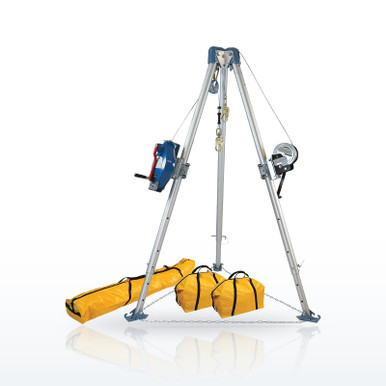 FallTech 7504 Confined Space Tripod Kits, 11 ft, SRL-R and WinchTwo-line tripod kit: a personnel winch for movement and a 3-way SRL-R for fall arrest and retrieval (FallTech data)
Why the ladder decides, not the depth. FallTech’s article corrects the field habit of counting feet: depth alone is not the deciding factor, the presence or absence of a ladder is. With a ladder the device is a backup; the worker is never dependent on it to move. The moment self-egress goes away, even briefly, the device is primary life support, and a winch was never designed for that alone: under ANSI Z359.4 a personnel winch carries a secondary brake for a failure of the primary mechanism, but that brake is not a fall arrester and does not manage fall force the way an SRL or an energy-absorbing lanyard does. The second line exists because winches are mechanical devices operated by people, and either can fail. FallTech also names the misuse that follows from skipping it: SRL-Rs run as everyday winches for lowering and material handling wear internally where no inspection can see, and show up later as slipping devices and failed rescues.
The two systems, as FallTech defines them
From “One Line vs. Two Line Confined Space Systems”.
What the OSHA paragraphs require under both systems
The rule and the manufacturer’s operating notes:
- 1910.146(k)(3): to facilitate non-entry rescue, retrieval systems or methods are used whenever an authorized entrant enters a permit space, unless the equipment would increase the overall risk or would not contribute to the rescue.
- 1910.146(k)(3)(i): each entrant uses a chest or full body harness with the retrieval line attached at the center of the back near shoulder level, above the head, or at another point the employer can establish presents a profile small enough for successful removal; wristlets only where a harness is infeasible or creates a greater hazard.
- 1910.146(k)(3)(ii): the other end of the retrieval line is attached to a mechanical device or fixed point outside the space so rescue can begin as soon as the rescuer becomes aware it is necessary; a mechanical device is available to retrieve personnel from vertical type permit spaces more than 5 feet deep.
- 1926.1211(c): the construction standard carries the same retrieval-system requirement.
- FallTech’s winch manual: the winch operator directs the cable and keeps constant contact with the entrant; 15 lb of tension is kept on the cable in both directions to prevent bird-nesting on the drum; the entrant ascends and descends at a consistent, even pace.
- FallTech’s harness pages list the retrieval attachment points (Front, Back, Shoulders) in the Attachment Points field.
Which configuration, by how the worker moves (FallTech’s test)
| Entry | Can the worker self-egress? | Lines | Primary device | Backup or second line |
|---|---|---|---|---|
| Manhole or vault with a fixed or portable ladder | yes, for the whole entry | one | the ladder | SRL-R (or a winch kept taut) for retrieval |
| Tank, vessel or silo, worker lowered and raised | no | two (mandatory) | personnel winch (ANSI Z359.4, secondary brake) | independent SRL-R for fall arrest and retrieval |
| Any entry where self-egress is lost even briefly | no | two (mandatory) | winch | SRL-R |
Source: FallTech, “One Line vs. Two Line Confined Space Systems: What’s Acceptable and What’s Required”
Questions people ask
What is a one-line confined space system?
A system where the entrant climbs in and out on a ladder and a single mechanical device, usually an SRL-R, is a backup for retrieval. FallTech states it is acceptable only while there is a continuous, independent means of entry and egress.
When is a two-line system required?
Any time the worker is raised and lowered mechanically, in FallTech’s words tanks, vessels, silos and large process equipment: the winch moves the worker and a second, independent line (typically an SRL-R) arrests a fall and provides retrieval if the winch or operator fails.
What are the OSHA requirements for a confined space retrieval system?
A harness with the retrieval line at the dorsal position, above the head or another approved point; wristlets only where a harness is infeasible; the line’s other end on a mechanical device or fixed point outside the space; and a mechanical device available for vertical spaces more than 5 feet deep (1910.146(k)(3); 1926.1211(c)). Whether one line meets it or two are needed is the question FallTech’s self-egress test answers above.
Can a winch alone be used for fall protection?
No. FallTech states winches are not fall arrest devices; the ANSI Z359.4 secondary brake covers a mechanism failure and does not manage fall force. On a one-line ladder entry a winch must stay taut; where the winch moves the worker a second line is mandatory.
What is an SRL-R?
A self-retracting lifeline with rescue and retrieval: under ANSI/ASSP Z359.14-2021 it is the third device type beside SRL and SRL-P, a fall arrester that can also raise or lower a fall-arrested user. FallTech lists 3-way SRL-Rs from 45 to 120 ft in galvanized or stainless cable and Technora rope.
Does depth decide one line or two?
FallTech states depth alone is not the deciding factor; the presence or absence of a ladder is. OSHA separately requires a mechanical retrieval device to be available for vertical spaces more than 5 feet deep (1910.146(k)(3)(ii)).
Can two people use one tripod?
FallTech’s FAQ: yes, but only for emergency rescue; only one person is connected to the tripod during normal use.
The ratings, test results and standards shown here are the manufacturers' published values, reproduced as published. Nothing on this page is a recommendation by Bayshore Safety that any product is suitable for a particular task, hazard or workplace. Selecting safety products and protective equipment is the responsibility of the end user and the employer, based on their own hazard assessment and the regulations that apply to their work. Confirm every value on the manufacturer's own documentation before use.