
Pesticide application PPE and the Worker Protection Standard: what the label and 40 CFR 170.507 require
Under the Worker Protection Standard, the pesticide label is the rule. 40 CFR 170.507(a) requires any person performing handler activities to use the clothing and PPE specified on the pesticide product labeling, and 170.507(b) requires the handler employer to provide that PPE clean and in proper operating condition. The regulation then defines the label words: “coveralls” must be loose-fitting one- or two-piece garments covering the entire body except head, hands and feet; a “chemical-resistant suit” is the same coverage in chemical-resistant material; and “chemical-resistant” means a material that allows no measurable movement of the pesticide being used through it during use. Long and short-sleeved shirts, pants, shoes and socks are not PPE under the rule, though the label can still require them. Coveralls drenched or heavily contaminated with a DANGER or WARNING pesticide must not be reused, contaminated PPE may not be taken home, and the employer must prevent heat illness whenever label PPE is worn. No International Enviroguard sheet publishes a pesticide test, so none can be called chemical-resistant to a given product from its data; a disposable coverall meets the regulation’s definition of coveralls, and the chemical lists on the ChemSplash 1 and MicroGuard MP sheets are what an employer compares against the label and the safety data sheet.
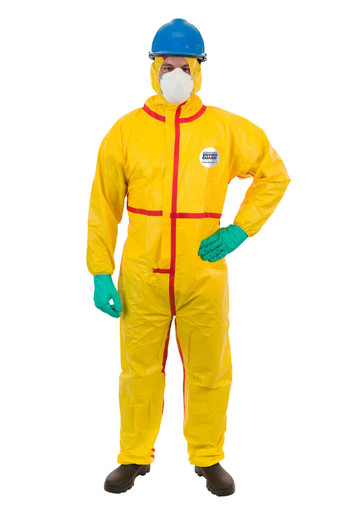 Enviroguard 7015YT ChemSplash 1 Disposable Chemical Splash Coverall with Hood, Elastic Wrist and Ankle, Taped SeamsHybrid membrane fabric with taped seams, attached hood, elastic wrists and ankles. Published ISO 6530 / EN 368 penetration and repellency classes on nine agents; MVTR over 3000 g/m²/24 hr by ASTM E96.
Why does the label decide instead of the regulation? Because every registered pesticide carries its own PPE statement, written for that product’s toxicity and route of exposure, and EPA’s rule simply makes that statement binding on the handler and the employer. The Worker Protection Standard covers people on farms, in forests, nurseries and greenhouses who mix, load, apply, flag, clean equipment or handle open containers, and workers sent into a treated area before the restricted-entry interval has run. 170.507 translates the label’s words into minimum garment definitions and adds the employer duties around them: provide, inspect, clean, store, replace and keep it off the ride home.
40 CFR 170.305, definition of handler; 170.507(a), (b), (c) and (d); 170.605(d).What do the label words mean under 170.507(b)?
The regulation’s own definitions, which are the minimum a garment has to meet when the label uses the word.
What PPE do pesticide handlers have to wear?
Whatever the label says, as 170.507(a) puts it: the clothing and personal protective equipment specified on the pesticide product labeling for use of the product. The handler employer provides it, in clean and proper operating condition, and ensures it is used correctly, for its intended purpose and according to the manufacturer’s instructions. Before each day of use, all PPE is inspected for leaks, holes, tears or worn places, and damaged equipment is repaired or discarded. The same rules reach early-entry workers: an agricultural employer who sends a worker into a treated area during the restricted-entry interval must provide the PPE the label specifies for early entry, meeting the same 170.507(b) definitions.
40 CFR 170.507(a), (b), (c)(1) and (c)(2); 170.605(d) and (e).EPA’s handler PPE page lists the exceptions: handler employers may allow handlers to omit some label PPE when using a closed system, in an enclosed cab or in a cockpit, under the conditions in the rule. It also lists the employer duties in plain words, including a clean place away from pesticide storage and use areas to store personal clothing, put PPE on at the start of an exposure period and take it off at the end, and heat-illness measures while PPE is worn.
EPA, Personal Protective Equipment for Pesticide Handlers, Duties and Exceptions sections; 40 CFR 170.507(d)(9) and (e); 170.607.When can a pesticide coverall be reused, and when must it be thrown away?
170.507(d) sets the cleaning rules. PPE is cleaned according to the manufacturer’s instructions or the label before each day of reuse, and in the absence of instructions washed thoroughly in detergent and hot water. Contaminated PPE is kept separate from other clothing and laundry and washed separately, dried thoroughly before storage or reuse, and stored apart from personal clothing and pesticide areas. Then the disposal line: coveralls or other absorbent materials that have been drenched or heavily contaminated with a pesticide that has the signal word DANGER or WARNING on the label must not be reused and must be disposed of; anyone handling that contaminated PPE wears the gloves the label specifies for mixing and loading. PPE that cannot or will not be cleaned properly is made unusable as apparel. A single-use coverall settles the question the same way for every label: worn once, then disposed of under the applicable rules.
40 CFR 170.507(d)(1) through (5).Two more lines matter for the crew. The employer must not allow or direct any handler to wear home or take home employer-provided PPE contaminated with pesticides, and must tell anyone who cleans or launders the PPE that it may be contaminated, how to clean it safely and how to decontaminate afterwards. Decontamination supplies for handlers include at least three gallons of water per handler, soap, single-use towels and one clean change of clothing, such as coveralls, for use in an emergency.
40 CFR 170.507(d)(8) and (d)(10); 170.509(b) and (b)(3).Does a disposable coverall count as a chemical-resistant suit?
Only if the material allows no measurable movement of the pesticide being used through it during use, which is a test against the specific product. No International Enviroguard sheet publishes a pesticide test, so none of these garments can be called chemical-resistant to a given pesticide from its data. What the sheets do publish is a chemical list by a named method. ChemSplash 1 lists nine agents by ISO 6530 / EN 368 with penetration and repellency classes, including sodium hydroxide 50 percent, hydrochloric acid 36 to 37 percent, sulfuric acid 96 percent, isopropanol, toluene, n-heptane, dichloromethane, hydrofluoric acid and JP8 jet fuel, with MVTR over 3000 g/m²/24 hr by ASTM E96 and hydrostatic resistance of 226 cm by ISO 811. MicroGuard MP lists bleach 5 percent, hydraulic jack oil, isocyanate-based paint hardener, motor oil, sodium hydroxide 10 percent and mineral oil as Pass by ASTM F903. Neither list is a pesticide. The comparison an employer can make is between those entries, the active ingredient and carrier on the safety data sheet, which 1910.1200 requires to carry Section 8 on exposure controls and personal protection, and the label’s PPE statement. Where the label says “coveralls” without “chemical-resistant,” the regulation’s definition is coverage, not a barrier test, and a hooded disposable coverall with elastic wrists and ankles is that coverage with the head covered too.
40 CFR 170.507(b)(1), (b)(3) and (b)(4); ChemSplash 1 sell sheet, Agent Testing table and physical properties; MicroGuard MP sell sheet, Liquid and Chemical Testing table; 29 CFR 1910.1200(g)(2)(viii).Which fabrics does the manufacturer name for agricultural work?
One. The PyroGuard CRFR apron sheet lists agricultural work, chemical mixing and tank cleaning among the applications for its 9110T chemical-resistant and flame-resistant PVC apron with long sleeves, elastic wrists and taped seams. No coverall sheet names pesticides or agriculture. ChemSplash 1 is described for manufacturing, emergency response, environmental cleanup and other situations with the threat of chemical splash; MicroGuard MP for waste management, painting, food processing, refinery turnaround, industrial, pharmaceutical and abatement; SMS for particulates and light liquid splashes or sprays; Polypropylene for dust in non-hazardous environments, with food processing and environmental cleanup on its list. For a label that calls for coveralls over work clothing in a dry or light-spray exposure, those last two are the economical coverage; for mixing and loading, where the splash is concentrate, the published chemical data on ChemSplash 1 is the only Enviroguard coverall data there is to read.
PyroGuard CRFR apron sheet (applications); ChemSplash 1, MicroGuard MP, SMS and Polypropylene sell sheets and brand pages (applications).What about aprons, sleeves, hoods and footwear?
A label that says chemical-resistant apron means coverage from mid-chest to the knees; the 702846Y ChemSplash 1 apron and the 802448 MicroGuard MP apron are 28 by 46 inches, bib style with ties, which is that coverage on most wearers, and the chemical-resistance question is the same one as for the coverall. Sleeves, 18 inches with elastic at both ends in ChemSplash 1 (7065YT taped, 7065YS serged) and MicroGuard MP (8065), cover the forearm between glove and apron. Chemical-resistant headgear under the rule is a chemical-resistant hood or wide-brim hat; an attached hood on a coverall covers the head, and whether it is chemical-resistant is again the product-specific question. Chemical-resistant footwear can be chemical-resistant shoe coverings worn over shoes or boots; the manufacturer describes its CPE shoe covers as waterproof coated polyethylene for non-hazardous particles, liquids and chemicals, without a pesticide test.
40 CFR 170.507(b)(6), (b)(8) and (b)(9); ChemSplash 1 and MicroGuard MP garment lists; Heavy-Duty CPE shoe cover sheet.Questions people ask
What PPE is required for pesticide application?
Whatever the pesticide product label specifies; 40 CFR 170.507(a) requires handlers to use the clothing and PPE on the labeling, and 170.507(b) requires the employer to provide it clean and in proper operating condition.
What counts as coveralls under the Worker Protection Standard?
Loose-fitting, one- or two-piece garments that cover, at a minimum, the entire body except head, hands and feet (40 CFR 170.507(b)(4)).
What does chemical-resistant mean on a pesticide label?
Material that allows no measurable movement of the pesticide being used through it during use (40 CFR 170.507(b)(1)); it is a test against the specific product, and no Enviroguard sheet publishes a pesticide test.
Can you reuse coveralls after spraying pesticides?
Only if cleaned per the manufacturer or label before each day of reuse; coveralls drenched or heavily contaminated with a DANGER or WARNING pesticide must not be reused and must be disposed of (40 CFR 170.507(d)(1) and (d)(2)).
Can handlers take pesticide PPE home?
No. The handler employer must not allow or direct any handler to wear home or take home employer-provided PPE contaminated with pesticides (40 CFR 170.507(d)(10)).
Are long sleeves and pants PPE under the rule?
No. 170.507(b) says long-sleeved shirts, short-sleeved shirts, long pants, short pants, shoes and socks are not PPE, although the label can require them as work clothing.
Does the rule cover workers who re-enter a sprayed field early?
Yes. 40 CFR 170.605(d) requires the agricultural employer to provide early-entry workers the PPE the label specifies for early entry, meeting the 170.507(b) definitions.
The ratings, test results and standards shown here are the manufacturers' published values, reproduced as published. Nothing on this page is a recommendation by Bayshore Safety that any product is suitable for a particular task, hazard or workplace. Selecting safety products and protective equipment is the responsibility of the end user and the employer, based on their own hazard assessment and the regulations that apply to their work. Confirm every value on the manufacturer's own documentation before use.