
What are category 1, 2 and 3 gloves? The PPE categories under the European regulation, and how they map to the ratings
Category 1, 2 and 3 are not glove ratings; they are the three risk categories of the European PPE Regulation (EU) 2016/425, Annex I, which decide how much certification a glove needs before it is sold in Europe. Category I is minimal risk (superficial mechanical injury, cleaning materials of weak action, contact with hot surfaces under 50 °C): the manufacturer self-declares. Category II is every risk not in I or III: an EU type-examination by a notified body, which is where EN 388 mechanical gloves sit. Category III is risk that can cause very serious consequences such as death or irreversible damage to health (chemicals and micro-organisms, electricity, high and low temperatures, cuts by hand-held chainsaws): type-examination plus ongoing production surveillance, which is where EN 374 chemical gloves, EN 407 heat gloves above the Category I limits and electrical gloves sit. The US rules do not use these categories; a glove sold here carries its ANSI/ISEA 105, ASTM D120 or other rating directly.
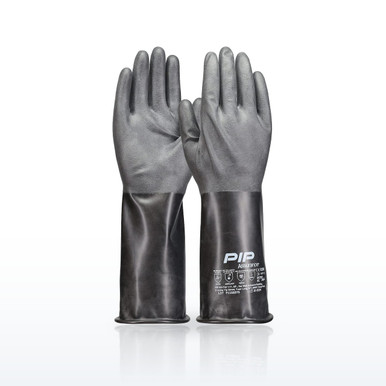 Assurance BUT03R Chemical Resistant Gloves, Butyl, 12 mil, 14 inChemical glove with an EN 374 marking, the Category III group (PIP data)
Why the question gets asked. European glove packaging and spec sheets print the category (CAT I, II or III) beside the CE mark, and the number travels with the glove into US catalogs, so buyers see “category 3 gloves” and read it as a protection level. It is a certification route, not a performance score: two chemical gloves can both be Category III and differ by six levels on the EN 374 permeation scale, and a Category II cut glove can out-rate a Category III one on abrasion. The ratings that describe performance are the ones in the EN 388, EN 374 and EN 407 pictograms and, in the US, the ANSI/ISEA 105 levels PIP publishes per style.
The three categories as the regulation defines them
Regulation (EU) 2016/425, Annex I.
Where common glove standards fall
| Standard on the glove | What it rates | PPE category (EU) | US equivalent on the same glove |
|---|---|---|---|
| EN 388:2016 | Abrasion, blade cut, tear, puncture, ISO 13997 cut letter, impact P | II | ANSI/ISEA 105 abrasion, cut A1–A9, puncture; ANSI/ISEA 138 impact |
| EN 374-1:2016 | Chemical permeation (Type A, B, C with chemical letters) and penetration | III | No ANSI equivalent; manufacturers publish ASTM F739 breakthrough times |
| EN 374-5:2016 | Micro-organisms (bacteria, fungi; VIRUS when tested to ISO 16604) | III | ASTM F1671 (bloodborne pathogen penetration) where tested |
| EN 407:2020 | Flame, contact heat, convective, radiant heat, small and large splashes of molten metal | II or III by the temperature | ANSI/ISEA 105 contact heat levels 1–5 (ASTM F1060) |
| EN 511:2006 | Convective cold, contact cold, water penetration | II | No ANSI rating; manufacturers state lining and insulation |
| EN 60903 | Electrical insulating gloves, classes 00 to 4 | III | ASTM D120 classes 00 to 4 |
The category follows the risk the glove is sold against; the same yarn can be Category II in a work glove and Category III in a chainsaw glove.
Regulation (EU) 2016/425 Annex I; the standards named; PIP ANSI/ISEA 105 vs EN 388 comparison guide.
How Portwest’s declarations place its gloves
Portwest publishes a declaration of conformity for every glove on the US file, linked from each product page: the chemical gloves (A810, A812) are declared Category III with EN ISO 374-1 and 374-5, the cut-resistant and coated gloves Category II with EN 388 and the test house named (SATRA Technology Europe on most), and the inspection, jersey liner and string-knit gloves (A010, A040, A111) Category I, minimal risk, with no performance code.
Portwest US declarations of conformity (documents.portwest.com), fetched Nov 7 2026; Portwest product pages and US data sheets for the styles shown (documents.portwest.com), fetched Nov 7 2026Questions people ask
What are category 3 gloves?
Gloves certified to Category III of the European PPE Regulation, the group for risks that can cause death or irreversible harm: chemical and micro-organism gloves to EN 374, electrical insulating gloves, chainsaw gloves. It is a certification category, not a performance level.
What are class 2 gloves rated for?
In the US that phrase usually means ASTM D120 Class 2 rubber insulating gloves, proof-tested at 20,000 V a.c. and used up to 17,000 V a.c.; see the electrical insulating gloves guide. In Europe EN 60903 uses the same classes.
What are type 4 gloves?
There is no Type 4 glove; the number is usually an EN 388 digit (abrasion, cut, tear or puncture at level 4) or an old ANSI cut level 4 from before 2016. The EN 388 and ANSI cut level guides explain both scales.
Are category 2 gloves cut resistant?
Category II is where EN 388 mechanical gloves sit, and most cut-resistant work gloves are Category II; the cut performance is the ISO 13997 letter on the EN 388 mark and the ANSI/ISEA 105 level, not the category.
Do US gloves have PPE categories?
No. OSHA 1910.138 requires gloves selected for the hazard; the ratings are ANSI/ISEA 105, ANSI/ISEA 138, ASTM D120 and the manufacturers’ published figures.
What is Category II PPE?
Under the European PPE Regulation (EU) 2016/425, Category II is every risk not listed as minimal (Category I) or as very serious (Category III). A Category II glove needs an EU type-examination by a notified body before it is sold; EN 388 mechanical gloves sit here. The category decides the certification route, not the glove’s performance level.
What type of gloves are used for chemicals in the European system?
Category III gloves tested to EN ISO 374, because chemicals are listed among the very serious risks. The glove carries the beaker pictogram with letters for the chemicals it resisted for 30 minutes or more (Type A six letters, Type B three, Type C one), and the notified body’s number beside the CE mark. Portwest’s declarations of conformity place its chemical gloves in Category III.
What is the EN 374 standard for gloves?
EN ISO 374-1:2016 is the European standard for gloves protecting against dangerous chemicals and micro-organisms, a Category III product under the PPE Regulation. A glove is Type A, B or C by how many of the eighteen test chemicals it held for 30 minutes (six, three, or one for 10 minutes), with the letters printed under the flask; MCR Safety publishes a matrix of the letters its chemical gloves carry.
Is a glove’s PPE category the same as an arc flash PPE category?
No. The European categories I to III say how much certification a glove needed before sale. NFPA 70E’s PPE categories 1 to 4 are arc flash minimums in cal/cm² (4, 8, 25 and 40) for clothing, and ASTM D120 Classes 00 to 4 are rubber insulating glove voltages; each is a different number for a different thing.
The ratings, test results and standards shown here are the manufacturers' published values, reproduced as published. Nothing on this page is a recommendation by Bayshore Safety that any product is suitable for a particular task, hazard or workplace. Selecting safety products and protective equipment is the responsibility of the end user and the employer, based on their own hazard assessment and the regulations that apply to their work. Confirm every value on the manufacturer's own documentation before use.