
What is a margin trowel, a pointing trowel and a notched trowel, and which size do you use? Trowel shapes and what each is for, roofing trowels for cement and mastic, notch sizes for tile, plastering, finishing and brick trowels
A margin trowel is a small, square-ended rectangular blade (2 by 5 inches is the common size) for scooping cement out of a can, mixing small batches and working into corners; a pointing trowel is a small triangular blade (4 to 7 inches) for filling mortar joints and spreading roof cement around a pipe or a flashing; a notched trowel has square or U-shaped teeth along its edges that meter adhesive to a set thickness for tile and flooring. Roofers use a round-nose or pointed-nose trowel (5 and 7 inch) to spread plastic roof cement, flashing cement and mastic, and a wide round-nose torch trowel to work hot modified bitumen at laps and details. The trowel for a roof patch is a round-nose or margin trowel; the size of a notched trowel is set by the tile and the adhesive manufacturer’s table.
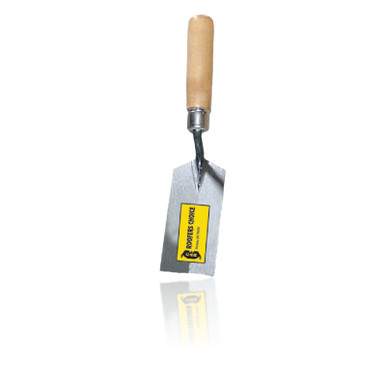 C&R 2M Trowel, 2 in, MarginThe product data lists the TR-7 as a 7 in round-nose trowel
Shape tells the job. Rectangular blades (margin, finishing, plastering, notched) spread and smooth over an area; triangular blades (pointing, brick, gauging) fill joints and work into corners; round-nose and pointed-nose blades (the roofer’s trowels) push stiff roof cement into a flashing without a sharp corner cutting the membrane. The questions people ask — what a margin trowel, pointing trowel, magic trowel or B3 notched trowel is, what size notch for which tile, what a bricklaying, masonry, concrete or finishing trowel does, the difference between a spade and a trowel — are answered by that shape rule below, with the roofing uses first because that is what our trowels are for.
Trowels, question by question
Sizes are from the product data on this site; the notch tables are the tile-adhesive manufacturers’ and the tile trade’s.
Trowels in plain words
- Margin trowel: small square blade; scoops, mixes, scrapes, corners. Everyone carries one.
- Pointing trowel: small triangle; fills joints and reaches around pipes and flashings.
- Round-nose and pointed-nose trowels (5 and 7 in) spread roof cement and mastic without nicking the roof.
- Torch trowel: wide, heavy round nose for pressing hot modified bitumen at laps.
- Notched trowel meters adhesive: 1/4 x 1/4 for 4x4 wall tile and backsplash, 1/4 x 3/8 for 12x12, 1/2 x 1/2 or a U-notch for large format; B3 is a 3 mm notch.
- Finishing and plastering trowels are long rectangles for concrete and plaster; brick trowels are big triangles for mortar.
- Back butter large tile; aim for 95 percent coverage outside and in wet areas.
- Garden trowel and spade are digging tools, not spreading tools.
Questions people ask
What is a magic trowel?
A brand of flexible plastic-bladed skimming trowel used like a squeegee on drywall mud and plaster.
What is a bricklaying trowel used for?
Picking up, spreading and buttering mortar for brick and block; the big triangular trowel.
How to select trowel size?
By tile size and the adhesive manufacturer’s table: bigger tile, deeper notch, to reach 80 to 95 percent coverage.
What is a masonry trowel used for?
Spreading mortar, filling joints and finishing; the family includes brick, pointing, margin and gauging trowels.
What size trowel for 600x600 floor tiles?
A 1/2 x 1/2 inch square notch or 3/4 inch U-notch, with the tile back buttered.
What is the difference between a margin trowel and a pointing trowel?
Square end for scooping, mixing and corners vs triangular point for filling joints and reaching around details.
What is the difference between a garden spade and a trowel?
A spade digs with a full-size blade; a garden trowel is a hand scoop; the mason’s trowel spreads and is a different tool.
What do you use a finishing trowel for?
Smoothing fresh concrete after floating; a long steel rectangle.
What is the standard size plastering trowel?
About 11 to 14 inches by 4-3/4 inches.
What is a B3 notched trowel?
A European 3 mm (about 1/8 inch) notch for mosaics and thin wall tile.
What is the difference between a brick trowel and a pointing trowel?
Size: a brick trowel is 10 to 12 inches for spreading beds; a pointing trowel is 4 to 7 inches for joints.
What size trowel should I use for 4x4 ceramic tile?
1/4 x 1/4 inch square notch.
What is a pointer trowel?
Another name for the pointing trowel.
What size trowel for 4x12 wall tile?
1/4 x 1/4 inch square notch; 1/4 x 3/8 if the tile back is deeply textured.
What are the different types of trowels?
Margin, pointing, brick, gauging, finishing, plastering, pool, notched, bucket, edger, and the roofing round-nose, pointed-nose and torch trowels.
What is the difference between a finishing trowel and a margin trowel?
A finishing trowel is a long rectangle for smoothing concrete; a margin trowel is a small square blade for scooping and corners.
What size trowel machine?
24 to 36 inch walk-behind for small slabs, 36 to 48 inch for commercial floors, ride-on twin rotors for warehouses.
What is a margin trowel used for?
Scooping cement from a can, mixing small batches, cleaning tools and working material into corners.
What is back buttering tile?
Spreading a thin coat of adhesive on the back of the tile with the flat of the trowel before setting it, to raise coverage.
What does a trowel finish look like?
On concrete, smooth and dense with a slight sheen; on stucco, the pattern the trowel leaves.
Related guides
Roof cement, sealant and primerASTM D4586 and D41, and removing tarRoofing torches and torch-downPropane torches and modified bitumenPutty knives, scrapers and razor bladesWhich is which and how to keep them sharpShovels, spades and scoopsThe three types and what each is forWhich gloves protect against chemicals?How to read a chemical resistance chartThe ratings, test results and standards shown here are the manufacturers' published values, reproduced as published. Nothing on this page is a recommendation by Bayshore Safety that any product is suitable for a particular task, hazard or workplace. Selecting safety products and protective equipment is the responsibility of the end user and the employer, based on their own hazard assessment and the regulations that apply to their work. Confirm every value on the manufacturer's own documentation before use.