
What is the difference between a roofing hammer and a regular hammer? Roofing hatchets and the shingle gauge, magnetic cap-nail hammers, 16 vs 20 vs 22 oz, smooth vs milled faces, framing, claw and drywall hammers, and the Estwing warranty
A roofing hammer (roofing hatchet, shingler’s hatchet) has a square, usually milled face for driving roofing nails, a hatchet blade on the back for cutting shingles and splitting shakes, a notch or slot in the blade for pulling nails, and on most models an adjustable gauge pin that sets the shingle exposure (5 inches on standard three-tab) so courses are laid without a tape. A regular claw hammer drives and pulls nails and does nothing else. Weight: 16 oz is the general-purpose head, 20 oz the framer’s and roofer’s choice for longer nails, 22 to 28 oz for framing with a milled face that grips the nail head. Estwing states on its warranty page that its warranty is not a lifetime warranty but that it fully warrants its all-steel hammers against failure in normal use; it makes them in Rockford, Illinois.
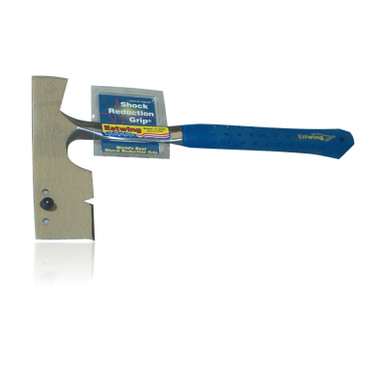 Estwing E3-S Roofing Hatchet, Vinyl GripThe product data lists the E3-S as the Estwing roofing hatchet with a vinyl grip
What a hammer is for. Estwing’s warranty page puts it in one line: nail hammers are made to drive and withdraw common unhardened nails only, and it lists what wrecks one (striking other tools or hardened nails, pulling screws and nail sets, using the side of the head) and when to throw one away (a chipped or mushroomed face, a cracked claw, a dented handle). Everything else people ask — 16 or 20 ounce, milled or smooth, what a roofing hammer looks like, whether Estwing hammers are guaranteed for life, who makes a good one, what a drywall hatchet or a hammer tacker is for — is answered below with that rule in the background. The hammer tacker questions are covered in the staple-gun guide linked below.
Hammers and hatchets, question by question
Weights and features are from the product data on this site; the warranty statements are quoted from estwing.com.
Hammers in plain words
- Roofing hatchet: milled face, hatchet blade with a nail notch, gauge pin set at the shingle exposure (5 inches on standard shingles).
- 16 oz for general work and roofing nails; 20 oz for framing nails and long roofing nails; 22 to 28 oz for framing only.
- Milled face grips the nail and marks wood; smooth face for finish work; magnetic face starts cap nails one-handed.
- Straight claw (rip) pries; curved claw pulls. Roofers carry a rip hammer with the nail gun.
- Estwing: not a lifetime warranty, but all-steel hammers are warranted against failure in normal use; abuse and wear are not covered.
- Nail hammers drive and pull common unhardened nails only; never strike another tool or a hardened nail.
- Discard a hammer with a chipped or mushroomed face, a cracked claw or a dented handle.
- Wear eye protection when striking; Estwing’s page says bystanders too.
Questions people ask
Is a 16 oz or 20 oz hammer better?
16 oz for general work, trim and roofing nails all day; 20 oz for framing nails and long roofing nails. They are for different nails, not better or worse.
Are Estwing hammers lifetime?
Estwing states its warranty is not a lifetime warranty, but that it fully warrants its all-steel hammers against failure in normal use, excluding misuse, abuse and wear.
What is the most expensive framing hammer?
Titanium-head framing hammers cost several times a forged steel one; we do not rank other manufacturers’ prices.
What is the difference between a roofing hammer and a regular hammer?
A roofing hammer adds a hatchet blade with a nail notch and a gauge pin for shingle exposure; a regular hammer drives and pulls nails only.
What does a roofing hammer look like?
A small axe with a square milled hammer face, a flat blade with a notch, and a knurled gauge pin along the blade.
What are the different types of hammer faces?
Smooth, milled (waffle), magnetic, crowned, and soft or dead-blow faces for assembly.
What are the different types of hammer tools?
Claw, framing (rip), ball-peen, sledge, club or drilling hammer, mallet, roofing hatchet, drywall hatchet, brick hammer, tack hammer, magnetic hammer.
Are Estwing axes any good?
We carry Estwing hammers and pry bars, not its axes, and do not rate products we do not carry.
How to reload a hammer stapler?
Pull the follower out, drop in a strip of staples crown up, slide the follower back until it latches.
What does a framing hammer do?
Drives 16d framing nails with a heavy milled head and pries boards apart with a straight claw.
What hammer do carpenters use?
A 20 to 28 oz straight-claw framing hammer for framing; a 16 oz smooth-face claw hammer for finish work.
What hammer should I use for finishing nails?
A 13 to 16 oz smooth-face hammer with a nail set.
What is a 22 oz hammer used for?
Framing: sinking 16d nails in two blows with a milled face.
Are Estwing hammers guaranteed for life?
No; Estwing says so on its warranty page, while warranting its all-steel hammers against failure in normal use.
What is a hammer?
A striking tool: a head with a face and a claw or peen on a handle, made to drive and withdraw common unhardened nails.
What is a hammer handle called?
The handle, haft or helve; the hole it passes through is the eye.
What are the staples called that you hammer in?
Fence or U-staples; the roofer’s underlayment staples go in with a hammer tacker.
What are the three types of hammers?
Claw, framing and ball-peen are the usual three; sledge, club and mallet make six.
What hammer is most commonly used in carpentry?
The 16 oz claw hammer, with a 20 oz straight claw on framing crews.
How much does a 22 oz Estwing hammer weigh?
The 22 oz is the head; the whole one-piece hammer is about 2-1/2 to 2-3/4 lb.
What is a drywall hatchet used for?
Driving drywall nails with a smooth crowned face and scoring, trimming and prying board with the blade.
Where can I buy Estwing hammers?
From authorized Estwing dealers; we stock the roofing hatchet, shingler’s hammer, drywall hatchet and straight-claw hammers and ship nationwide.
Related guides
Staple guns and hammer tackersStaple sizes, loading and unjammingPry bars, wrecking bars and nail pullersWhich bar for which jobRoof tear-off toolsShingle shovels, spud bars and how long it takesOSHA safety glasses requirementsWhat 1910.133 saysTool tethering and dropped objectsWhat ANSI/ISEA 121 coversThe ratings, test results and standards shown here are the manufacturers' published values, reproduced as published. Nothing on this page is a recommendation by Bayshore Safety that any product is suitable for a particular task, hazard or workplace. Selecting safety products and protective equipment is the responsibility of the end user and the employer, based on their own hazard assessment and the regulations that apply to their work. Confirm every value on the manufacturer's own documentation before use.