
Tool tethering and dropped-object rules: what ANSI/ISEA 121 covers, what OSHA requires, and how a tool tether is rated
OSHA has no rule that says “tether your tools.” What it has is a duty to protect workers from falling objects: 1926.501(c) requires toeboards, screens, guardrails, canopies or barricades where there is a hazard of objects falling on workers below, 1926.759 covers falling-object protection in steel erection, and 1910.28(c) and 1926.100 cover head protection and overhead hazards. Tool tethering is how crews meet that duty at height when the work itself cannot be screened, and ANSI/ISEA 121-2018 (updated 2023) is the standard that rates the equipment: anchor attachments (the tab, ring or tape fixed to the tool), tool attachments (the cuff, cinch or D-ring attached to the tool), tool tethers (the lanyard between tool and anchor) and containers (bags and buckets with closures) are each tested to a stated load. Safewaze’s ToolCuff line lists a load rating on every part: 1, 2, 5, 15, 35 and 80 lb, with the manual’s rule that no tool heavier than 5 lb is tethered to the body and that a tool tether is never part of a fall arrest or restraint system.
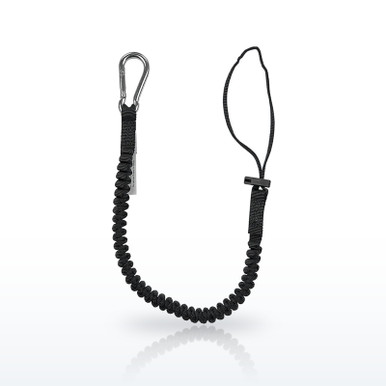 Safewaze FS8016 Tool Tethers, 15 lb ElasticatedTool tether with a stated load rating, ANSI/ISEA 121 (Safewaze data)
Why the rating is the whole product. A tool tether is an energy problem in miniature: a 5-pound hammer dropped 50 feet arrives with the energy of a much heavier object dropped from a step, and a tether has to stop it without the attachment pulling off the tool or the tether tearing. ANSI/ISEA 121 made that measurable: each component is drop-tested at its rated load and labeled, so a 15-pound cinch is not used on a 35-pound drill. The body-attachment limit in the manual exists for the worker, not the tool: a heavy tool arrested at the end of a tether attached to a belt or harness pulls the worker, so anything over 5 pounds tethers to the structure, not the person. OSHA inspects the result (did an object fall on someone, was the area below protected), which is why the standard and the manufacturer’s manual are what a dropped-object program is written to.
What ANSI/ISEA 121 covers
The four categories the standard tests, with the Safewaze parts in each.
What OSHA requires on falling objects
The duty is to protect the people below; tethering is one means:
- 1926.501(c): where there is a hazard of falling objects, each employee is protected with toeboards, screens or guardrail systems to prevent objects from falling, or a canopy structure keeping objects far enough from the edge, or barricades keeping employees out of the area below.
- 1926.502(j): toeboards at least 3.5 inches high, able to withstand 50 lb, with no more than a quarter-inch gap; paneling or screening where material is piled higher than the toeboard.
- 1926.759: in steel erection, materials and equipment are secured against displacement, and no work is done below a steel erection zone except for the employees engaged in it unless overhead protection is provided.
- 1926.100 and 1910.135: head protection where there is a possible danger of head injury from falling objects; the manufacturer’s hard hat Type and Class are on the hard hat guides.
- No OSHA paragraph names tool tethers; the employer chooses the means, and a tethering program is written to ANSI/ISEA 121 for the equipment and to the manufacturer’s manual for the limits.
Safewaze ToolCuff load ratings, from the manual
| Part | Item | Maximum tool weight |
|---|---|---|
| SW423 / SW422 | 1 in blue and 2 in yellow tool tape | 2 lb (tape); used to build the attachment point |
| SW400, SW402, SW408 | D-ring tool attachments (10-packs) | 2 lb, 5 lb, 15 lb |
| SW426, SW428 | Small and large tool rings (25-packs) | 2 lb |
| SW425 | Elasticated tool attachment (3-pack) | 5 lb |
| SW406 | Medium-duty cinch attachment with stabilization tabs | 35 lb |
| SW407 | Heavy-duty cinch attachment with stabilization tabs | 80 lb |
| SW411, SW414 | Coil tool tethers | 5 lb, 2 lb |
| SW416, SW417 | 12 in and 24 in tool tethers (10-packs) | 5 lb |
| SW431, SW432 | Medium-duty elasticated tethers | 35 lb |
| SW433, SW434 | Heavy-duty elasticated tethers | 80 lb |
| SW435, SW437 | Retractable tool tethers | 5 lb, 1 lb |
| SW436, SW438 | Elasticated tethers with carabiner, cinch | 15 lb |
The manual’s rule: no tool over 5 lb is connected to the body; tools must not exceed the maximum load rating of the lanyard; inspect before each use; remove from service after a drop that loads the tether.
Source: Safewaze ToolCuff Manual (220-00001), product table and load ratings; Safewaze ToolCuff technical data sheets (ANSI/ISEA 121-2018 and 121-2023 as listed per part).
How FallTech For Tools rates a tether system
FallTech For Tools states the rating rule on its tether manual: a system is a tool attachment, a tool tether and a tool anchor, each labeled with a maximum load and tether length, used for a single tool whose weight does not exceed the capacity of the lowest-rated component (its tethers top out at 15 lb for a single tool; the 40 lb non-stretch tethers and the 35 lb attachment carry their own labels), listed to ANSI/ISEA 121-2018 and marked “not for fall protection”. Its tethering guide poster sorts the parts by weight (attachments at 2, 5 and 35 lb; tethers at 2, 5 and 15 lb; wrist anchors at 5 lb; hard hat tethers at 2 lb) and shows the routes: an open-handle tool gets a D-ring attachment, tape and a tether; a tool with a captive eye takes a choke-on or direct-connect tether; a power tool gets a choke-on attachment; close work takes a wrist tether. Its weight-capacity guide adds that tool tether ratings describe tool capacity and never the capacity of the fall arrest system, and that tethered tools still count toward the worker’s equipped weight. The Tool Weight Capacity field on each FallTech tool page carries the figure.
FallTech Tool Tethers User Instruction Manual MTOL04 Rev G, section 3; FallTech For Tools Tool Tethering Guide poster (480-00027, 2019); FallTech, “Fall Protection Weight Capacity” (falltech.com, fetched Nov 8 2026); the Tool Weight Capacity and ANSI Standards fields on each FallTech tool tethering page.Questions people ask
Does OSHA require tool tethering?
Not by name. OSHA requires protection from falling objects (toeboards, screens, guardrails, canopies, barricades under 1926.501(c); secured materials in steel erection under 1926.759). Tethering is one means of meeting that duty, and ANSI/ISEA 121 is the standard the equipment is rated to.
What do tool lanyards hold?
The tool, not the worker: a tool tether is rated for the weight of the tool it carries (Safewaze’s ToolCuff load ratings are in the table above) and must never be used as a personal lanyard. The anchor attachment on the tool, the tether and the attachment on the belt or structure are each rated under ANSI/ISEA 121.
Which type of personal fall arrest equipment should never be used for tools?
The reverse rule applies: a tool tether is never used for the worker, and a personal lanyard is not rated as a tool tether. ANSI/ISEA 121 rates tool tethers by tool weight; ANSI Z359.13 lanyards are rated to arrest a person. Keep the two systems apart and label them as the manufacturer does.
Is a tool lanyard PPE?
It protects the people below rather than the wearer, so it is a dropped-object control rather than personal protective equipment, and it is never part of a fall arrest or restraint system (ToolCuff manual).
What are the main causes of dropped objects?
OSHA’s rules address the conditions it regulates: unsecured material at an edge, gaps under guardrails, work above other workers, and loose tools at height. A tethering program covers the last of those.
What is ANSI/ISEA 121?
The American national standard for dropped object prevention solutions (2018, updated 2023). It tests and labels anchor attachments, tool attachments, tool tethers and containers at a stated load; Safewaze lists it on its ToolCuff parts.
How much weight can a tool lanyard hold?
Its rated load, printed on the part: Safewaze ToolCuff tethers run 1, 2, 5, 15, 35 and 80 lb. The tool must not exceed the rating, and the manual limits body-attached tools to 5 lb.
Where does a tool tether attach?
Tools up to 5 lb may tether to a belt, harness tool loop or wrist cuff; heavier tools tether to the structure or an anchor point. The attachment on the tool side is tape, a D-ring, a ring or a cinch rated for the tool’s weight.
The ratings, test results and standards shown here are the manufacturers' published values, reproduced as published. Nothing on this page is a recommendation by Bayshore Safety that any product is suitable for a particular task, hazard or workplace. Selecting safety products and protective equipment is the responsibility of the end user and the employer, based on their own hazard assessment and the regulations that apply to their work. Confirm every value on the manufacturer's own documentation before use.