
What staples does a hammer tacker take, and is an electric staple gun worth it? Hammer tackers for felt and underlayment, T50 and 1/4 to 9/16 inch staples, loading and unjamming, manual vs electric vs pneumatic, and staple gun vs nail gun
A hammer tacker is a stapler swung like a hammer: each blow drives one flat-crown staple, which is how roofers fasten felt and synthetic underlayment and how insulation and housewrap go up. Most hammer tackers take A-11 or T50-pattern staples (3/8 inch crown, 1/4 to 3/8 inch legs for a tacker; 1/4 to 9/16 inch in a hand or electric gun); ours uses A-11 staples and we stock them 5,000 to a box. A hand-squeeze staple gun does the same job one staple at a time with more precision and less speed; an electric gun is worth it for upholstery, screen and carpet pad where hundreds of staples go into hard material and hand fatigue is the limit; a pneumatic stapler is the production tool for sheathing, lath and roofing felt on a crew that already has air on the roof. A staple gun is not a nail gun: staples hold sheet goods, nails hold structure.
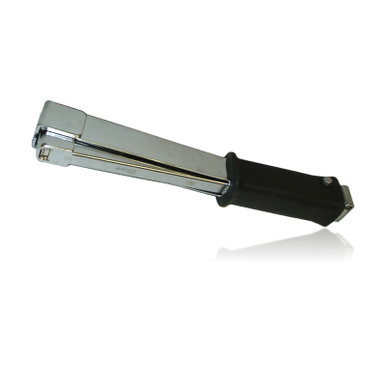 C&R Hammer TackerThe product data lists the C&R hammer tacker as using A-11 staples
Why the staple number matters. Staple guns are picky about their staples: the crown width, the wire gauge and the leg length have to match the magazine or the gun jams, which is the single most common stapler complaint. The names on the boxes (T50, A-11, JT21, Arrow, Stanley cross-references) are the sizing system, and the cards below decode it, then answer the rest: how to load and unjam, manual vs electric vs pneumatic, whether an electric gun is worth it, staple gun vs nail gun, upholstery vs construction staplers, and what staples go in a hammer tacker for roofing felt.
Staplers and staples, question by question
Staple designations are those printed on the staple boxes; the tacker and staple data are from the product pages on this site.
Staplers in plain words
- Hammer tacker: one staple per swing; the felt, underlayment and insulation tool. Ours takes A-11 staples.
- T50 and A-11: 3/8 inch flat crown, heavy wire, legs 1/4 to 9/16 inch. The pattern is printed on the gun.
- Patterns do not interchange; leg length varies within a pattern.
- Load legs down, crown up, pusher latched; unjam with the strip out and pliers at the nose.
- Electric guns earn their keep on upholstery, screen and hardwood; hand guns for occasional work; pneumatic for production.
- Upholstery staples are fine 22 gauge wire; construction staples are 0.050 inch wire.
- Staples hold sheets; nails hold structure. A staple gun is not a nail gun.
- Synthetic underlayment usually wants cap nails or cap staples; read the roll.
Questions people ask
Are electric staple guns worth it?
For upholstery, screen, carpet pad and hardwood, yes; for occasional light work a hand gun does the same job without an outlet.
What is the difference between a staple gun and an upholstery staple gun?
Construction guns drive heavy 0.050 inch wire T50-class staples; upholstery guns drive fine 22 gauge staples, usually with air.
What staples does a hammer tacker take?
Most take T50 or A-11 3/8 inch crown staples in 1/4 to 3/8 inch legs; ours takes A-11. The pattern is printed on the tool.
How to reload a hammer stapler?
Pull the follower out of the magazine, drop in the strip legs down, slide the follower back until it latches.
What does T50 mean in staples?
A flat-crown staple pattern 3/8 inch wide in 0.050 inch wire, in legs from 1/4 to 9/16 inch, used by most heavy-duty staplers.
What size staples for a T50 staple gun?
1/4 to 9/16 inch legs; 1/4 to 3/8 for housewrap and insulation, 3/8 for carpet pad, 1/2 for wire and lattice.
How do I know what size staples my stapler takes?
It is printed on the gun: the pattern and the leg lengths it accepts.
Are staple gun staples standard?
Within a pattern, yes; between patterns, no.
Is there a difference between a nail gun and a staple gun?
Yes: staples hold sheet goods across a crown; nails hold structure and shingles.
How do you load a staple gun?
Release the pusher latch, pull the rod, drop the strip in legs down, slide the rod back and latch it.
Can you use a staple gun instead of a nail gun?
Not for framing, decking, trim or shingles; only where the code or the manufacturer allows staples for sheathing.
What staple gun is easy to use?
A low-force hand gun with the trigger near the base of the handle, or a hammer tacker for felt and insulation.
Do staple guns work on wood?
Yes, in soft and medium wood; hardwood wants a heavy-duty or electric gun and a shorter leg.
What kind of staples for chicken wire?
Fence staples driven by hand, or 1/2 inch T50 staples from a gun into a wood frame.
What is the standard size of staples for a staple gun?
There is none across guns; T50 3/8 inch crown is the most common heavy-duty pattern.
What are T50 staples?
The 3/8 inch flat-crown heavy-wire staple pattern most hand, electric and hammer staplers use.
What is a hammer tacker?
A stapler swung like a hammer that drives one staple per blow, for felt, underlayment, insulation and housewrap.
How to unjam a staple gun?
Unload the strip, open the nose and pull the bent staple with needle-nose pliers; check the pattern and the driver blade.
Related guides
Roofing hammers and hatchetsWeights, faces, gauges and EstwingAir hose, fittings and air tool oilFor roofing nailersRivet guns and pop rivetsSizes, materials and setting a rivetOSHA safety glasses requirementsWhat 1910.133 saysWhen is hearing protection required?The OSHA 85 and 90 dB rulesThe ratings, test results and standards shown here are the manufacturers' published values, reproduced as published. Nothing on this page is a recommendation by Bayshore Safety that any product is suitable for a particular task, hazard or workplace. Selecting safety products and protective equipment is the responsibility of the end user and the employer, based on their own hazard assessment and the regulations that apply to their work. Confirm every value on the manufacturer's own documentation before use.