
What certification is required on safety glasses? The Z87 mark, what OSHA accepts, and the other marks a lens or frame can carry
In the United States, safety glasses need the ANSI/ISEA Z87.1 mark: 29 CFR 1910.133(b)(1) (and 1926.102(b)(1) for construction) requires eye and face protection to comply with ANSI/ISEA Z87.1-2010, Z87.1-2003 or Z87.1-1989 (R-1998), and the manufacturer shows that by marking the frame and lens. The mark is “Z87” for basic impact or “Z87+” for high impact, with the manufacturer’s mark beside it; there is no government certificate, number or sticker, and a frame without the mark is not safety eyewear whatever the lens is made of. MCR Safety lists Z87+ on every safety glass and goggle on this site, and adds the marks a style carries for other countries where it has them: CSA Z94.3 (Canada), EN 166 (Europe), AS/NZS 1337.1 (Australia and New Zealand) and MIL-PRF-32423 ballistic on a few styles.
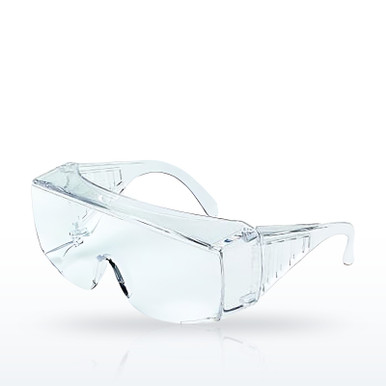 MCR Safety 98 Safety Glasses, Clear Lens, Over the Glass, DielectricMarked Z87+, CSA Z94.3 and EN 166, as MCR Safety lists it (MCR Safety data)
Why “certified” is the wrong picture. ANSI is a standards body, not a certifier, and OSHA does not test eyewear. The manufacturer tests its product to Z87.1 (or has a laboratory do it) and then marks it; the mark is the manufacturer’s claim that the product passed, and the employer is entitled to rely on it. What the law requires is the compliance, shown by the mark, under 1910.133. Military ballistic (MIL-PRF-32423), Canadian CSA Z94.3 and European EN 166 are separate programs with their own marks, and a pair of glasses can carry several. Prescription safety glasses carry the same Z87 marks on the frame and the lens, from the lab that made them. The marks tell you impact level and lens type; they do not say which hazard the eyewear is for, which the employer decides from the hazard assessment.
The marks, as Z87.1-2020 defines them
What is on the frame and the lens of a pair that passed.
What MCR Safety lists, style by style
- ANSI Z87+: on every MCR Safety safety glass and goggle on this site (107 listings); on most face shield windows, with a few windows marked Z87.1 with CSA Z94.3.
- CSA Z94.3: on 74 glasses and goggles; MCR Safety marks a few lens options in a series as not CSA (the 98 series shade lenses, for instance), and the product page says which.
- EN 166 and AS/NZS 1337.1: on 49 and 29 listings respectively.
- MIL-PRF-32423 ballistic: on the Checklite, Dominator, ForceFlex, Swagger styles that MCR Safety lists with it.
- UV: MCR Safety’s lens guide states that its lenses absorb 99.9 percent of UV radiation; the U mark on the lens is the Z87.1 way of saying it.
- Side shields: MCR Safety’s catalog warns on one detachable-side-shield frame that the frame does not pass Z87+ with the shields removed; 1910.133(a)(2) requires side protection wherever there is a flying-object hazard.
Portwest’s marks
Portwest’s safety glasses list Z87.1+ with EN 166 and an EN 170 or EN 172 filter mark; none lists CSA Z94.3, MIL-PRF-32423 or a D3 splash mark on its US page, so they sit in their own group above with exactly the marks Portwest states.
Portwest product pages and US data sheets for the styles shown (documents.portwest.com), fetched Nov 7 2026The marks Radians defines on its eyewear
Radians’ product icons page defines the marks its eyewear carries: the ANSI Z87.1+ logo for products that meet the Z87.1+ requirements; UVA/UVB for 99.9 percent UVA and UVB protection; anti-fog and hard coat where those coatings are available; polarized lenses that eliminate reflective glare hitting the lens flat and part of the glare at other angles; CSA for the Canadian Z94.3 eyewear requirements; CE for European standards; VO Ballistic for products that pass the MIL-PRF-31013 military ballistic test; and foam for foam-lined frames. On this site the Standards line on each eyewear page lists ANSI Z87.1 or Z87.1+ and, where Radians prints them, CSA Z94.3, MIL-PRF ballistic and the D3 splash and D4 dust marks.
Radians Product Technologies page (radians.com/resources/product-technologies, radians.com, fetched Nov 8 2026)More questions people ask
What are the OSHA standards for safety glasses?
The ANSI/ISEA Z87.1 mark (Z87 or Z87+ with the manufacturer’s mark), which 29 CFR 1910.133(b)(1) requires by incorporating the standard. There is no separate certificate or government approval.
Which ANSI standard should be stamped on safety eyewear?
ANSI/ISEA Z87.1. The frame and lens carry Z87 (basic impact) or Z87+ (high impact) beside the manufacturer’s mark, and 29 CFR 1910.133(b)(1) requires eye protection to comply with the 2010, 2003 or 1989 edition of that standard or be shown to be at least as effective. There is no government stamp or certificate number.
Answers from the sources named above and in the byline.Questions people ask
Does OSHA approve Z87 glasses?
OSHA does not approve products. It requires eye protection that complies with Z87.1-2010, 2003 or 1989; the Z87 mark is the manufacturer’s statement of that compliance.
What is the difference between Z87 and Z87+?
Z87 is basic impact (drop ball); Z87+ is high impact (high-velocity and high-mass tests). MCR Safety lists Z87+ on its safety glasses and goggles.
Are military-grade safety glasses different?
MIL-PRF-32423 is a US military ballistic fragmentation test at higher velocity than Z87+; a few MCR Safety styles list it beside Z87+. It is not an OSHA requirement.
Is it a law to wear safety glasses at work?
Where an eye hazard exists, yes: 29 CFR 1910.133 and 1926.102 require the employer to make sure each exposed employee wears eye or face protection that complies with ANSI/ISEA Z87.1. The law reaches the employer; the worker’s part is to wear what the hazard assessment and training call for.
What are ANSI approved safety glasses?
ANSI does not approve products. Safety glasses are tested by the manufacturer (or a laboratory it uses) to ANSI/ISEA Z87.1 and marked Z87 or Z87+ with the manufacturer’s mark; that marking is the whole of the “approval”, and OSHA reads it as compliance with 1910.133(b).
What makes glasses ANSI Z87?
Passing the Z87.1 tests (optical quality, basic or high impact, coverage and lens retention) and carrying the mark. Z87 is basic impact, Z87+ high impact; letters after it (D3, D4, D5, U, L, W, X, H) record the other tests the protector passed. No mark, no rating.
What are the OSHA standards for safety glasses?
The ANSI/ISEA Z87.1 mark (Z87 or Z87+ with the manufacturer’s mark), which 29 CFR 1910.133(b)(1) requires by incorporating the standard. There is no separate certificate or government approval.
What is ANSI in glasses?
In the US, ANSI Z87.1 under 1910.133. CSA Z94.3 is the Canadian mark; many MCR Safety styles carry both, and the product page lists them.
Which ANSI standard should be stamped on safety eyewear?
ANSI/ISEA Z87.1. The frame and lens carry Z87 (basic impact) or Z87+ (high impact) beside the manufacturer’s mark, and 29 CFR 1910.133(b)(1) requires eye protection to comply with the 2010, 2003 or 1989 edition of that standard or be shown to be at least as effective. There is no government stamp or certificate number.
Do all safety glasses have to be stamped Z87?
Yes, under 1910.133(a)(4) and (b): every protector is marked by its manufacturer and complies with ANSI/ISEA Z87.1, and the Z87 or Z87+ mark with the manufacturer’s mark is how that is shown. Unmarked eyewear is not safety eyewear under the rule.
What does the printed Z87 on safety glasses signify?
That the manufacturer certifies the protector to ANSI/ISEA Z87.1 at the level marked: Z87 basic impact, Z87+ high impact. A frame marked Z87+ passed with its lenses as a unit, which is why MCR Safety warns on one detachable-side-shield frame that it does not pass Z87+ with the shields removed.
Related guides
What does ANSI Z87.1 mean on safety glasses?Z87 vs Z87+, and how to read the markingsOSHA safety glasses requirementsWhat 1910.133 saysWhat is EN 166, and how does it compare with ANSI Z87.1?The European eye protection marksAre brand sunglasses Z87 rated?How to tell, and what counts on the jobThe ratings, test results and standards shown here are the manufacturers' published values, reproduced as published. Nothing on this page is a recommendation by Bayshore Safety that any product is suitable for a particular task, hazard or workplace. Selecting safety products and protective equipment is the responsibility of the end user and the employer, based on their own hazard assessment and the regulations that apply to their work. Confirm every value on the manufacturer's own documentation before use.