
Self-extinguishing (SE) vest vs FR vest: what ASTM D6413 tests, what an arc rating adds, and which Radians vests carry each
They are two different claims. A self-extinguishing vest has passed ASTM D6413, the vertical flame test: a strip of the fabric is held in a flame for 12 seconds and the lab records how long it keeps burning after the flame is removed (after-flame), how long it glows (afterglow) and how far it charred. Passing means the fabric stops burning on its own; it says nothing about how much heat it would stop in an arc flash or how it performs in a flash fire. An FR or arc-rated vest has been tested to a garment standard, ASTM F1506 for arc flash, with an arc rating in cal/cm² printed on the label, or NFPA 2112 for flash fire, and ANSI/ISEA 107-2020 allows the “FR” designation on a hi-vis garment only when its materials meet one of the flame resistance standards the hi-vis standard lists; a garment that does not meet one must say so on its label. Radians sells both and keeps them apart: its SE vests (SV25, SV45, SV75B, SV225, SV2725) are listed to ASTM D6413 with no arc rating, in a Self-Extinguishing category of their own, and its FR vests (SV99, SV97, SV92 and the Westex DH Air styles) are listed with an ATPV of 5.1 to 8 cal/cm², a category of 1 or 2, and ASTM F1506, NFPA 70E and in some cases NFPA 2112 and UL certification.
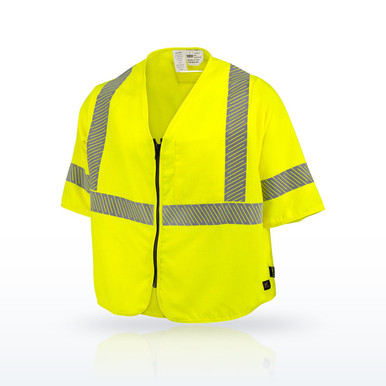 Radians SV99A-3SZGSFR FR Hi-Vis Safety Vests, ATPV 8.0 cal/cm², CAT 2Radians FR hi-vis vest with the ATPV, category and standards printed (Radians data)
Why the distinction matters on a jobsite. A roadway crew near a welder, a utility crew at a transformer and a refinery crew at a flare all wear hi-vis, and all three have a reason to ask whether the vest will burn. The answers differ. The welder’s concern is a spark landing on polyester mesh and the vest going up; a self-extinguishing vest answers that, because D6413 shows the fabric stops burning when the spark is gone. The utility crew’s concern is an arc flash delivering several calories per square centimeter to the whole torso in a fraction of a second; only an arc rating answers that, and a vest with no arc rating adds no protection and may add fuel, which is why 1910.269(l)(8)(iii) bars melting fabrics over arc-rated clothing. The refinery crew’s concern is a flash fire, which NFPA 2112 tests on an instrumented manikin. Radians labels its lines so the three can be told apart: SE means D6413, FR means an arc rating with the garment standards, and the plain polyester vests carry neither. Read the Standards line; the word on the hang tag is only as good as the test behind it.
The tests behind the words
What each standard measures, as the standard describes it.
How Radians labels its hi-vis vests, by line
From the product pages on radians.com, fetched Nov 8 2026:
- Self-extinguishing (SE): SV25, SV45, SV75B, SV225 and SV2725-3, polyester mesh or solid, ANSI/ISEA 107 Type R Class 2 or 3, Standards line ASTM D6413, no arc rating.
- FR, CAT 1: SV97-M2VGMFR and SV97-M3VGMFR (modacrylic, 5.1 cal/cm²), SV92-M (modacrylic, 5.4 cal/cm²), SV99-M2 and SV99-M3 (5.5 oz, 6.6 cal/cm²), SV99W-M2 and SV99W-M3 (5.5 oz Westex DH, 6.8 cal/cm²), SV92B-M2 (5.5 oz Westex DH, 6.6 cal/cm²).
- FR, CAT 2: SV99A-2SZGSFR and SV99A-3SZGSFR (5.7 oz Westex DH Air, 8 cal/cm², NFPA 2112, NFPA 70E, UL certified, ANSI/ISEA 107-2020).
- FR hi-vis shirts: the Neese VDH5VSH3 Class 3 shirt (5.7 oz Westex DH Air, 8 cal/cm², CAT 2) and the Radians ST921 modacrylic T-shirts (9.6 cal/cm², CAT 2).
- Plain hi-vis: every other Radians, DEWALT and Radwear USA vest carries ANSI/ISEA 107 Type and Class only, with no flame listing.
Questions people ask
Is a self-extinguishing vest the same as an FR vest?
No. Self-extinguishing means the fabric passed ASTM D6413, the vertical flame test, and stops burning when the flame is removed. An FR vest meets a garment standard, ASTM F1506 with an arc rating or NFPA 2112 for flash fire. Radians lists the two in separate categories.
Is ANSI Class 3 FR?
No. ANSI/ISEA 107 Class 3 describes how much fluorescent and reflective material the garment carries. Flame resistance is a separate, optional claim under the standard, and a Class 3 garment is FR only if its label and Standards line say so.
What does ASTM D6413 test?
A vertical strip of fabric exposed to a flame for 12 seconds; the lab records after-flame time, afterglow time and char length.
What is the arc rating on a Radians FR vest?
Radians prints 5.1 to 5.4 cal/cm² (CAT 1) on its modacrylic vests, 6.6 to 6.8 cal/cm² (CAT 1) on the 5.5 oz Westex DH vests, and 8 cal/cm² (CAT 2) on the 5.7 oz Westex DH Air vests.
Can I wear a regular hi-vis vest over FR clothing?
OSHA 1910.269(l)(8)(iii) prohibits clothing that could melt onto skin or keep burning where the arc flash hazard exists, naming nylon and polyester. Radians’ arc-rated vests are the outer layer its pages list for that work; its SE vests are not arc rated.
Does a self-extinguishing vest have a cal/cm² rating?
No. D6413 produces no energy figure. Radians prints no arc rating on its SE vests.
Which Radians vests are self-extinguishing?
SV25, SV45, SV75B, SV225 and SV2725-3, each with ASTM D6413 on the Standards line and no arc rating.
The ratings, test results and standards shown here are the manufacturers' published values, reproduced as published. Nothing on this page is a recommendation by Bayshore Safety that any product is suitable for a particular task, hazard or workplace. Selecting safety products and protective equipment is the responsibility of the end user and the employer, based on their own hazard assessment and the regulations that apply to their work. Confirm every value on the manufacturer's own documentation before use.