
Does a shock pack mean an SRL is leading-edge rated? Internal brake vs external energy absorber on Class 1 and Class 2 SRLs
No. The class of a self-retracting lifeline is set by the tests it passes and the anchorage range it is rated for, not by where its energy management sits. FallTech’s white paper takes apart the rule of thumb that an SRL with a shock pack must be a leading-edge device and one without must be overhead-only: ANSI/ASSP Z359.14-2021 limits maximum arrest force, average arrest force and arrest distance, and does not prescribe how a device absorbs the energy. A Class 1 SRL may use an internal friction brake or an external tear-away absorber; a Class 2 SRL is defined by the 0.005-inch edge test and the below-D-ring anchorage range. The association came from history: the first SRLs used internal brakes, and the 2014 leading-edge requirements pushed manufacturers to add external packs to those designs. Both systems lock the drum and then decelerate the worker; the internal brake does it with friction inside the housing, the external pack by tearing stitched webbing outside it, and both have to land inside the same limits.
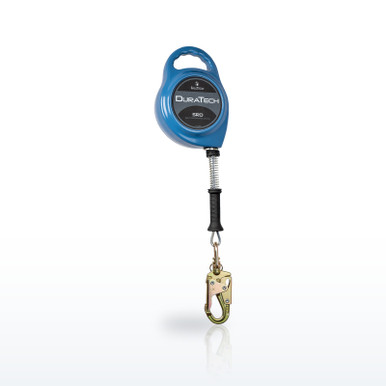 FallTech 7227C Self-Retracting Lifelines, 20-60 ft DuraTechClass 1 cable SRL with an external energy absorber: the class is on the label, not in the pack (FallTech data)
Why the visible pack misleads. When a tear-away absorber deploys you can see it; when an internal brake slows the drum you cannot. That difference in visibility became a belief that the external pack adds fall distance and the internal brake stops the fall at once. FallTech’s paper separates the two phases every SRL has, lock-up distance (the device engaging) and deceleration distance (the energy being absorbed), and notes both designs must meet the same arrest distance limit, 42 inches for the 2021 classes. The reason manufacturers have moved toward external absorbers is mechanical: an internal brake needs brake discs, torque calibration, friction surfaces and a reserve of lifeline on the drum so it can rotate while braking near full extension, which means a larger, heavier housing; moving the energy management outside lets the device shrink, which matters most on an SRL-P carried all day.
The two systems, as FallTech describes them
From the white paper.
What to read instead of the shock pack, as FallTech lists it
“What safety professionals should focus on”, from the paper:
- The ANSI classification on the label (Class 1 or Class 2, and the device type SRL, SRL-P or SRL-R).
- The performance figures: maximum arrest force, average arrest force, maximum arrest distance (the product pages on this site carry the first and third for each FallTech device).
- The intended anchorage location on the label and in the manual.
- The manufacturer’s documentation, including the clearance chart a Class 2 device must carry.
- A device without a visible shock pack is not automatically overhead-only; a device with an external absorber is not automatically leading-edge rated.
- The FallTech FAQ: an SRL has energy-absorbing capability through an internal brake or an external energy absorber; an SRD may or may not.
Where FallTech’s own lines put the energy management (from its SRL comparison guide and category pages)
| Line | Class | Energy management as FallTech lists it | Lifeline |
|---|---|---|---|
| FT-R+ Cable | Class 2 | armored external absorber, UV and water resistant | 7/32 in galvanized wire rope |
| FT-R Cable | Class 2 | armored external absorber | 7/32 in galvanized wire rope |
| CTR Cable | Class 2 | external absorber with WrapPack cover | 7/32 in galvanized wire rope |
| CTR Class 1 | Class 1 | armored external absorber | 7/32 in galvanized wire rope |
| DuraTech Cable (leading edge) | Class 2 | internal brake and external absorber | 3/16 in galvanized wire rope |
| DuraTech Cable (overhead) | Class 1 | internal brake | 7/32 in galvanized wire rope |
| Leading Edge SRLs (DuraTech and Contractor LE) | Class 2 | energy-absorbing deceleration with enhanced internal braking, integrated ViewPack external absorber | 7/32 in galvanized steel cable |
Source: FallTech SRL Comparison Guide (SRL_Quick_Guide_102026) and Leading Edge SRLs category page; a Class 1 line and a Class 2 line both appear with external absorbers, which is the paper’s point.
Questions people ask
Does a shock pack mean an SRL is leading-edge rated?
No. FallTech states the class is set by performance and intended anchorage, not by the absorber; a Class 1 may use an internal brake or an external pack, and a Class 2 is defined by the edge test and the below-D-ring range.
What is the function of a shock absorber on a lanyard or SRL?
To dissipate the energy of the fall over a distance so the force on the body stays under OSHA’s 1,800 lb limit and the system stops the worker within 3.5 feet of deceleration (1926.502(d)(16)). On a lanyard it is the tear-web pack; on an SRL it is either the internal brake on the drum or an external pack at the harness end, and FallTech states that both are energy absorbers under the standard.
Does an internal brake stop a fall faster than an external absorber?
FallTech’s paper says the visibility of the tearing pack creates that impression; both designs have a lock-up phase and a deceleration phase and both must meet the same arrest distance limit (42 inches for the 2021 classes).
Why did people think Class 1 meant internal brake?
Because the first SRLs used internal brakes and the 2014 leading-edge requirements led manufacturers to add external packs; that was design convention, never written into the standard.
What is the difference between an SRD and an SRL?
FallTech’s FAQ: an SRD is a self-retracting device that may or may not have energy-absorbing capability; an SRL has it, through an internal brake or an external energy absorber.
Why are manufacturers moving to external absorbers?
FallTech lists the mechanical reason: an internal brake needs discs, calibration, friction surfaces and a reserve of lifeline on the drum, which means a larger, heavier housing; external absorption allows a simpler, more compact, lighter device.
Where do I find the class and the arrest figures?
On the device label and in the manual; on this site the SRL Class, Maximum Arrest Force and Maximum Arrest Distance fields of each FallTech SRL page carry them as FallTech publishes them.
The ratings, test results and standards shown here are the manufacturers' published values, reproduced as published. Nothing on this page is a recommendation by Bayshore Safety that any product is suitable for a particular task, hazard or workplace. Selecting safety products and protective equipment is the responsibility of the end user and the employer, based on their own hazard assessment and the regulations that apply to their work. Confirm every value on the manufacturer's own documentation before use.