
Bayshore Safety & Industrial Supplies Guide
What are the 3 C’s of first aid? Check, Call, Care, the ABCs, the 7 steps and 7 principles of first aid, the four rules, the first action before approaching a patient, what first aid is in one sentence, and what a first aider does
The 3 C’s are Check, Call, Care, the frame the American Red Cross puts on every emergency: check the scene for safety and then the person, call 911 and get equipment, then give care to the level of your training. The ABCs (airway, breathing, circulation) are what you check in an unresponsive person, and the Red Cross now folds them into one check for responsiveness, breathing and life-threatening bleeding, taking no more than 10 seconds. The "7 steps" and "7 principles" lists on the web are the same frame cut finer. First aid in one sentence: the immediate care given to an injured or ill person until professional help takes over. Under OSHA 1910.151(b) a first aider is a person "adequately trained to render first aid", and OSHA’s 2019 letter says Red Cross training is the minimum level it has relied on since 1978.
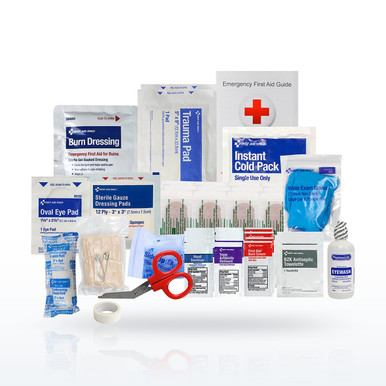 First Aid Only 91359 First Aid Kit Refill, 25 Person, Class A, 94 PiecesFirst Aid Only prints a 25 person ANSI Class A refill with the first aid guide, 94 pieces
Why the 3 C’s outrank the lists. The most-asked question in this market is "what are the 3 C’s in basic first aid", and it is asked by people who learned a list once and want it back. The Red Cross answer is three words, and every longer list (the 7 steps, the 7 principles, the four rules, the 10 tips, the ABCs, DRSABCD) is the same three words expanded for a different course. This page gives the Red Cross frame in the Red Cross’s words, the ABCs and the primary survey, the first action before approaching anyone, the definition of first aid and of a first aider as OSHA’s rule and letters state them (and the other meaning of "first aid only" on an OSHA log), and what a workplace keeps on hand so the Care step has something to use. It does not teach the course; the Red Cross class is two years of certification and the kit carries its guide.
Check, Call, Care, as the Red Cross states it
From the Red Cross first aid steps page, "Checking an Injured or Ill Person".
- CHECK the scene for safety, form an initial impression, obtain consent, and use personal protective equipment (PPE).
- If the person appears unresponsive, CHECK for responsiveness, breathing, life-threatening bleeding or other life-threatening conditions using shout-tap-shout. Check for no more than 10 seconds.
- If the person does not respond, is not fully awake, is not breathing or only gasping, or has life-threatening bleeding, CALL 911 and get equipment (or tell someone to), then give CARE based on the condition found and your level of training. For a person who is unresponsive and not breathing, start CPR and use an AED immediately.
- If the person is responsive and fully awake with no life-threatening condition: interview the person or bystanders about signs and symptoms, allergies, and medications and medical conditions (SAM); do a focused check based on what you are told and see. Do not move a person with a suspected head, neck or spinal injury, and do not ask them to move a part that hurts. Note any medical identification tag.
- After the CHECK step, CALL 911 and get equipment if needed, then give CARE based on the condition found and your level of training.
The questions, one by one
What are the 3 C’s in basic first aid?
Check, Call, Care. Check the scene (is it safe for you?) and then the person (responsive? breathing? bleeding badly?); Call 911 or send someone to, and get the kit and the AED; Care for what you found, within your training, until EMS takes over. Everything else in a first aid course hangs on those three; the Red Cross prints them as the steps above and its burn, bleeding, wound and cardiac arrest pages each begin with the same four lines (check the scene, check for signs and symptoms, call 911, give care).
What are the 7 steps of first aid, in order?
Courses stretch the Red Cross frame into seven: 1 check the scene for danger; 2 check the person for responsiveness (shout-tap-shout); 3 call 911 and get the kit and AED; 4 check airway and breathing and start CPR if not breathing; 5 control life-threatening bleeding; 6 care for the injury or illness found (wounds, burns, fractures, shock) to your training; 7 stay with the person, monitor and hand over to EMS. The order is the order of what kills first: no breathing, then bleeding, then the rest. The "first steps in first aid" are steps 1 and 2.
What are the ABCs of first aid, and what is DRSABCD?
Airway, Breathing, Circulation: is the airway open, is the person breathing, is blood circulating (a pulse, and no severe bleeding). The Red Cross combines them into one check for responsiveness, breathing and life-threatening bleeding of no more than 10 seconds, because a lay rescuer checking a pulse wastes time. DRSABCD is the Australian expansion: Danger, Response, Send for help, Airway, Breathing, CPR, Defibrillation; it is the same sequence as Check, Call, Care with the AED named at the end.
What is the first action you should take before approaching the patient?
Check the scene for safety. The Red Cross puts it first in every protocol ("check the scene safety, form an initial impression, obtain consent and put on PPE"), and the Stop the Bleed course states "your safety is your first priority: if you are injured, you cannot help others". Traffic, live electricity, gas, fire, a person still armed, a chemical splash hazard: those are checked before the person is touched, and gloves go on before any blood does.
What are the 7 principles, the four rules and the 10 golden rules of first aid?
Different trainers’ lists of the same ideas: preserve life, prevent the condition getting worse, promote recovery (the three P’s), protect yourself, get help, do no harm, act within your training, obtain consent, reassure the person, and keep a record. The Red Cross frame carries them all: Check covers safety and consent, Call covers getting help, Care "based on the condition found and your level of training" covers do no harm and act within your training. None of these lists is a standard; the Red Cross course content is.
What is first aid, in one sentence, and what is its purpose?
First aid is the immediate care given to a person who is injured or suddenly ill, to preserve life, prevent the condition from worsening and promote recovery, until professional medical help takes over. OSHA’s recordkeeping rule (29 CFR 1904.7) gives a different, narrower definition for the OSHA 300 log: a closed list of treatments such as nonprescription medication at nonprescription strength, cleaning and covering a wound, hot or cold therapy and removing splinters, which is what "first aid only" means on an injury record. The first aid provider guide linked below has that list.
What is "first aid only"?
Two things. On an OSHA log, a "first aid only" case is an injury that needed nothing beyond the treatments in 1904.7(b)(5)(ii) and so is not recordable. In a catalog, First Aid Only is the brand owned by Acme United Corporation that makes the kits, cabinets, SmartCompliance refills and PhysiciansCare medications on this site. The two meanings share nothing but the words.
Who is a first aider, what is their role, and what is the minimum qualification?
Under 1910.151(b), where there is no infirmary, clinic or hospital in near proximity, "a person or persons shall be adequately trained to render first aid"; 1926.50(c) in construction asks for "a valid certificate in first-aid training from the U.S. Bureau of Mines, the American Red Cross, or equivalent training that can be verified by documentary evidence". OSHA’s 2019 letter: OSHA does not certify courses, has relied on the Red Cross since a 1978 agreement under which the Red Cross standard course is "the recommended MINIMUM level of first-aid training", and reads "adequately trained" to include the 2015 bleeding-control techniques. The first aider’s role is the Care step: give first aid to their training until EMS arrives, keep the kit stocked, and record what was done.
What are 10 basic first aid tips, and what are the most common first aid injuries and emergencies?
OSHA 3317 lists what a first aid course covers, which is the honest list of common workplace emergencies: wounds (abrasions, lacerations, punctures, amputations), burns, bleeding, shock, fractures and sprains, head and spine injuries, eye injuries, chemical exposures, heat and cold illness, and the medical emergencies (cardiac arrest, choking, allergic reactions, seizures, diabetic emergencies, stroke). Ten tips that follow from the Red Cross frame: check the scene, put on gloves, call early, do not move a spinal injury, pressure on bleeding, cool a burn with water, leave a fracture as found, cold on a sprain, watch for shock, and know where the kit and AED are.
What PPE is essential for first aiders?
Gloves first, and a CPR breathing barrier; eye and face protection and a gown where blood may splash. 1910.151 Appendix A: where exposure to blood is reasonably anticipated during first aid, the employer provides the PPE of 1910.1030(d)(3), "such as gloves, gowns, face shields, masks, and eye protection". The Z308.1-2021 kit carries 2 pairs of exam gloves (Class A) or 4 (Class B) and a breathing barrier; the BBP apparel pack in the band adds the gown, shield and mask.
Who is the father of first aid, and why is first aid important?
The phrase is usually given to Friedrich von Esmarch, the 19th-century German surgeon who coined the term and taught bandaging to civilians, or to the St John Ambulance founders in Britain; it is history, not a standard. Why it matters is in OSHA’s near-proximity letters: for cardiac arrest, stopped breathing and uncontrolled bleeding, "first aid treatment must be provided within the first few minutes to avoid permanent medical impairment or death", which is why a trained person or EMS must be reachable within 3 to 4 minutes where those injuries are possible.
What should a basic first aid kit have for the Care step?
The Z308.1-2021 Class A fill: adhesive bandages, tape, antibiotic and antiseptic applications, a breathing barrier, a burn dressing and burn treatments, a cold pack, eye coverings and eye wash, a first aid guide, hand sanitizer, exam gloves, a roller bandage, scissors, sterile pads, trauma pads, a triangular bandage, a tourniquet and a foil blanket. The kit items guide linked below goes through what each is used for, and the Class A vs Class B guide the counts.
In plain words
- Check the scene, check the person (10 seconds), call 911 and get the kit and AED, care to your training.
- ABC: airway, breathing, circulation; the Red Cross checks all three at once. DRSABCD is the same with danger and the AED named.
- First action: is it safe for you? Gloves before blood.
- The 7 steps, 7 principles, four rules and 10 tips are the same frame cut finer.
- First aid: immediate care until professional help takes over. "First aid only" on an OSHA log is a 1904.7 treatment list.
- A first aider under 1910.151 is "adequately trained"; the Red Cross standard course is OSHA’s stated minimum.
- PPE for the first aider: gloves, breathing barrier, eye and face protection where blood may splash (1910.151 App A, 1910.1030).
Questions people ask
What are the 3 C’s of first aid?
Check, Call, Care: check the scene and the person, call 911 and get equipment, care to your level of training (American Red Cross).
What are the 7 steps of first aid?
Check the scene; check responsiveness; call 911 and get the kit and AED; check breathing and start CPR if needed; control life-threatening bleeding; care for what you find; monitor and hand over to EMS.
What are the ABCs of first aid?
Airway, breathing, circulation; the Red Cross combines them into one 10-second check for responsiveness, breathing and life-threatening bleeding.
What is the first action before approaching a patient?
Check the scene for safety and put on PPE; your safety is the first priority.
What is first aid in one sentence?
Immediate care for an injured or suddenly ill person to preserve life, prevent worsening and promote recovery until professional help takes over.
What is first aid only?
On an OSHA log, an injury treated only with the 1904.7 first aid list; in a catalog, the First Aid Only brand of Acme United.
Who is a first aider?
A person adequately trained to render first aid under 1910.151(b), or holding a Red Cross or equivalent certificate under 1926.50(c).
What is the minimum qualification for a first aider?
OSHA does not certify courses; it has relied on the Red Cross standard course as the minimum since 1978, and reads adequate training to include the 2015 bleeding-control techniques.
What is DRSABCD?
Danger, Response, Send for help, Airway, Breathing, CPR, Defibrillation: the Australian form of Check, Call, Care.
What PPE does a first aider need?
Gloves and a CPR barrier always; eye and face protection and a gown where blood may splash, per 1910.151 Appendix A and 1910.1030.
What are the 7 principles of first aid?
Trainers’ lists of preserve life, prevent worsening, promote recovery, protect yourself, get help, do no harm, act within training; all inside the Red Cross frame.
Why is first aid important?
OSHA’s letters: for cardiac arrest, stopped breathing and uncontrolled bleeding, treatment in the first few minutes prevents permanent harm or death.
The ratings, test results and standards shown here are the manufacturers' published values, reproduced as published. Nothing on this page is a recommendation by Bayshore Safety that any product is suitable for a particular task, hazard or workplace. Selecting safety products and protective equipment is the responsibility of the end user and the employer, based on their own hazard assessment and the regulations that apply to their work. Confirm every value on the manufacturer's own documentation before use.
© 2026 Bayshore Safety & Industrial Supplies, Inc. All rights reserved. This guide may not be copied or republished without written permission.