
Bayshore Safety & Industrial Supplies Guide
What are the types of bandages? Adhesive, gauze, roller, elastic, triangular, tubular and self-adhering bandages, the 4, 7 and 10 types people ask about, fabric vs plastic vs waterproof, non-adhesive bandages, finger cots, and when to use each
A bandage is what holds a dressing on, or applies pressure, or supports a joint; the dressing is the pad that touches the wound. Four families cover nearly everything in a first aid kit: adhesive strips (plastic, fabric, sheer, waterproof, blue metal-detectable), roller bandages (conforming gauze rolls, self-adhering cohesive wraps and elastic bandages), triangular bandages (the 40 x 40 x 56 inch muslin cravat that makes a sling or ties a splint), and the pads that go under them (sterile gauze pads, non-adherent pads and trauma pads). The "7 types" and "10 types" lists on the web are these four families cut finer. ANSI/ISEA Z308.1-2021 puts 16 adhesive bandages, a 2 inch roller bandage, a triangular bandage, sterile pads and trauma pads in a Class A kit, and 50 adhesive bandages plus a 4 inch roller bandage in Class B.
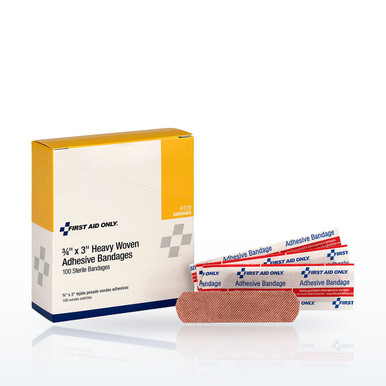 First Aid Only H119 3/4 in x 3 in Heavy Woven Fabric Bandages, 100 per BoxFirst Aid Only prints heavy woven fabric, 1 x 3 inch, ventilated, not made with natural rubber latex, 100 per box
Why the lists disagree. Ask three sources for "the types of bandages" and you get four, seven and ten, because they are counting different things: some count what the bandage is made of (gauze, elastic, cohesive, plastic, fabric), some count the shape (strip, fingertip, knuckle, patch, butterfly), some count the job (holding a dressing, applying pressure, supporting a joint, making a sling). A first aid cabinet does not need the taxonomy; it needs to know which item to reach for. This page sorts bandages by the job they do, names the item that does it in our First Aid Only line with the figures the manufacturer prints (size, count, material, latex statement), and answers the questions people type into a search box about stretchy wraps, waterproof strips, finger cots and the wrap the lab puts on after a blood draw. The dressing itself (gauze pads and their sizes) has its own guide linked below, and so do the elastic and compression bandages, the tapes, and the finger splints and slings.
The four families, and what each is for
The names are the manufacturer’s; the Z308.1 items are the 2021 minimum fill as First Aid Only prints it in its ANSI document.
The questions, one by one
Each answer is from the manufacturer’s own product statements or the Red Cross first aid pages named in the byline.
What are the four types of bandages?
The four-type list that first aid courses use is by job: roller bandages (gauze, cohesive and elastic rolls that wrap a limb), triangular bandages (slings and cravats), adhesive bandages (strips with their own pad) and tubular bandages (a sleeve of elasticated gauze pulled over a finger or a limb). Some lists swap tubular for "pressure bandage", which is any roller bandage used to hold firm pressure on a bleeding wound. The Red Cross wounds page describes the first three in its care steps: a dressing held by a roller bandage, direct pressure, and the "bandage splitting" trick of tearing the tail of a roller bandage into two tails and tying them when you have no tape.
What are the 7 types of gauze bandages?
Seven is one catalog’s way of cutting gauze by form: sterile gauze pads (2 x 2, 3 x 3, 4 x 4 inch, 8-ply or 12-ply), non-sterile gauze sponges, conforming (stretch) gauze rolls, plain woven gauze rolls, compressed or Z-fold packing gauze, petrolatum or non-adherent gauze, and hemostatic gauze. First Aid Only’s line has pads, conforming rolls (2, 3 and 4 inch by 4 or 5 yards), sterile stretch rolls, an 18 x 36 inch gauze compress, Z-fold compressed gauze and NuStat and Celox hemostatic gauze; the gauze guide linked below goes through sizes and sterile vs non-sterile.
What are the 10 types of bandages?
The ten-type lists add shapes and materials to the four families: adhesive strip, fingertip, knuckle, patch, butterfly closure, gauze roller, cohesive (self-adhering) wrap, elastic (ACE-type) bandage, triangular bandage and tubular bandage. Every one of those except the tubular bandage is in the band on this page or in the fingertip-and-knuckle guide linked below. If a list reaches ten by adding "compression bandage" and "pressure bandage", those are elastic and roller bandages used a certain way, not different items.
What do you call the stretchy bandage?
Two things are called that. The stretchy bandage that sticks to itself and tears by hand is a cohesive or self-adhering wrap (First Aid Only prints "easy tear, self-adhering cohesive wrap, breathable, non-slip, no clips or tape necessary" on its 1, 2, 3 and 4 inch rolls). The stretchy bandage with clips or a hook-and-loop closure that you wrap around a sprained ankle is an elastic bandage; "ACE" is a brand name for that kind. Conforming gauze also stretches, but it is lighter and is meant to hold a dressing rather than to compress.
What is the wrap they use after a blood draw?
A cohesive (self-adhering) wrap, usually 1 inch wide, wound two or three turns over a cotton ball or gauze square. It sticks only to itself, so it comes off without pulling hair, which is why labs use it. First Aid Only’s 5-910 is the 1 x 5 yard roll; the 2 and 3 inch widths are the ones for a wrist or ankle.
How do self-adhering bandages work, and are they reusable?
The cohesive wrap is a porous elastic fabric coated so that it bonds to itself where the layers overlap and not to skin or hair; First Aid Only describes its rolls as breathable, non-slip and latex-free (the 5-910 and 5-911 rolls are printed "not made with natural rubber latex"). It is sold as a single-use first aid item: once the turns are unwound the coating has picked up lint and skin oil and it no longer grips well, and a wrap that has touched a wound is contaminated. Sizes in the line: 1, 2, 3 and 4 inch by 5 yards, plus a blue 3 inch roll for food service.
What are non-adhesive bandages?
The phrase is used for two different things. A non-adherent pad is a dressing whose wound-side face is a perforated film or coated gauze that does not stick to a weeping wound or burn; First Aid Only’s 3-601 (2 x 3 inch) and 3-605 (3 x 4 inch) non-adherent pads are described as "absorbs without adhering to wound, ease of removal minimizes trauma to wound site". A non-adhesive bandage is a roller bandage with no glue (gauze, cohesive or elastic) that holds such a pad in place. The two together are what you reach for when the question is "what can I cover a wound with that won’t stick".
What is the difference between fabric, plastic, sheer and waterproof bandages?
The backing. First Aid Only prints the differences on the boxes: plastic bandages are "made with a pliable vinyl, each bandage is ventilated, helps to repel water and dirt"; fabric bandages are "heavy woven" and "designed to stretch and conform to the wounded area", which is why they stay on knuckles and fingers; sheer bandages "blend better with your skin"; waterproof bandages are a sealed film that "helps to repel water and dirt" all round the pad. All of the First Aid Only strips in the band are printed latex-free or "not made with natural rubber latex".
Is a waterproof bandage good, and which one?
For a hand that goes into water or a dirty job it keeps the pad dry, which is the point; the manufacturer’s claim is that it repels water and dirt, not that it is better for healing. The trade-off is less ventilation than a fabric strip. First Aid Only’s 90995 waterproof bandages come 20 to a box, and the blue metal-detectable plastic strips serve the same purpose on a food line.
Which adhesive is used in bandages?
First Aid Only prints the pad construction and the latex statement, not the adhesive chemistry: its strips are "not made with natural rubber latex" or "latex-free", and the non-adherent pads with adhesive edges carry "gentle hypoallergenic adhesive tabs". Medical adhesive on strips is generally an acrylic or rubber-based pressure-sensitive adhesive; the tape guide linked below covers what that means for skin that tears.
Are finger cots waterproof, and why use them instead of gloves?
A nitrile finger cot is a liquid-tight sleeve for one finger; First Aid Only describes its 90377 large nitrile cots as "protect finger wounds, provide for static free touch, latex-free, powder free". It goes over a bandaged fingertip so the dressing stays dry and the bandage stays on, and it lets the rest of the hand work bare, which is why food handlers and assemblers use them over a full glove. Sizes in the line: 24-count large, a 144-count box in two sizes and the SmartCompliance 50-count refill.
Which bandage is used to apply pressure?
A roller bandage. For ordinary bleeding the Red Cross care step is a dressing on the wound and firm direct pressure, then a roller bandage (gauze or cohesive wrap) wound over the dressing to keep the pressure on; for life-threatening limb bleeding the Red Cross and OSHA’s 2019 bleeding-control letter name the tourniquet and hemostatic dressings. An elastic bandage can hold pressure on a dressing too; the compression-bandage guide linked below covers when it should not be used.
What are the popular brands of bandages?
Band-Aid is a brand so well known that the word is used for every adhesive strip; Curad, Nexcare and the store brands are the others on a pharmacy shelf. For a workplace cabinet the brand matters less than the fill: First Aid Only’s strips come in the counts the Z308.1 kits need (16 per unit box, 100 per box, 1,000 per case), in fabric, plastic, sheer, waterproof and blue metal-detectable, and the SmartCompliance refills slot into its cabinets.
Why do restaurants use blue bandages?
Because no food is blue. A blue strip that falls into a batch is seen, and the metal-detectable versions carry an internal foil strip ("bandages internal foil allows for quick metal detection", as First Aid Only prints it) so a line metal detector finds one that is not seen. The fingertip-and-knuckle guide linked below covers the blue fingertip and knuckle shapes.
Is a gauze bandage the same as a roller bandage, and is stretch bandage the same as gauze?
A gauze roll is one kind of roller bandage; cohesive wrap and elastic bandage are the other two. "Stretch gauze" and "conforming gauze" are the same thing: First Aid Only describes its rolls as "uniform weave of cotton and polymer yarns, sufficient stretch to conform to most areas, fast woven edges minimize lint". An elastic bandage stretches far more and is woven for compression, not absorbency.
In plain words
- Dressing: the pad on the wound. Bandage: what holds it on. An adhesive strip is both in one piece.
- Four families: adhesive strips, roller bandages (gauze, cohesive, elastic), triangular bandages, and the pads under them.
- Fabric strips stretch and stay on joints; plastic strips repel water and dirt; waterproof strips seal the pad; sheer strips are for appearance; blue strips are for food lines.
- Cohesive wrap sticks to itself, tears by hand and is single use. Elastic bandages compress and are closed with clips or hook-and-loop.
- A triangular bandage is a sling open and a cravat folded. The Class A kit has one, Class B two.
- Finger cots keep a finger dressing dry and let the rest of the hand work bare.
- The Z308.1-2021 Class A fill: 16 adhesive bandages 1 x 3 inch, 1 roller bandage 2 inch x 4 yards, 1 triangular bandage, 2 sterile pads 3 x 3 inch, 2 trauma pads 5 x 9 inch. Class B: 50 adhesive bandages, a 2 inch and a 4 inch roller, 2 triangular, 4 sterile pads, 4 trauma pads.
Questions people ask
What are the four types of bandages?
Roller bandages (gauze, cohesive, elastic), triangular bandages, adhesive bandages and tubular bandages; some courses list a pressure bandage in place of the tubular one.
What are the 10 types of bandages?
Adhesive strip, fingertip, knuckle, patch, butterfly closure, gauze roller, cohesive wrap, elastic bandage, triangular bandage and tubular bandage.
What is the stretchy bandage called?
Self-adhering (cohesive) wrap if it sticks to itself; elastic bandage (ACE is a brand) if it closes with clips or hook-and-loop.
What is the wrap used after a blood draw?
A 1 inch cohesive (self-adhering) wrap over a cotton ball; it sticks only to itself.
Are self-adhesive bandage wraps reusable?
They are sold as single-use first aid items; a used wrap has lost its grip and has touched a wound.
What are non-adhesive bandages?
Either a non-adherent pad that does not stick to the wound, or a roller bandage with no glue that holds the pad on.
Is a waterproof bandage good?
It keeps the pad dry on a wet or dirty job, as the manufacturer states (repels water and dirt); it breathes less than a fabric strip.
Are finger cots waterproof?
A nitrile finger cot is a liquid-tight sleeve for one finger; First Aid Only prints latex-free and powder-free on its cots.
Why use finger cots instead of gloves?
To keep a bandaged finger dry and the bandage on while the rest of the hand works bare.
Which bandage applies pressure?
A roller bandage over a dressing; the Red Cross care step is direct pressure, then a bandage to hold it.
What is a gauze wrap called?
A conforming or stretch gauze roll (roller gauze); 2 inch x 4 yards is the Class A size.
What bandages does ANSI Z308.1 require?
Class A: 16 adhesive bandages 1 x 3 inch, a 2 inch roller, a triangular bandage, 2 sterile pads and 2 trauma pads. Class B: 50 adhesive, a 2 and a 4 inch roller, 2 triangular, 4 sterile pads, 4 trauma pads.
What is a finger bandage called?
A fingertip bandage (the butterfly-shaped strip that wraps the tip) or a knuckle bandage (the H-shaped strip for a joint).
Which bandages are latex-free?
Every First Aid Only adhesive strip, cohesive wrap, non-adherent pad and finger cot in the band is printed latex-free or not made with natural rubber latex; check the product page for the item you buy.
Related guides
Fingertip and knuckle bandagesHow to apply themWhat should be in a workplace first aid kit?The Z308.1 minimum fillANSI Z308.1 Class A vs Class B first aid kitsWhat is in each fillBleeding control kits and tourniquetsWhat Stop the Bleed and Z308.1 sayFirst aid kit refillsHow often to check and restockThe ratings, test results and standards shown here are the manufacturers' published values, reproduced as published. Nothing on this page is a recommendation by Bayshore Safety that any product is suitable for a particular task, hazard or workplace. Selecting safety products and protective equipment is the responsibility of the end user and the employer, based on their own hazard assessment and the regulations that apply to their work. Confirm every value on the manufacturer's own documentation before use.
© 2026 Bayshore Safety & Industrial Supplies, Inc. All rights reserved. This guide may not be copied or republished without written permission.