
Bayshore Safety & Industrial Supplies Guide
What should be in a 72-hour emergency kit? The ready.gov disaster supplies list, the 10 essential survival items, the 20 items in an emergency kit, go bag vs bug out bag, earthquake, hurricane and tornado kits, and the workplace shelter-in-place kit
A 72-hour kit is the ready.gov basic disaster supplies kit: enough to "survive on your own for several days" after an emergency. The list, as ready.gov prints it: water (one gallon per person per day for several days), food (a several-day supply of non-perishable food), a battery-powered or hand crank radio and a NOAA weather radio, a flashlight, a first aid kit, extra batteries, a whistle, a dust mask, plastic sheeting, scissors and duct tape, moist towelettes, garbage bags and plastic ties, a wrench or pliers, a manual can opener, local maps, and a cell phone with chargers and a backup battery; then the additional supplies by need (medications, glasses, infant and pet supplies, cash, documents, a sleeping bag or warm blanket for each person, clothing and sturdy shoes, a fire extinguisher, matches, hygiene items, mess kits, paper and pencil, activities for children). Ready.gov says to prepare supplies for home, work and the car, and that a work kit should let you shelter at work for at least 24 hours. There are no free government survival kits; the government publishes the list, and the kits in the band are First Aid Only’s built to it.
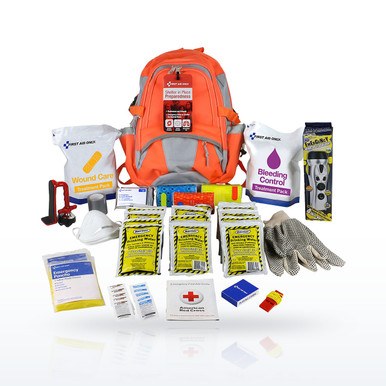 First Aid Only 91308 Shelter in Place Emergency Preparedness BackpackFirst Aid Only prints a shelter-in-place emergency preparedness backpack for a business, office or school classroom, with a door jammer, crank radio, water, blankets and a bleeding control set
Why the list is short and the market is loud. "Where can I find free government survival kits" is the most-searched question in this cluster, and the answer is that the government gives away the list, not the kit: ready.gov publishes the basic disaster supplies kit and a printable checklist, and FEMA, the Red Cross and the states repeat it. Everything else people ask (the 10 essential items, the 20 items, what to stockpile, go bag versus bug out bag, the 5 C’s and the 3-3-3 rule) is that list sorted by someone’s priorities or dressed for a scenario. This page gives the ready.gov list as printed, the Red Cross frame for the first aid kit inside it, the First Aid Only kits that pack it for a home, a car, an office or a classroom with their printed contents, and plain answers to the stockpiling and war questions, which are the same list with more water.
The ready.gov basic disaster supplies kit, as printed (last updated July 1 2026)
| Item | What ready.gov says | In a First Aid Only preparedness kit |
|---|---|---|
| Water | One gallon per person per day for several days, for drinking and sanitation | Emergency water packets (4 oz) and a 2.5 gallon pouch in the hurricane backpack; 24 packets in the 24-person kit |
| Food | At least a several-day supply of non-perishable food | Emergency food bars (5-year shelf life as First Aid Only prints for the 24-person kit) |
| Radio | Battery-powered or hand crank radio and a NOAA Weather Radio with tone alert | Crank flashlight, radio and phone charger in the hurricane, tornado and shelter-in-place backpacks |
| Flashlight and extra batteries | Listed separately | Crank light; light sticks |
| First aid kit | Listed | A personal first aid kit or the Z308.1 items in each backpack |
| Whistle | To signal for help | In every backpack |
| Dust mask | To help filter contaminated air | Dust-protection face mask; face masks with ear loops |
| Plastic sheeting, scissors and duct tape | To shelter in place | Duct tape in the backpacks; the shelter-in-place kit adds a door jammer |
| Moist towelettes, garbage bags and plastic ties | For personal sanitation | BZK towelettes, tissues, biohazard bags |
| Wrench or pliers, manual can opener, local maps | To turn off utilities, open food, find the way | Not in the kits; add for the site |
| Cell phone with chargers and a backup battery | Listed | Crank charger in the backpacks |
| Additional: medications, glasses, infant and pet supplies, cash, documents, a sleeping bag or warm blanket per person, clothing, fire extinguisher, matches, hygiene, mess kits, paper and pencil, children’s activities | Consider based on individual needs | Emergency blanket, poncho, hand warmers, waterproof matches, gloves, two-tablet medication packets, a deck of cards in the shelter-in-place kit |
Source: ready.gov Build A Kit page (last updated July 1 2026); First Aid Only product pages and brochures (firstaidonly.com)
The questions, one by one
Where can I find free government survival kits, and what does FEMA say to buy?
There are none to find; FEMA (ready.gov) publishes the list and a printable Emergency Supply List and tells you to assemble it "in one or two easy-to-carry containers such as plastic bins or a duffel bag". The five items people quote as FEMA’s basics are the first five on its list: water, food, a radio, a flashlight and a first aid kit. Some states, counties and employers hand out starter kits at preparedness events; those are local programs, not a federal issue.
What are the 10 essential survival kit items?
From the ready.gov list, the ten most sources agree on: water, food, a radio, a flashlight with batteries, a first aid kit, a whistle, a dust mask, plastic sheeting and duct tape, sanitation supplies, and a phone charger. The outdoor "ten essentials" (navigation, sun protection, insulation, light, first aid, fire, repair kit, food, water, shelter) are the hiker’s version of the same list.
What are 20 items in an emergency kit, and what should a good emergency kit contain?
The full ready.gov basic list is fifteen lines; the twenty-item lists add five from the additional supplies: medications, a blanket per person, a change of clothes and shoes, cash and copies of documents, and matches or a lighter. A good kit is that list sized to the people, the days (72 hours is the usual target; ready.gov says "several days") and the place (home, work, car), checked yearly ("re-think your needs every year", "replace expired items as needed").
What is the difference between a go bag and a bug out bag, and what is a 72-hour kit?
The same bag by three names. A go bag or grab-and-go bag is what ready.gov calls the work kit "stored in a grab and go case" for an evacuation; a bug out bag is the survivalist name for a bag packed to leave home for three days; a 72-hour kit is the Red Cross and FEMA name for the household supply for three days, which may be a bin at home rather than a bag. The contents are the ready.gov list; the difference is whether it has to be carried.
What is in a survival kit, and what would be a good survival kit?
For a disaster, the ready.gov list. For the outdoors, the ten essentials. A good one for a workplace is what First Aid Only builds as its preparedness backpacks: the hurricane backpack prints a crank flashlight-radio-charger, light sticks, food bars, water packets and a 2.5 gallon pouch, a poncho, a whistle, an emergency blanket, duct tape, a dust mask, gloves, waterproof matches, tissues, antiseptic towelettes, a toothbrush and toothpaste, biohazard bags, a personal first aid kit, a cold pack, hand warmers and two-tablet medications; the shelter-in-place backpack adds a door jammer, four face masks, three rescue blankets, ponchos and a full bleeding control and first aid set for a classroom or office.
How do I prepare for war, WW3 or a long emergency at home, and what should I stockpile?
The same list, scaled: ready.gov’s "several days" becomes two weeks of water (a gallon per person per day) and shelf-stable food, with the radio, light, first aid, sanitation and medication lines unchanged, plus copies of documents and cash. Nothing in the federal guidance names a war scenario or a 39-food list; a household that has the 72-hour kit and extends water and food is doing what the guidance says. We sell the first aid and preparedness side; we do not sell food storage beyond the kit bars and water packets.
What should I include on a prepper checklist, and what is the 3-3-3 rule and the 5 C’s of survival?
The 3-3-3 (or rule of threes) is a survival-course mnemonic: three minutes without air, three hours without shelter in bad weather, three days without water, three weeks without food; it sets the order of the kit (airway and first aid, shelter and warmth, water, then food). The 5 C’s are a bushcraft list: cutting tool, combustion, cover, container, cordage. A prepper checklist is the ready.gov list plus those, plus whatever the household’s scenario adds; none of it is a standard.
What are the 7 steps to earthquake safety, and the 10 things for a hurricane?
The federal steps are the same frame for every hazard: make a plan, build a kit, know the alerts, secure the house (strap water heaters and shelves for an earthquake; shutters and the evacuation route for a hurricane), practice (drop, cover and hold on; the evacuation drive), keep documents and cash, and check the kit yearly. The ten things for a hurricane are the ready.gov kit plus the evacuation route and the fuel in the car; First Aid Only’s hurricane and tornado backpacks are the kit side of those lists.
What are the 5 steps or phases of disaster preparedness, and the phases of emergency preparedness?
Emergency management uses five phases: prevention, mitigation, preparedness, response and recovery; a household’s "5 steps" are make a plan, build a kit, stay informed, get involved and practice. The workplace equivalent is the emergency action plan OSHA 1910.38 requires where a standard calls for one, on the guide linked below.
Are survival first aid kits any good, and what first aid goes in a go bag?
A kit labeled to Z308.1-2021 is the one whose contents are known; the Red Cross home kit and the personal first aid kit in the First Aid Only backpacks are the smaller versions. In a go bag the first aid belongs to the Red Cross care step for the injuries a disaster brings: bleeding (gauze, a pressure dressing, a tourniquet), wounds (bandages, antiseptic, gloves), burns (a burn dressing), and warmth (the foil blanket). The kit items guide linked below goes through each.
Where can I buy a 72-hour kit, and who sells emergency kits?
We do: the First Aid Only preparedness backpacks for one and two people, the hurricane and tornado versions, the 24-person kit for a school or office, the shelter-in-place backpack for a classroom or a business, and the pieces (blankets, water packets, light sticks, a seat belt cutter and glass breaker for the car) to build one. The current prices are on the rows in the band, and we sell nationwide.
In plain words
- The government publishes the list (ready.gov), not a free kit.
- Water a gallon per person per day, food for several days, radio, light, first aid kit, batteries, whistle, dust mask, sheeting and tape, sanitation, tools, can opener, maps, phone charger.
- Then: medications, blanket per person, clothes and shoes, cash and documents, extinguisher, matches, hygiene, children’s items.
- Home, work (24 hours, grab and go) and car. Check it every year; replace what expires.
- Go bag, bug out bag, 72-hour kit: the same thing, carried or not.
- Rule of threes: air, shelter, water, food, in that order.
- First aid inside it: bleeding, wounds, burns, warmth, as the Red Cross steps go.
Questions people ask
Where can I find free government survival kits?
Nowhere; ready.gov publishes the list and a printable checklist, and local programs sometimes hand out starter kits.
What are the 10 essential survival kit items?
Water, food, radio, flashlight and batteries, first aid kit, whistle, dust mask, plastic sheeting and duct tape, sanitation supplies, phone charger.
What are 20 items in an emergency kit?
The fifteen ready.gov basic lines plus medications, a blanket per person, clothes and shoes, cash and documents, and matches.
What does FEMA say to buy?
The ready.gov basic kit, starting with water, food, a radio, a flashlight and a first aid kit.
What is the difference between a bug out bag and a go bag?
Names for the same 72-hour bag; a go bag is the ready.gov grab-and-go case for work or evacuation.
What is the 3-3-3 rule for survival?
Three minutes without air, three hours without shelter, three days without water, three weeks without food; it orders the kit.
What are the 5 C’s of survival?
Cutting tool, combustion, cover, container, cordage: a bushcraft list, not a standard.
How much water should a 72-hour kit have?
One gallon per person per day for several days (ready.gov).
What should a workplace emergency kit hold?
Food, water, medicines and walking shoes for at least 24 hours, in a grab-and-go case (ready.gov); First Aid Only’s shelter-in-place backpack adds a door jammer, masks and a bleeding control set.
How do I prepare for a long emergency at home?
The same list with more water and shelf-stable food, checked yearly; the guidance names no war list.
What first aid goes in a go bag?
Bleeding control, wound care, a burn dressing, gloves and a foil blanket; a Z308.1 kit covers it.
Who sells emergency kits?
We do, and we sell nationwide: First Aid Only preparedness backpacks for one, two and 24 people, hurricane, tornado and shelter-in-place versions, and the pieces.
The ratings, test results and standards shown here are the manufacturers' published values, reproduced as published. Nothing on this page is a recommendation by Bayshore Safety that any product is suitable for a particular task, hazard or workplace. Selecting safety products and protective equipment is the responsibility of the end user and the employer, based on their own hazard assessment and the regulations that apply to their work. Confirm every value on the manufacturer's own documentation before use.
© 2026 Bayshore Safety & Industrial Supplies, Inc. All rights reserved. This guide may not be copied or republished without written permission.