
Bayshore Safety & Industrial Supplies Guide
What do you do with a full sharps container? Sharps disposal at work under OSHA 1910.1030, the FDA container rules, mail-back and drop-off programs, how often containers are replaced, biohazard bags and bins, and the sharps container in a BBP kit
A sharps container is closed when it is about three-quarters full, never overfilled, never emptied and reused, and disposed of as regulated medical waste through the route your state and community allow: a medical waste hauler for a workplace, a mail-back program, a drop-off site or a household hazardous waste program for a person who self-injects. The FDA says to use an FDA-cleared container (rigid plastic, puncture-resistant, leak-resistant, with a fill line) and to follow community guidelines for the full container, and never to reuse one. OSHA 1910.1030 requires an employer whose employees handle contaminated sharps to provide containers that are closable, puncture-resistant, leakproof on the sides and bottom and labeled or color-coded, located as close as feasible to where sharps are used, replaced routinely and not allowed to overfill, and closed before removal; regulated waste goes in closable, labeled or red bags or containers. A first aid kit does not generate sharps; the sharps container in a BBP kit is for a needle found on the floor, the parking lot or a restroom.
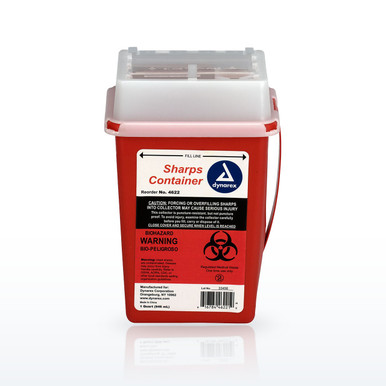 First Aid Only M94 Sharps Container, 2 VersionsFirst Aid Only prints a sharps container in two versions, for the safe containment of used needles and sharps
Why a first aid page is about a trash can. "What do you do with a full sharps container" is the most-asked sharps question, and the person asking is often a diabetic at home; but the same question lands on every safety manager who keeps a BBP kit, finds a needle in the yard, or runs a plant with a clinic. The rules are the same two: the FDA’s for the container and the community route, and OSHA 1910.1030’s for the workplace. This page gives both as they are written, the difference between a sharps container, a biohazard bag and a biohazard bin, how often a container is replaced, who must provide one, and what First Aid Only sells for the kit and the wall, with the honest line that pharmacy drop-off is a local program and not a national rule.
What to do with a full sharps container
The FDA’s two-step process, with the OSHA 1910.1030 workplace rule beside it.
- Put every used needle, syringe, lancet or blade in the container at once; never recap, bend or break a needle (1910.1030(d)(2)(vii)).
- Watch the fill line: when the container is about three-quarters full, close it. The FDA: "overfilling a sharps disposal container increases the risk of accidental needle-stick injury". OSHA: containers must be "replaced routinely and not be allowed to overfill" and closed "immediately prior to removal or replacement".
- Seal the lid as the container is designed to be sealed; if it is leaking or punctured, put it in a second closable, leakproof, labeled container (1910.1030(d)(4)(iii)(A)(3)).
- Dispose of it by the route your state and community allow: a licensed medical waste hauler for a workplace, a mail-back program (the container is shipped in its approved box), a drop-off site (hospitals, pharmacies, clinics or waste facilities that run one), a household hazardous waste collection, or special waste pickup. The FDA: "check with your local trash removal services or health department".
- Never empty a sharps container into the trash, never reuse one, and never put loose needles in a biohazard bag or the regular trash.
- Start a new container in the bracket and log the change with the kit check.
The questions, one by one
Where can I empty my sharps container, and where can I take a full one?
Nowhere: a sharps container is never emptied; the full container is disposed of whole. Where it goes depends on where you live. The FDA lists the routes: drop-off collection sites (hospitals, doctors’ offices, pharmacies, health departments or fire stations that run them), household hazardous waste collection sites, mail-back programs, residential special waste pickup and, in some states, approved sharps in the household trash. Whether a given pharmacy takes them is that chain’s local program, not a rule; the FDA’s Safe Sharps Disposal pages list state programs. A workplace with regulated waste uses a licensed hauler or a mail-back service.
How often should sharps containers be replaced?
When they reach the fill line (about three-quarters full), or sooner on a schedule the workplace sets; OSHA’s words are "replaced routinely and not be allowed to overfill". A kit container that has one needle in it after a parking-lot cleanup is still closed and sent out at the next cleanup or the next kit check, because a half-empty container of used sharps is a stored hazard; the FDA’s single-use tube is built for exactly that one-needle case.
Do employers have to provide sharps containers, and where do they need to be located?
1910.1030(d)(4)(iii)(A) requires an employer whose employees have occupational exposure to contaminated sharps to provide containers that are closable, puncture-resistant, leakproof on sides and bottom and labeled with the biohazard symbol or color-coded red, "easily accessible to personnel and located as close as is feasible to the immediate area where sharps are used or can be reasonably anticipated to be found", maintained upright, replaced routinely and closed before removal. A workplace with no occupational exposure (no one handles needles) has no sharps container duty; it keeps one in the BBP kit for a found needle because 1910.1030 and 1910.151 Appendix A put the PPE and the cleanup supplies on the employer where exposure is reasonably anticipated.
What type of container is used for sharps, and what is an FDA-cleared sharps container?
A rigid, puncture-resistant, leak-resistant plastic container with a secure lid and a fill line, labeled with the biohazard symbol; the FDA clears them as medical devices and says they "come marked with a line that indicates when the container should be considered full". First Aid Only’s M94 comes in two versions (one quart and five quart) with wall brackets, and the K708301 is the single-use transport tube "for on-the-go individuals who self-inject drug therapies where short-term containment of used sharps is necessary". Where no cleared container exists, the FDA accepts a heavy-duty household plastic container (a laundry detergent bottle) that is leak-resistant, puncture-resistant, upright and labeled; a coffee can or a soda bottle is not.
What goes in a biohazard bin, what goes in red biohazard bags, and what is the symbol?
Regulated waste as 1910.1030 defines it: liquid or semi-liquid blood or other potentially infectious materials, items that would release them if compressed, items caked with dried blood that could flake, contaminated sharps (in their own rigid container, never loose in a bag), and pathological or microbiological waste. It goes in a bag or container that is closable, built to contain the contents without leaking, and labeled with the biohazard symbol or color-coded red; First Aid Only’s 24 x 24 inch biohazard bags are printed "bright red color with universal symbol". The symbol is the three-crescent biohazard mark in fluorescent orange or orange-red. Gloves, wipes and gauze from a minor cut with a spot of blood are not regulated waste under the federal rule; a state rule may say otherwise.
How do you close a full red biohazard bag, and a sharps collector?
A bag is gathered at the neck, twisted and closed with the tie so nothing leaks or spills, then double-bagged if the outside is contaminated or it is punctured (1910.1030(d)(4)(iii)(B)); it is never compressed by hand. A sharps collector is closed by snapping its lid to the locked position the manufacturer built in (a permanent lock on most) and is never opened again; the single-use tube screws closed.
What is the difference between red and yellow biohazard bags?
In US practice red bags are regulated (infectious) medical waste under 1910.1030’s color code; yellow bags are used by some states and facilities for trace chemotherapy waste or, in other countries, for infectious waste. The bag color your hauler asks for is the one to use; the federal rule accepts red or a biohazard label.
What are the CDC and OSHA guidelines for handling sharps?
OSHA 1910.1030(d)(2): contaminated needles are not bent, recapped or removed (recapping only by a one-handed technique where no alternative exists), not sheared or broken, and are placed in the containers described above immediately after use; the CDC’s guidance for health care adds engineered sharps injury protections and the same no-recap rule. For a found needle: gloves, pick it up by the barrel with tongs or the kit’s tool, point away, into the container at once, never into a pocket or a bag.
What is in a sharps clean-up kit, and what is a sharps container in a first aid kit for?
First Aid Only’s 90538 sharps clean-up kit is a single-use pack that "effectively aids the removal, containment, disinfection and disposal of discarded needles and syringes": gloves, a pick-up tool, a sharps tube, a disinfectant wipe and a disposal bag. It is in the kit for the needle in the yard, the restroom or the loading dock, so that the person who finds it has a container and does not improvise with a cup.
How do hospitals get rid of sharps containers, and what are the acceptable treatments for regulated medical waste?
Through licensed medical waste haulers who autoclave or incinerate the containers at a permitted facility under the state’s medical waste rules, or with reusable container services that collect, empty by machine and return the containers. 1910.1030(d)(4)(iii)(C) leaves disposal to "applicable regulations of the United States, States and Territories, and political subdivisions"; the state environmental or health agency writes them, and a workplace’s hauler holds the permit.
Are sharps containers recyclable, and can I put one in the trash?
Not in household or commercial recycling: the plastic is contaminated. Some states allow a sealed, approved sharps container in the household trash, labeled "do not recycle" and never in a recycling bin; others do not. The FDA says to check community guidelines; a workplace never puts regulated waste in the trash.
How do I dispose of needles at home, and what size is a biomedical waste bag?
The FDA’s two steps: a cleared container (or the heavy-plastic alternative) filled to the line, then the community route; the single-use transport tube is the travel version. Biohazard bags come in sizes from a 10 gallon 24 x 24 inch bag (First Aid Only’s) to the 30 and 40 gallon liners a clinic uses; the size follows the bin.
In plain words
- Three-quarters full: close it. Never overfill, never empty, never reuse.
- Needles go straight in; no recapping, bending or breaking (1910.1030).
- Disposal is the community’s route: hauler, mail-back, drop-off, household hazardous waste, or (some states) sealed in the trash. Pharmacies are a local program, not a rule.
- A workplace with occupational exposure must provide closable, puncture-resistant, leakproof, labeled containers near where sharps are used.
- Biohazard bag: regulated waste (blood, soaked items). Sharps: their own rigid container, never loose in a bag.
- Red or labeled; the symbol is the three-crescent mark.
- The kit’s sharps container and clean-up kit are for the needle you find.
Questions people ask
What do you do with a full sharps container?
Close it at about three-quarters full, seal it, and dispose of it whole by your community’s route: hauler, mail-back, drop-off site, household hazardous waste, or a state-approved trash method.
Where can I empty my sharps container?
Nowhere; it is never emptied or reused; the full container is disposed of.
How often should sharps containers be replaced?
At the fill line, about three-quarters full, or routinely on a schedule; OSHA says never allowed to overfill.
Do employers have to provide sharps containers?
Where employees have occupational exposure to contaminated sharps, yes, under 1910.1030(d)(4)(iii), located close to where sharps are used.
What type of container is used for sharps?
A rigid, puncture-resistant, leak-resistant, closable container with a fill line and the biohazard label; the FDA clears them.
What goes in a biohazard bin?
Regulated waste: liquid or semi-liquid blood or OPIM, items that would release them, dried-blood items that could flake, and sharps in their own rigid container.
What goes in red biohazard bags?
The same regulated waste other than sharps; the bag is closable, leak-resistant and red or labeled.
Can I take my sharps container to a pharmacy?
Only where that pharmacy runs a drop-off program; the FDA says to check local programs and state guidance.
Are sharps containers recyclable?
No; a sealed one goes in the trash only where the state allows it.
What is the biohazard symbol?
The three-crescent mark in fluorescent orange or orange-red, required on labels under 1910.1030.
Why is there a sharps container in a first aid kit?
For a needle found on the floor, in a restroom or a parking lot; First Aid Only’s clean-up kit adds a pick-up tool and a tube.
How should needles be handled?
Never recapped, bent, sheared or broken; into the container immediately after use, as 1910.1030 requires.
The ratings, test results and standards shown here are the manufacturers' published values, reproduced as published. Nothing on this page is a recommendation by Bayshore Safety that any product is suitable for a particular task, hazard or workplace. Selecting safety products and protective equipment is the responsibility of the end user and the employer, based on their own hazard assessment and the regulations that apply to their work. Confirm every value on the manufacturer's own documentation before use.
© 2026 Bayshore Safety & Industrial Supplies, Inc. All rights reserved. This guide may not be copied or republished without written permission.