
Bayshore Safety & Industrial Supplies Guide
When should you use neoprene gloves? What neoprene resists, where nitrile is the glove instead, and the EN ISO 374-1 letters MCR Safety states
Neoprene is a synthetic rubber, and OSHA’s PPE booklet gives the plain answer to when it is used: neoprene gloves protect against hydraulic fluids, gasoline, alcohols, organic acids and alkalis, and generally have chemical and wear resistance superior to natural rubber. MCR Safety’s EN ISO 374-1 chemical matrix says the same thing in test letters: its NeoMax and BlackJack neoprene gloves carry A (methanol), K (sodium hydroxide 40%), L (sulphuric acid 96%), M (nitric acid 65%), N (acetic acid 99%), O (ammonium hydroxide 25%), P (hydrogen peroxide 30%), S (hydrofluoric acid 40%) and T (formaldehyde 37%) in the combinations on the product pages, and two 18 and 31 inch styles add J (n-heptane). Nitrile is the glove instead where oil, fuel and grease are the exposure: OSHA’s booklet lists nitrile for oils, greases, acids, caustics and alcohols and for chlorinated solvents, and MCR Safety’s Nitri-Chem nitrile styles carry J (n-heptane) on every listed style where its neoprene styles mostly do not. Neither material carries letter B (acetone) or D (dichloromethane) on MCR Safety’s matrix; those go to butyl and laminate gloves from manufacturers whose charts list them. The glove is chosen from the chart against the chemical in section 8 of the safety data sheet, as 29 CFR 1910.138(b) requires, not from the material name.
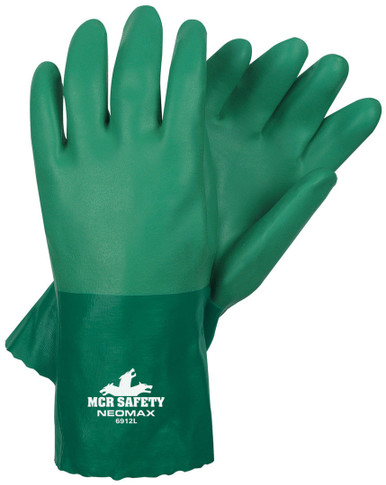 MCR Safety NeoMax 6912 Chemical Resistant Gloves, Neoprene, 12 in, EN 374 Type AType A neoprene glove with the letters MCR Safety states (MCR Safety data)
Why the material name is the start and not the answer. A chemical glove is a barrier the chemical moves through, molecule by molecule, and the chart gives the minutes it takes (breakthrough time) and what the chemical does to the glove on the way (degradation). Neoprene’s place in the charts is the middle ground OSHA describes: acids, caustics, alcohols and hydraulic fluids, with better wear than natural rubber and more flexibility in cold than nitrile, at a higher price than PVC. Nitrile holds its ground against oils, fuels and aliphatic solvents (the n-heptane letter) and gives up ketones and chlorinated solvents in minutes; butyl is the material charts place with acetone and esters; PVC covers acids and bases at the lowest cost and loses most organic solvents. The EN ISO 374-1 letters on an MCR Safety glove are that chart compressed: a letter means the glove held that test chemical for over 30 minutes (Type A and B) or over 10 minutes (Type C), and a missing letter means it did not or was not tested. The table below lists every neoprene style MCR Safety has in the matrix beside the nitrile styles, letter by letter, so the comparison the question is really asking can be read off.
What the letters on an MCR Safety neoprene glove mean
EN ISO 374-1:2016 test chemicals, as MCR Safety’s matrix prints them.
When neoprene is the glove, and when it is not, by the sources
- Acids and caustics (battery acid, drain and tank cleaners, plating, etching): OSHA lists neoprene for organic acids and alkalis, and the K, L, M, N, O letters on MCR Safety’s neoprene styles are those chemicals; nitrile carries most of the same letters, PVC the acids and bases at lower cost.
- Alcohols and hydraulic fluids: OSHA’s list for neoprene; letter A (methanol) is on the neoprene styles and on few nitrile styles.
- Oils, fuels and greases: nitrile, per OSHA’s list and the J letter on every Nitri-Chem style; neoprene only where the style carries J (6948, 6950).
- Ketones (acetone) and chlorinated solvents (methylene chloride): neither; OSHA’s booklet places ketones with butyl, and MCR Safety’s matrix has no B or D on any glove.
- Cold: neoprene stays flexible in cold, which is why it is also the coating on insulated winter gloves; the cold rating, where there is one, is the EN 511 code on the glove.
- Length and lining: MCR Safety’s neoprene gloves run 12 to 31 inches with cotton interlock or foam linings; the length is chosen by how far the hand goes into the liquid.
- Mixtures: OSHA’s Appendix B says to pick the glove by the component with the shortest breakthrough time; the SDS section 8 names the glove material to start from.
MCR Safety neoprene and nitrile chemical gloves in the EN ISO 374-1 matrix, letter by letter
| Style | Material | Type | Letters (chemicals held over 30 minutes) | Thickness, length and lining |
|---|---|---|---|---|
| 6912 | Neoprene | Type A | A K L O P T (methanol, sodium hydroxide 40%, sulphuric acid 96%, ammonium hydroxide 25%, hydrogen peroxide 30%, formaldehyde 37%) | 12 in Cotton Interlock |
| 6914 | Neoprene | Type A | A K L O P T (methanol, sodium hydroxide 40%, sulphuric acid 96%, ammonium hydroxide 25%, hydrogen peroxide 30%, formaldehyde 37%) | 14 in Cotton Interlock |
| 6962 | Neoprene | Type A | A K L O P T (methanol, sodium hydroxide 40%, sulphuric acid 96%, ammonium hydroxide 25%, hydrogen peroxide 30%, formaldehyde 37%) | 12 in Cotton Interlock |
| 6948 | Neoprene | Type A | A J K L O P S T (methanol, n-heptane, sodium hydroxide 40%, sulphuric acid 96%, ammonium hydroxide 25%, hydrogen peroxide 30%, hydrofluoric acid 40%, formaldehyde 37%) | 18 in Cotton Interlock |
| 6950 | Neoprene | Type A | A J K L O P S T (methanol, n-heptane, sodium hydroxide 40%, sulphuric acid 96%, ammonium hydroxide 25%, hydrogen peroxide 30%, hydrofluoric acid 40%, formaldehyde 37%) | 31 in Cotton Interlock |
| 6924 | Neoprene | Type B | — | 53 mil 14 in Cotton interlock |
| 6932 | Neoprene | Type B | A K L P T (methanol, sodium hydroxide 40%, sulphuric acid 96%, hydrogen peroxide 30%, formaldehyde 37%) | 12 in Cotton Interlock |
| 6944 | Neoprene | Type B | K L P T (sodium hydroxide 40%, sulphuric acid 96%, hydrogen peroxide 30%, formaldehyde 37%) | 14 in Foam |
| 5309 | Nitrile | Type A | J K L M N O P S T (n-heptane, sodium hydroxide 40%, sulphuric acid 96%, nitric acid 65%, acetic acid 99%, ammonium hydroxide 25%, hydrogen peroxide 30%, hydrofluoric acid 40%, formaldehyde 37%) | 11 mil 13 in Unlined |
| 5309E | Nitrile | Type A | J K M N O T (n-heptane, sodium hydroxide 40%, nitric acid 65%, acetic acid 99%, ammonium hydroxide 25%, formaldehyde 37%) | 11 mil 13 in |
| 5319E | Nitrile | Type A | J K L M N O P S T (n-heptane, sodium hydroxide 40%, sulphuric acid 96%, nitric acid 65%, acetic acid 99%, ammonium hydroxide 25%, hydrogen peroxide 30%, hydrofluoric acid 40%, formaldehyde 37%) | 15 mil 13 in Flock lined |
| 5350 | Nitrile | Type A | A G J K L M N O P S T (methanol, diethylamine, n-heptane, sodium hydroxide 40%, sulphuric acid 96%, nitric acid 65%, acetic acid 99%, ammonium hydroxide 25%, hydrogen peroxide 30%, hydrofluoric acid 40%, formaldehyde 37%) | 22 mil 18 in Unlined |
MCR Safety prints with the matrix that its gloves have not been tested against all chemicals or mixtures and that the EN 374 ratings are from laboratory conditions, for advisory use.
Source: MCR Safety, Chemical Products Matrix (EN ISO 374-1:2016); the EN 374 field on each product page.
More questions people ask
Are neoprene gloves warm, and do they keep your hands dry?
Neoprene is a closed-cell synthetic rubber that stays flexible in cold, which is why the neoprene guide notes it as the coating on insulated winter gloves and why wetsuits are made of it; a neoprene chemical glove is warm in the sense that it insulates the hand from a cold liquid better than a thin nitrile glove, and its cold rating, where a manufacturer prints one, is the EN 511 code. It keeps hands dry from water and the chemicals it holds (the EN ISO 374-1 letters and the permeation table say which); it is not breathable, so sweat stays inside, and MCR Safety lines its neoprene gloves with cotton interlock or foam for that reason. What happens when neoprene gets wet is nothing to the glove: it is a waterproof rubber, and the lining, not the shell, is what gets damp.
Answers from the sources named above and in the byline.Questions people ask
When should you use neoprene gloves?
For the chemicals OSHA’s PPE booklet lists for neoprene, hydraulic fluids, gasoline, alcohols, organic acids and alkalis, when the glove’s chart or EN ISO 374-1 letters cover the chemical on the SDS: MCR Safety’s neoprene styles carry methanol, the acids and bases, peroxide and formaldehyde letters.
What do neoprene gloves protect against?
Per OSHA 3151, hydraulic fluids, gasoline, alcohols, organic acids and alkalis, with chemical and wear resistance generally superior to natural rubber. The letters on MCR Safety’s styles (A, K, L, M, N, O, P, S, T; J on two) are the tested specifics.
Neoprene vs nitrile gloves: what is the difference?
Both are synthetic rubbers. Nitrile is the oil, fuel and grease glove (letter J on every Nitri-Chem style) and the common disposable; neoprene covers alcohols and acids with more flexibility in cold and more stretch, at a higher price. Neither holds acetone or methylene chloride on MCR Safety’s matrix.
Are neoprene gloves good for cold weather?
Neoprene stays flexible in cold and is used as the coating on insulated winter gloves; whether a given glove is warm is answered by its lining and its EN 511 code on the product page, not by the polymer.
Is neoprene latex-free?
Yes. Neoprene (polychloroprene) contains no natural rubber latex protein; the latex allergy guide covers reactions to the accelerators used in synthetic rubbers.
Which chemicals are incompatible with neoprene gloves?
On MCR Safety’s matrix the ketones (B), chlorinated solvents (D) and aromatics (F) are absent from every neoprene style; OSHA’s booklet places those with butyl or laminate gloves. The chart for the glove in hand decides.
How long can you wear neoprene chemical gloves?
Less than the breakthrough time on the chart (over 30 minutes for a lettered chemical on a Type A or B glove), because the chart is run on a new, unflexed sample at 23 °C; the employer sets the change-out time in the hazard assessment under 1910.138(b).
Are neoprene gloves warm?
Neoprene stays flexible in cold and insulates a hand from a cold liquid better than thin nitrile; the cold rating, where printed, is the EN 511 code. It is also the coating on many insulated winter gloves.
What are neoprene gloves used for?
Per OSHA’s booklet: hydraulic fluids, gasoline, alcohols, organic acids and alkalis, with wear resistance above natural rubber; on MCR Safety’s matrix, methanol, the acids and bases, peroxide and formaldehyde. Cold-weather coated gloves use it for flexibility.
What are the disadvantages of neoprene?
Letter B (acetone) and D (dichloromethane) appear on none of MCR Safety’s neoprene styles, so ketones and chlorinated solvents are not its chemicals; it costs more than PVC; it does not breathe. The permeation table for the style is the figure.
Is neoprene a plastic or rubber, and is it latex?
A synthetic rubber (polychloroprene) with no natural rubber latex protein; OSHA’s booklet lists it among the rubbers used for chemical gloves.
Are NBR and neoprene the same?
No. NBR is nitrile rubber (acrylonitrile-butadiene); neoprene is polychloroprene. Nitrile carries n-heptane (J) on every MCR Safety style where neoprene mostly does not; neoprene stays more flexible in cold.
What are the key differences between butyl and neoprene gloves?
Butyl holds the ketones and esters (acetone at 480 minutes on PIP’s butyl gloves) that neoprene does not; neoprene holds fuels and hydraulic fluids better than butyl, which OSHA’s booklet says does not perform well with hydrocarbons.
Related guides
How to read a chemical resistance chartBreakthrough, degradation, the lettersWhat gloves for methylene chloride?Solvent by solvent on MCR Safety’s matrixNitrile vs latex vs vinyl glovesWhat each material resistsOSHA hand protection requirementsWhat 1910.138 saysCold-weather work glovesWhat the EN 511 ratings meanThe ratings, test results and standards shown here are the manufacturers' published values, reproduced as published. Nothing on this page is a recommendation by Bayshore Safety that any product is suitable for a particular task, hazard or workplace. Selecting safety products and protective equipment is the responsibility of the end user and the employer, based on their own hazard assessment and the regulations that apply to their work. Confirm every value on the manufacturer's own documentation before use.
© 2026 Bayshore Safety & Industrial Supplies, Inc. All rights reserved. This guide may not be copied or republished without written permission.