
Bayshore Safety & Industrial Supplies Guide
Where do the AED pads go on a child? Which pads to use on a child older than 8 or over 55 pounds, whether pediatric pads can be used, what to do if the pads would touch, where anterolateral pads go, and what the Red Cross AED steps say
The American Red Cross AED steps page is written for "a non-breathing child aged 8 or older who weighs more than 55 pounds, or an adult", and for that person the pads go one on the upper right side of the chest and one on the lower left side, a few inches below the left armpit; its note for a small chest is "if the pads may touch, place one pad in the middle of the chest and the other pad on the back, between the shoulder blades". A child 8 or older or over 55 pounds uses the adult pads. For a child under 8 or under 55 pounds, pediatric pads or the AED’s pediatric setting are used where the AED has them, placed as the AED’s voice prompts and the pad diagram direct, which for most units is the front-and-back (anterior-posterior) placement; the Red Cross pediatric course and the AED manufacturer’s instructions are the sources for that age group, and the ZOLL trainer First Aid Only sells carries separate pediatric training electrodes for the practice. We print the Red Cross steps as published and do not add placement advice of our own.
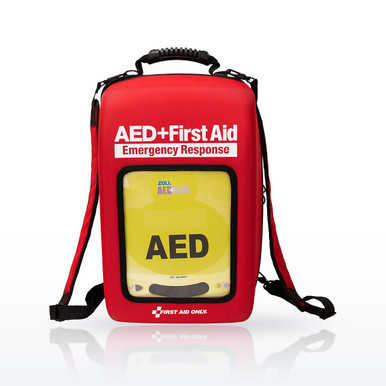 First Aid Only 91744 CPR Kit, Class B, 236 PiecesFirst Aid Only prints a Class B AED and first aid emergency response bag with eight treatment packs, wall mountable and portable, that holds any AED
Why the age line matters. The pass-1 AED guide answers the adult questions: CPR or AED first, the 3-minute rule, where the pads go on an adult, pads and batteries, cabinets and signs. The child questions come from the same training quizzes (which pads for a child older than 8, can pediatric pads go on an adult, what if the pads touch) and from school, daycare, camp and youth-sports staff who have an AED on the wall and a cabinet of adult pads. This page prints the Red Cross AED steps as published, the age and weight line the Red Cross draws, and what to do when the pads would touch, and sends everything below that line to the pediatric course and the AED’s own instructions, which is where it belongs.
The Red Cross AED steps, as published (child 8 or older over 55 pounds, or an adult)
From the American Red Cross AED Steps page; a trained rescuer follows the AED’s voice prompts over any printed list.
- Complete the CHECK and CALL steps (check the scene and the person; have a bystander call 911).
- As soon as an AED is available, turn it on and follow the voice prompts.
- Remove clothing and attach pads correctly: remove all clothing covering the chest; if necessary, wipe the chest dry; place one pad on the upper right side of the chest; place the other pad on the lower left side of the chest, a few inches below the left armpit. Note: if the pads may touch, place one pad in the middle of the chest and the other pad on the back, between the shoulder blades.
- Plug the pad connector cable into the AED, if necessary.
- Prepare to let the AED analyze the heart’s rhythm: make sure no one is touching the person; say "CLEAR!" in a loud, commanding voice.
- Deliver a shock, if the AED determines one is needed: make sure no one is touching the person; say "CLEAR!"; push the shock button.
- After the AED delivers the shock, or if no shock is advised, immediately start CPR, beginning with compressions.
The questions, one by one
Where should the pads be placed on a child?
For a child 8 or older who weighs more than 55 pounds, the Red Cross placement is the adult one: upper right chest, lower left side below the armpit, and front-and-back if the pads would touch. For a smaller child the AED’s pediatric pads or pediatric setting are used as the pad diagram and voice prompts direct; the common pediatric placement printed on the pads is one on the center of the chest and one on the center of the back. That is the manufacturer’s and the pediatric course’s instruction, and we repeat it only as their instruction.
When to use an AED on a child, and can you use an AED on children under 8?
The Red Cross AED steps page covers the non-breathing child 8 or older over 55 pounds and the adult; its Adult and Pediatric First Aid/CPR/AED course covers "AED use for adults and children" and "how to use AEDs in children and infants safely". An AED is used on a child who is unresponsive and not breathing, as the course teaches, with pediatric pads or the pediatric setting where the unit has them. The age cutoff on the pads is the manufacturer’s; ZOLL’s and other makers’ pediatric electrodes state the age and weight on the package.
Which AED pads should you use on a child older than 8, or weighing more than 55 pounds?
Adult pads. The Red Cross draws the line at 8 years or 55 pounds; above either, the adult steps and the adult pads apply.
Can you use pediatric AED pads on a child, and what age and weight are pediatric pads for?
Pediatric pads are for the child under the manufacturer’s age and weight line, which on most units is under 8 years or under 55 pounds (25 kg); the figures are printed on the pad package and in the AED manual. Pediatric pads deliver a reduced energy and are not used on an adult.
What to do if you don’t have pediatric AED pads, or they are unavailable?
The pediatric courses and the AED manufacturers’ manuals address this case; the Red Cross AED steps page itself does not, so we do not print a rule of our own. What the page does say is that when pads may touch, one goes on the middle of the chest and the other on the back between the shoulder blades, which is the placement that keeps two pads from touching on a small chest. A site with children on it keeps the pediatric pads in the cabinet with the adult pads so the question does not arise.
Is it okay if AED pads touch on a small child’s chest?
No. The Red Cross note is explicit: "if the pads may touch, place one pad in the middle of the chest and the other pad on the back, between the shoulder blades". Pads that touch cannot read the rhythm or deliver the shock correctly.
Where should anterolateral AED pads be placed on an 8-year-old child, and on adults and children 8 and older?
Anterolateral is the name of the standard adult placement: one pad on the upper right of the chest (below the collarbone, right of the breastbone) and one on the lower left side, a few inches below the left armpit. For the 8-year-old and anyone older it is the placement in step 3 above. Anterior-posterior (front and back) is the alternative when the pads would touch.
Does the AED decide whether to shock a child?
The AED analyzes the rhythm and advises or delivers a shock on its own; the rescuer’s job is the pads, the "CLEAR", the button on a semi-automatic unit, and the CPR. First Aid Only describes the ZOLL AED Plus fully automatic unit as delivering the shock itself after a countdown when it detects a shockable rhythm, with Real CPR Help prompting "push harder" or "good compressions"; the semi-automatic version waits for the button. Both read pediatric pads when they are connected.
Does OSHA require an AED at a school or daycare?
OSHA has no AED requirement; OSHA 3317 says every worksite should consider one. School and childcare AED requirements are state law and vary; the pass-1 AED guide covers the OSHA side and the cabinets and signs.
In plain words
- Child 8 or older, or over 55 pounds: adult pads, adult placement (upper right chest, lower left side).
- Smaller child: pediatric pads or pediatric setting, placed as the pad diagram and voice prompts direct.
- If the pads would touch: one on the middle of the chest, one on the back between the shoulder blades.
- Pediatric pads are never used on an adult.
- Turn the AED on first and let the prompts lead; the printed list is a reminder.
- Keep the pediatric pads in the cabinet with the adult pads wherever children are.
Questions people ask
Where do AED pads go on a child?
Child 8 or older over 55 pounds: upper right chest and lower left side; smaller child: pediatric pads as the pad diagram directs, commonly chest and back.
Which pads for a child older than 8?
Adult pads.
Which pads for a child over 55 pounds?
Adult pads; the Red Cross line is 8 years or 55 pounds.
Can pediatric pads be used on an adult?
No; they deliver a reduced energy.
What if the pads would touch?
One in the middle of the chest, one on the back between the shoulder blades.
What if there are no pediatric pads?
The pediatric course and the AED manual address it; the Red Cross steps page does not, and we do not add a rule.
What does anterolateral mean?
The standard placement: upper right chest and lower left side below the armpit.
What does anterior-posterior mean?
Front and back: middle of the chest and between the shoulder blades.
Does OSHA require an AED?
No; OSHA 3317 says to consider one; school and childcare rules are state law.
Related guides
AED questions answeredCPR or AED first, the 3-minute rule, pads, batteries and cabinetsCPR masks, face shields and pocket masksThe one-way valve and what to do with no maskFirst aid kits for offices, schools, daycare and churchesDoes an office legally need one?What is first aid under OSHA?When a trained first aid provider is requiredWhat must an emergency action plan include?The six elements of OSHA 1910.38The ratings, test results and standards shown here are the manufacturers' published values, reproduced as published. Nothing on this page is a recommendation by Bayshore Safety that any product is suitable for a particular task, hazard or workplace. Selecting safety products and protective equipment is the responsibility of the end user and the employer, based on their own hazard assessment and the regulations that apply to their work. Confirm every value on the manufacturer's own documentation before use.
© 2026 Bayshore Safety & Industrial Supplies, Inc. All rights reserved. This guide may not be copied or republished without written permission.