
Bayshore Safety & Industrial Supplies Guide
Does an office legally need a first aid kit? What to put in an office, school, classroom, daycare and church first aid kit, the OSHA rule that covers them all, the single-use classroom packs, the pediatric station, and the desk-drawer kit
Yes, an office needs a first aid kit under the same rule as a factory: 29 CFR 1910.151(b) applies to every general industry employer, and requires "adequate first aid supplies" to be "readily available" wherever there is no infirmary, clinic or hospital "in near proximity" used to treat injured employees. OSHA’s March 2007 letter on near proximity reads that as emergency care within 3 to 4 minutes where serious injuries are possible and "up to 15 minutes" where they are more remote, naming offices as its example; an office within 15 minutes of an emergency room may rely on it, but the letter still expects the employer to assess its own injuries, and OSHA’s February 2007 letter says the supplies must fit "the specific needs of the workplace". Schools, daycare centers and churches are covered the same way for their employees (public schools in states with their own OSHA plans, such as California), and the children and congregation are covered by state licensing and the organization’s own duty of care rather than by OSHA. What goes in the kit is the ANSI Z308.1 Class A fill for the staff, plus for a school or daycare the child-sized items First Aid Only packs in its classroom and pediatric kits: single-use packs for cuts and scrapes, bumps and bruises and nosebleeds, non-stick pads, disposable thermometers, sting relief and cold packs.
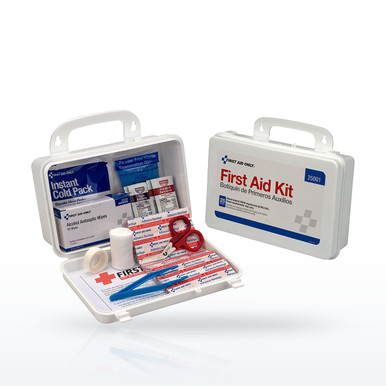 First Aid Only 25001 Office First Aid Kit, 25 Person, 111 Pieces, PlasticFirst Aid Only prints a 25-person office first aid kit, 111 pieces, in a plastic case
Why the office question has a longer answer than yes. The rule is one sentence and it applies to the office, but the letters OSHA wrote around it are where the "legally" part lives: how near a clinic has to be before the employer can skip the kit, and what "adequate" means for a desk job. This page prints those letters and then does the same for the places that ask next, schools, daycare and churches, where the employees are covered by OSHA, the children by licensing, and the kit on the wall serves both. The product side is First Aid Only’s office kits in 25 and 75 person sizes, its classroom and pediatric kits built around single-use packs, and the Red Cross cabinets and CPR station a church or hall mounts by the door.
Who is covered, and by what
| Place | The employees | The public, students or children | The kit that fits |
|---|---|---|---|
| Office | 1910.151(b): adequate supplies readily available unless a clinic is in near proximity (OSHA letters: 3 to 4 minutes for serious injury risk, up to 15 minutes for offices) | Visitors are covered by the same kit in practice | Class A kit sized to headcount; First Aid Only office kits 25 and 75 person; a SmartCompliance cabinet for 50 and up |
| School | Staff: 1910.151 (federal) or the state plan (California, Washington, Oregon and others cover public employees) | Students: state education and health codes, the nurse’s office, the district policy | Office kit for staff; classroom single-use packs; pediatric kit or station; a body fluid kit per building |
| Daycare and preschool | Staff: 1910.151 or the state plan | Children: state childcare licensing rules, which list the kit contents in most states | Pediatric kit; classroom care kit; thermometers, sting relief, cold packs; a body fluid kit |
| Church, hall, gym | Paid staff: 1910.151; volunteers are not employees under the Act | Congregation and members: the organization’s own duty of care and any state AED law | Red Cross cabinet or Class A kit by the door; CPR station; AED cabinet where the organization has one; body fluid kit |
| Home office | A self-employed person with no employees is not covered | A home or travel kit |
Source: 29 CFR 1910.151 Medical services and first aid (eCFR); OSHA letter of interpretation, March 23 2007, "in near proximity"; OSHA letter of interpretation, June 19 2019, First aid for bleeding control
The questions, one by one
Does an office legally need a first aid kit, and does OSHA require first aid kits in offices?
An office with employees is covered by 1910.151(b), and the only way out of the kit is a clinic, infirmary or hospital in near proximity that the employer uses for all injured employees. OSHA’s 2007 letter puts near proximity at 3 to 4 minutes where serious injuries are possible and allows up to 15 minutes for an office; an office with an emergency room 15 minutes away and no trained first aider can rely on it. Most offices keep a kit anyway, because the letter also says the choice must be made after assessing the workplace, and because a kit is cheaper than the argument. The live OSHA first aid kit guide covers the rule in full.
What to put in an office first aid kit, and which first aid box for office use?
The Z308.1 Class A fill: 16 adhesive bandages, antibiotic and antiseptic applications, a burn dressing, burn treatment, a cold pack, eye coverings and eye wash, first aid tape, gloves, a roller bandage, scissors, sterile pads, a trauma pad, a triangular bandage, a CPR barrier and a first aid guide; the live contents guide prints the counts. First Aid Only’s office kits (25001, 25 person, 111 pieces; 60002, 25 person, 130 pieces; FAO-60003, 75 person, 312 pieces) are that fill in a plastic case with a clear front for a visual check; an office over 50 people hangs a SmartCompliance cabinet with refill boxes instead. We do not rank boxes; the person count and the clear front are the two things to match.
How many kits does an office need, and where do they go?
One per floor or per 50 people, wherever the walk to the kit is under a minute or two; the live how-many-kits guide covers it. Common placement is the break room or the copy room on each floor, at a height everyone can reach (the mounting guide linked below has the ADA figure), with the AED cabinet beside it where there is one.
What should be in a classroom first aid kit, and in a first aid kit at a school?
For staff, the Class A fill in the school office; for the classroom, what First Aid Only’s education brochure packs: single-use treatment packs for the three common classroom injuries. The Classroom Care Kit (91575, 47 pieces) holds 4 cuts-and-scrapes packs, 2 bumps-and-bruises packs, 2 nosebleed packs, 4 nitrile gloves and a guide, sized to fit a desk drawer; the Classroom Single Use Packs (91573, 10 packs) each hold a BZK towelette, a fabric fingertip bandage, first aid tape, 4 plastic bandages and 2 sterile gauze pads. The brochure’s reasoning is that "big feelings from little injuries can quickly spiral into classroom disruptions" and a single-use pack means a teacher is not "rummaging through messy supplies"; it states the kit is for elementary schools, preschools and daycares.
What should be in a daycare first aid kit, and what are some must-have items for daycare?
State childcare licensing rules list the contents and the license holder reads their own state’s list; First Aid Only’s pediatric kit (712004, 25 person) is the manufacturer’s version: eyewash with eye pads, fabric and plastic bandages in child sizes, antiseptic spray and BZK towelettes, a cold pack, conforming gauze, 10 disposable thermometers, burn cream and antibiotic ointment packets, forceps, hydrogen peroxide, nitrile gloves, non-stick pads, scissors, sting relief wipes and waterproof tape. The pediatric 3-shelf station (712005) is the same fill for "over 50 children", which First Aid Only states is "the ideal solution for schools, day care centers and summer camps". A body fluid spill kit is the other must-have, for the vomit a daycare cleans up weekly.
What is a good emergency kit for kids at school, and what should be in a classroom emergency backpack?
The classroom backpack is the lockdown and evacuation kit: the first aid packs, water, a flashlight, a whistle, the class roster, and (in First Aid Only’s preparedness line) the shelter-in-place backpack and the door jammer the brochure lists "for schools, public buildings, offices or hospitality". The pass-1 72-hour kit guide covers the preparedness side; the classroom first aid kit stays in the desk, the backpack goes with the class.
Which first aid kit for a church?
A Class A kit or a Red Cross cabinet sized to the people usually in the building, mounted where the ushers can reach it, with a CPR station (face shields and gloves) and the AED cabinet beside it where the church has an AED, and a body fluid kit in the custodian’s closet. First Aid Only’s American Red Cross cabinets (1001-RC-0103 plastic, 1350-RC-0103 metal) and Red Cross CPR station (9145-RC) are built for that wall; we do not rank them, we match the headcount.
Does OSHA cover church volunteers and school parents?
No; the OSH Act covers employees, and a volunteer is not one. Paid church and school staff are covered (by federal OSHA for private employers, by the state plan for public schools in plan states). The kit does not know the difference, which is the practical reason a church stocks a workplace kit.
Does an office need an AED, an eyewash, or a BBP kit?
An AED is not required by OSHA (3317 says to consider one); an eyewash is required only where eyes may be exposed to injurious corrosives, which in an office is the janitor’s closet if anywhere; a BBP kit is expected where someone is assigned to clean up blood, which 1910.1030 makes the employer’s call in the exposure control plan. Most offices keep a body fluid kit for the break room and the restroom.
In plain words
- An office with employees needs a kit unless a clinic is minutes away (3 to 4 minutes for serious injury risk, up to 15 for an office).
- Fill it with the Z308.1 Class A list sized to the headcount; a clear front makes the check easy.
- School and daycare staff are covered by OSHA or the state plan; the children by state licensing.
- Classroom: single-use packs for cuts, bumps and nosebleeds; daycare: the pediatric kit with thermometers and sting relief.
- Church: a cabinet by the door, a CPR station, the AED cabinet, a body fluid kit for the custodian.
- Volunteers are not employees; the kit serves them anyway.
Questions people ask
Does an office legally need a first aid kit?
Yes under 1910.151(b) unless a clinic is in near proximity; OSHA’s letters allow up to 15 minutes for an office.
Does OSHA require first aid kits in offices?
The same rule applies to offices as to plants; the exception is a nearby clinic the employer uses for all injured employees.
What goes in an office first aid kit?
The ANSI Z308.1 Class A fill sized to the headcount.
What should be in a classroom first aid kit?
Single-use packs for cuts and scrapes, bumps and bruises and nosebleeds, gloves and a guide; the office holds the staff kit.
What should be in a daycare first aid kit?
Your state licensing list; First Aid Only’s pediatric kit adds child-size bandages, thermometers, sting relief, cold packs and non-stick pads.
Which first aid kit for a church?
A Class A kit or Red Cross cabinet sized to the congregation, with a CPR station, the AED cabinet and a body fluid kit.
Are volunteers covered by OSHA?
No; only employees, but the kit serves everyone.
Does an office need an eyewash?
Only where eyes may be exposed to injurious corrosives, such as a janitor’s closet with concentrated cleaners.
Does an office need an AED?
Not under OSHA; OSHA 3317 says to consider one.
Related guides
OSHA first aid kit requirementsWhat 1910.151 and ANSI Z308.1 requireHow many first aid kits does a workplace need?And where they goWhat should be in a workplace first aid kit?The Z308.1 minimum fillANSI Z308.1 Class A vs Class B first aid kitsWhat is in each fillFirst aid cabinet mounting height, placement and signsADA reach range, locked cabinets, the green crossAED pads on a childWhich pads, where they go, when they would touchHow do you manage a body fluid spill?Vomit, dried blood, biohazard bags and labelsWhat should be in a 72-hour emergency kit?The ready.gov list and the preparedness kitsThe ratings, test results and standards shown here are the manufacturers' published values, reproduced as published. Nothing on this page is a recommendation by Bayshore Safety that any product is suitable for a particular task, hazard or workplace. Selecting safety products and protective equipment is the responsibility of the end user and the employer, based on their own hazard assessment and the regulations that apply to their work. Confirm every value on the manufacturer's own documentation before use.
© 2026 Bayshore Safety & Industrial Supplies, Inc. All rights reserved. This guide may not be copied or republished without written permission.