
Bayshore Safety & Industrial Supplies Guide
Are vinyl gloves effective, and what are poly gloves? What PVC and polyethylene disposable gloves are rated for, where they fit and where they do not
A vinyl glove is effective for what it is made for: a short, low-risk barrier between a clean hand and dry or lightly wet work, at the lowest cost per glove, with no natural rubber latex in it. It is a polyvinyl chloride (PVC) film softened with plasticizers, made to ASTM D5250 when sold as an examination glove, and the FDA names PVC first among the materials a latex-allergic worker or patient should use. Where it is not effective is where the data says so: MCR Safety’s disposable glove guide puts vinyl lowest of the three materials for puncture and tear resistance, it fits loosely because the film does not stretch and recover like a rubber, and it resists few chemicals beyond water and mild detergents, so it is not the glove for solvents, oils, fuels or anything the chemical guides cover. A poly glove is thinner still: an embossed polyethylene film, loose and heat-sealed at the seams, worn for seconds on a sandwich line or a deli counter and changed at every task; it is a food-service barrier, not a protective glove, and OSHA’s PPE booklet lists polyethylene among the plastics used for chemical gloves only in laminated form. Vinyl and poly are both single-use gloves under the FDA Food Code, which treats all single-use gloves the same way: one task, discarded when soiled or torn. The vinyl gloves on this site are PIP’s Ambi-dex 64-V series (4 and 5 mil, 21 CFR listed, powdered and powder-free) and MCR Safety’s SensaTouch 5010, 5014, 5015 and 5025 (3 to 6.5 mil, FDA food contact); vinyl-coated knit work gloves and PVC chemical gloves are different products that share the polymer, and this site lists no polyethylene food-service glove.
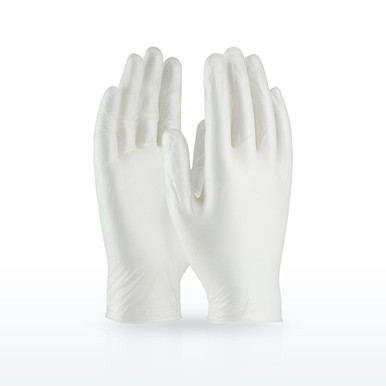 Ambi-dex 64-V2000PF Industrial Grade Disposable Vinyl Glove, Powder Free, 4 MilPIP lists this vinyl glove at 4 Mil, Powder Free, 21 CFR; CFIA (PIP data)
Why vinyl gets asked about more than any other glove. It is the glove most people meet first: the box at the salad bar, the hair salon, the school kitchen, the dollar store. Its price is why. PVC is a cheap polymer, the glove is made by dipping a former in a plastisol and curing it, and the result is a film that does not need the vulcanization and leaching steps a rubber glove does. The same chemistry explains the limits. PVC is rigid until plasticizers (historically phthalates, now often other esters) are blended in, and a plasticized film stretches less and recovers less than a rubber, which is why a vinyl glove fits loosely, why it tears at the cuff when pulled on, and why a puncture opens into a split. Plasticizers can also migrate, which is why food-contact vinyl is formulated and listed under 21 CFR Part 177 and why a vinyl glove is not used with oils and solvents that pull the plasticizer out and leave the film stiff. The question “are vinyl gloves safe” has two honest answers: safe to wear, in that there is no latex protein and the FDA counts PVC among the latex-free materials; and limited as a barrier, in that it is the lowest of the three disposable materials for puncture and tear, so a wet, sharp or long task is nitrile’s. Poly gloves sit a step below vinyl: polyethylene film, no stretch at all, sized by a loose pattern, worn over a washed hand for a single quick contact. Both are legitimate single-use gloves under the Food Code; neither is a chemical glove, a medical barrier for a long procedure, or a work glove. The vinyl-coated knit gloves on this site (MCR Safety 9800 series) and the PVC chemical gloves (PIP ProCoat and XtraTuff, MCR Safety Memphis PVC) use the same polymer in a different thickness and construction, and carry ratings the disposables do not.
The questions, one by one
From the manufacturers’ data, the FDA material statements and the Food Code.
What the vinyl glove page says, line by line
The lines on the PIP and MCR Safety vinyl glove pages and what each means.
- Material: vinyl or PVC, polyvinyl chloride, a plastic rather than a rubber; made flexible with plasticizers. The ASTM standard for a vinyl examination glove is D5250.
- Thickness: 3 to 6.5 mil on the gloves here (PIP 4 and 5 mil; MCR Safety 3, 5 and 6.5 mil). The mil is measured at the palm; the fingertip may be thicker and the cuff thinner.
- Powder: powdered gloves use cornstarch to ease donning; powder-free gloves are chlorinated or polymer-coated instead. Powder is banned on medical gloves since 2017 and still sold on industrial vinyl.
- Grade: industrial (PIP 64-V2000, 64-V77BPF; MCR Safety SensaTouch) or premium (PIP 64-435PF); none of the vinyl gloves here is examination grade.
- Standards line: 21 CFR (and CFIA for Canada) on the PIP Ambi-dex vinyl; FDA food contact on MCR Safety 5015. A vinyl glove without the line has not been stated for food.
- Fit and sizes: S (7) to 2XL (11) on PIP, S to XL on MCR Safety; the fit is loose by design, which is why a vinyl glove is pulled on and off fast and why liquid runs in at the cuff.
- Color: clear or blue. Blue vinyl, like blue nitrile, is the food-service color because a torn piece shows.
Vinyl, poly, nitrile and latex disposable gloves against the questions people ask
| Vinyl (PVC) | Poly (polyethylene) | Nitrile | Latex | |
|---|---|---|---|---|
| What it is | Plasticized PVC film, dipped | Polyethylene film, heat-sealed | Acrylonitrile-butadiene synthetic rubber, dipped | Natural rubber, dipped |
| Latex protein | None | None | None | Yes |
| Fit | Loose | None (bag-like) | Close; stretches and recovers | Closest |
| Puncture and tear (MCR Safety glove guide) | Low | Lowest | High | Medium to high |
| Chemicals | Water and mild detergents | None claimed | Oils, fuels, many solvents, caustics (see the chemical guides) | Water-based chemicals; poor with oils |
| Examination grade standard | ASTM D5250 | None | ASTM D6319 | ASTM D3578 |
| Food contact | Listed where the manufacturer states 21 CFR / FDA food contact | Listed by its manufacturers; none on this site | Listed where stated | Listed where stated; state restrictions |
| Typical kitchen use | Plating, assembly, service, short dry tasks | Sandwich and deli lines, quick changes | Raw meat, wet work, long tasks, cleaning | Where allowed |
| On this site | PIP Ambi-dex 64-V series; MCR Safety SensaTouch | Not listed | PIP, MCR Safety, Radians, Portwest | PIP Ambi-dex, Radians RWG91, MCR Safety Med Tech |
The ratings are the manufacturer’s comparisons of materials; the breakthrough times for specific chemicals are on the chemical glove pages.
Source: MCR Safety Disposable Glove Guide 2024 as quoted in the nitrile vs latex vs vinyl guide; ASTM D5250, D6319, D3578 as the manufacturers name them; the product pages on this site; FDA Medical Gloves page.
Questions people ask
Are vinyl gloves effective?
As a short, low-risk, latex-free barrier for dry or lightly wet tasks, yes; as a protective glove against punctures, chemicals or long wet work, no. MCR Safety’s glove guide rates vinyl lowest of the three disposable materials for puncture and tear and for chemicals beyond water-based cleaners.
Are vinyl gloves safe?
They contain no natural rubber latex, and the FDA lists PVC among the materials for latex-allergic users. Their limit is barrier strength, not toxicity; food-contact vinyl is formulated and listed under 21 CFR Part 177.
What are the disadvantages of vinyl gloves?
Low puncture and tear resistance, loose fit, little chemical resistance and plasticizer migration into oils and solvents. Not for sharps, chemicals or long exposure to body fluids.
Do vinyl gloves protect against bacteria?
An intact vinyl glove is a liquid barrier; the risk is that vinyl punctures and splits more easily than nitrile, so for blood and infectious materials over any length of time the rule and the data point to nitrile.
Are vinyl gloves powder-free?
Both kinds are sold: PIP lists the 64-V2000 powdered and the 64-V2000PF, 64-V77BPF and 64-435PF powder-free; MCR Safety lists 5025 powdered and 5010, 5014, 5015 powder-free.
Are vinyl or nitrile gloves better for food?
Both are single-use gloves under the Food Code when food-contact listed. Nitrile is stronger and fits closer for raw meat, wet work and long tasks; vinyl is lower cost for plating and service.
What are poly gloves?
Polyethylene film gloves, loose and heat-sealed, the thinnest single-use glove, for a single quick food contact. No fit, no rating, not a protective glove. This site lists none.
What is the difference between vinyl and poly gloves?
Vinyl is dipped PVC with some fit and puncture resistance and an examination-grade standard (ASTM D5250); poly is sealed polyethylene film with neither, a step below vinyl on every measure except price.
Can I be allergic to vinyl gloves?
Not to latex, since there is none; a skin reaction to a vinyl glove is irritant or allergic contact dermatitis to plasticizers, sweat or residues, the delayed reactions NIOSH describes. The latex allergy guide covers them.
Are vinyl gloves the same as PVC gloves?
Vinyl is PVC. A vinyl disposable, a vinyl-coated knit work glove and a PVC chemical glove are three products of the same polymer at different thicknesses; only the chemical glove carries permeation data.
Where can I find small vinyl gloves?
The Ambi-dex 64-V series runs S (7) to 2XL (11) and MCR Safety SensaTouch S to XL on this site; the size is the part-number ending. The disposable glove sizes guide covers measuring.
Are the store-brand vinyl gloves food safe?
Only the brand’s own box can say; the statement to look for is 21 CFR or FDA food contact. A vinyl glove without it has not been stated for food by its manufacturer.
Related guides
Nitrile vs latex vs vinyl glovesWhat each material resistsNitrile gloves and latex allergyAnd can you react to a non-latex glove?Are nitrile gloves food safe?What the 21 CFR food-contact listing meansDisposable gloves: when must they be changed?The rules on single-use glovesWhat are the downsides of nitrile gloves?By what the standards and the data sayWhich gloves protect against chemicals?How to read a chemical resistance chartThe ratings, test results and standards shown here are the manufacturers' published values, reproduced as published. Nothing on this page is a recommendation by Bayshore Safety that any product is suitable for a particular task, hazard or workplace. Selecting safety products and protective equipment is the responsibility of the end user and the employer, based on their own hazard assessment and the regulations that apply to their work. Confirm every value on the manufacturer's own documentation before use.
© 2026 Bayshore Safety & Industrial Supplies, Inc. All rights reserved. This guide may not be copied or republished without written permission.